










RV propane cylinder safety: transport, inspection, refill, or exchange?
Inspect a removable RV propane cylinder before loading, transport it upright and secured, ask the right refill or exchange questions, and know when to leave and call for help.

Tips and Trends
RV propane cylinder safety: transport, inspection, refill, or exchange?
Inspect a removable RV propane cylinder before loading, transport it upright and secured, ask the right refill or exchange questions, and know when to leave and call for help.
By Romana

A propane stop should begin before the cylinder leaves its rack. The useful questions are not just "refill or exchange?" They are: Is the cylinder safe to move? Is it still eligible to be filled? Will the replacement fit the RV's approved setup? And if something smells wrong, where does owner action end?
This guide covers removable DOT propane cylinders commonly carried on travel trailers and fifth-wheels, plus portable cylinders used with outdoor appliances. A permanently mounted motorhome propane tank is a different system. Follow the RV manufacturer's manual and use a qualified propane service center for that equipment.
The two-minute check before you drive
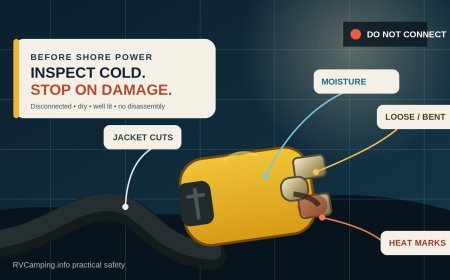
Do this check outdoors, with every ignition source off. It is a screening check, not a DOT requalification and not permission to repair anything.
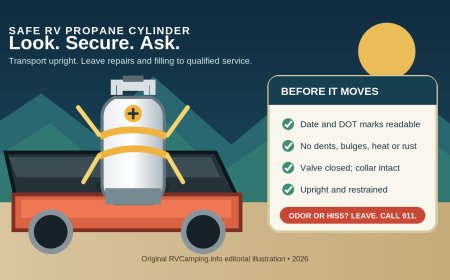
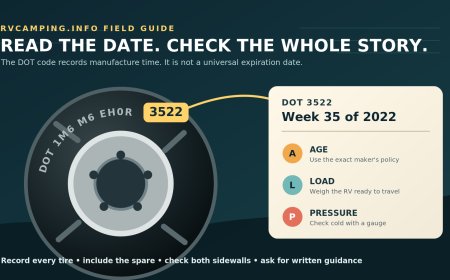
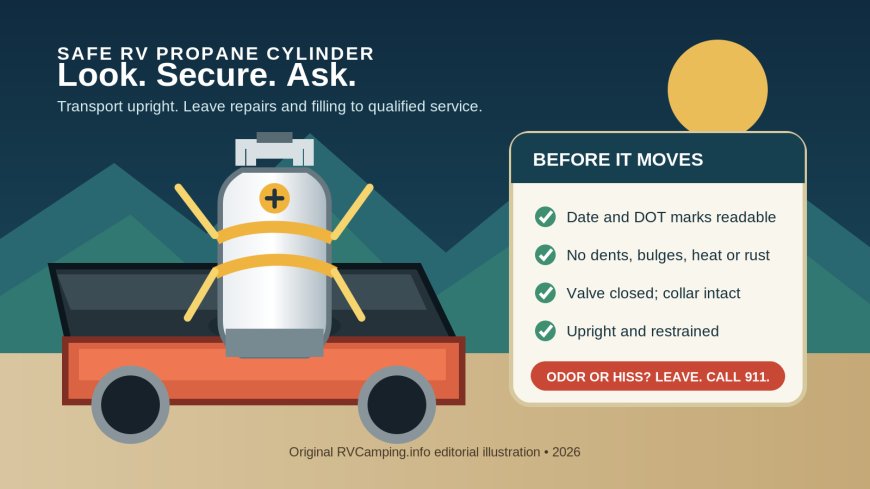
- Read the collar. Look for the DOT specification marking, manufacture date, and any later requalification mark. PHMSA sets the first requalification deadline at 12 years after manufacture; a cylinder requalified by the external visual method carries an "E" and has a five-year interval. A filler must not refill an overdue cylinder.[1]
- Look at the whole shell, especially the bottom. Stop if you see a bulge, cut, crack, serious dent, fire or heat damage, deep rust, corrosion, or pitting. PHMSA also flags damaged or missing footrings, collars, and valve protection, as well as defective valves and pressure-relief devices.[1]
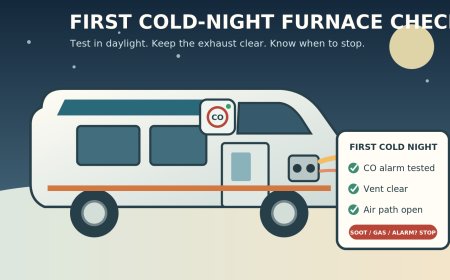
- Check the valve area without operating or dismantling it. A propane odor, hiss, visible vapor cloud, frost in an unexpected place, or flames means this is no longer a routine inspection. Do not load that cylinder into a vehicle.[2]
- Confirm that the valve is fully closed and protected by the cylinder's collar or specified cap. Do not force a stiff handwheel or apply tools to a valve. The safe choice is retailer or qualified-service evaluation, not a roadside fix.[2][4]
- Check the RV restraint before installing a replacement. The cylinder should match the size, valve, regulator connection, and hold-down arrangement specified for the RV. A cylinder that cannot sit squarely and be secured by the factory restraint is not a workable substitute.
A surface scuff is not the same thing as structural damage, but owners should not be the final judge of a questionable pressure vessel. Set it aside outdoors, away from ignition sources, and ask the propane retailer whether it should be rejected, requalified, exchanged, or disposed of.
Refill, requalify, or exchange?
The collar date often decides the next step, but condition can override the calendar. A cylinder that is in date can still be rejected for damage. An old cylinder may be returned through an exchange program or sent to a DOT-authorized requalifier, but it cannot simply be refilled because it "still looks fine." PHMSA maintains the applicable markings guidance and a locator for approved requalifiers.[1]
Use this decision table at the counter:
| What you find | Best next question | Safe boundary |
|---|---|---|
| In date, clean shell, sound collar and footring | "Can you inspect and refill this exact cylinder?" | Let the trained attendant make the fill decision. |
| Past the allowed date | "Do you requalify here, or can you direct me to an approved requalifier?" | Do not ask for an exception or obscure the stamp. |
| Standard empty 20-pound cylinder you no longer want | "Will your exchange program accept this brand and condition?" | Leave it at the outdoor exchange point; do not carry it into the store. |
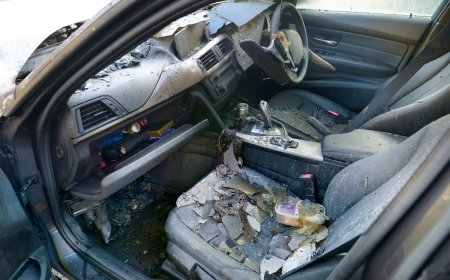
| Dent, deep corrosion, fire exposure, valve damage, or suspected leak | "What is your emergency or rejected-cylinder procedure?" | Do not transport a leaking cylinder to seek help. Call from a safe location. |
| Different size or connection from the RV's original cylinder | "Is this approved for my RV model and restraint?" | Do not improvise adapters, brackets, valves, or regulator changes. |
Exchange can remove the date-management chore for a standard grill-size cylinder. Blue Rhino says its returned cylinders are cleaned, leak-tested, inspected, retrofitted when components are outdated, and requalified when needed.[5] That is a provider-specific process, not a blanket promise about every exchange cage. Ask the operator what cylinder sizes it accepts, how much propane the exchange cylinder contains, and whether the valve and physical dimensions match your RV installation.
Refill can make sense when your cylinder is in good condition, still in qualification, and compatible with the RV. Ask the attendant to show you the tare-weight and date markings they use, whether the site fills your cylinder type, and what they do when a cylinder fails inspection. Filling and requalification belong to trained, authorized personnel. Never transfer propane from one cylinder to another or attempt to defeat an overfill-prevention device.
Transport the loose cylinder as cargo, not luggage
The preferred place for a detached cylinder is outside the passenger space, secured upright in an open pickup bed or another location allowed by the vehicle and cylinder instructions. PERC's portable-cylinder guide says to keep cylinders upright, prevent shifting or rolling, avoid the passenger area, drive directly to the destination, and remove them from the vehicle immediately.[2]
For an unavoidable short trip in an enclosed cargo area, keep ventilation in mind, minimize time, and do not make errands or meal stops with the cylinder aboard. Never leave it in a parked vehicle or trunk. Heat can cause the relief device to release propane, and an enclosed space can then hold flammable gas.[2]
A practical transport check:
- close the valve and keep fitted protective parts in place;
- stand the cylinder on its footring in the orientation intended by its maker;
- use a purpose-made stabilizer or firm container plus tie-downs so braking and cornering cannot tip, roll, or launch it;
- keep cigarettes, vapes, flames, sparking equipment, and other ignition sources away;
- go directly to the refill, exchange, campsite, or home unloading point;
- unload outdoors as soon as you arrive.
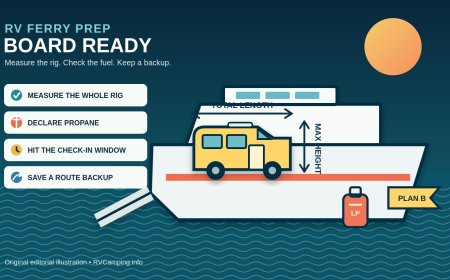
Do not assume that a personal trip is exempt from every limit that matters. PERC lists limits for closed-bodied and open-bed vehicles and warns that state or local restrictions may also apply.[2] Tunnels, ferries, bridges, campgrounds, and commercial operations can impose separate rules. Check the specific route operator and local authority before leaving; do not rely on a generic internet chart.
An RV's installed cylinder compartment is not general cargo space. Use the factory bracket, regulator position, hoses, compartment door, and ventilation exactly as the owner manual describes. Winnebago's propane guidance, for example, warns against placing portable cylinders inside the vehicle and directs owners to qualified service for propane-system components.[4] Your own model's manual controls because compartment and travel instructions vary.
If you smell propane, stop troubleshooting
Propane can settle in low areas. NFPA notes that LP-Gas vapor is heavier than air and may collect in ditches and below-grade confined spaces.[3] That is why stepping downhill from a leak, opening a basement door, or leaning into a storage compartment can move you toward danger rather than away from it.
Treat odor, hissing, an alarm, visible vapor, or flame as an emergency signal:
- Do not smoke, vape, light anything, start an engine, or operate nearby electrical switches.
- Move people and pets away from the RV and cylinder. Avoid low spots and do not walk through a visible vapor cloud.
- If there are no flames or visible propane cloud and you can close the cylinder valve without approaching the release, PERC says to close it clockwise. If that cannot be done immediately and safely, leave it alone.[2]
- From a safe location, call 911 or the fire department. Tell the dispatcher that a propane cylinder or RV propane system may be involved.
- Do not put the cylinder in a vehicle, carry it through a building, test the leak with a flame, or return to retrieve property.
- Do not use the cylinder or appliance again until a qualified professional has inspected it.[2]
These boundaries matter more than identifying the failed part. PERC says never to repair or modify cylinders and directs users to exchange the cylinder or call the propane retailer or a qualified professional.[2] Winnebago likewise reserves propane-system service and maintenance for a dealer or qualified propane service center.[4]
A routine connection check described in an appliance or RV manual is not the same situation as an active odor, hiss, alarm, vapor cloud, or fire. Once there is a suspected release, evacuation and emergency contact take priority over bubble tests, tightening, ventilation experiments, or fault-finding.
Questions worth asking at the propane counter
Keep the conversation short and specific:
- Is this cylinder still within its qualification period, and which stamp are you reading?
- Did the pre-fill inspection find any reason to reject it?
- If rejected, can you accept it for exchange or direct me to an approved requalifier or disposal program?
- Is the replacement the same cylinder size, valve type, and physical fit required by my RV?
- How should I secure this cylinder for the trip, and do local transport limits apply?
- What number should I call if I notice an odor or hiss before leaving the property?
Photographing the collar markings before a trip can make the counter conversation easier, but a photo does not replace physical inspection. The habit to keep is simple: inspect before loading, secure upright, make one direct trip, and hand repairs, filling, requalification, and any leak to people equipped for that work.
Sources
What's Your Reaction?