






Generator off at 7: Build an RV battery budget for quiet hours
Turn a campground's generator cutoff into a one-night RV power plan with a fill-in battery worksheet, usable-capacity check and morning reserve.

Generator off at 7: Build an RV battery budget for quiet hours
Campground quiet hours and generator hours are not interchangeable. Write down the exact generator cutoff, count every overnight electrical load, and keep a reserve rather than discovering at 2 a.m. that the battery plan was only a guess.
By Romana | September 21, 2026
A campground can be quiet while generators are still prohibited, and generator permission can end hours before quiet time begins. Yosemite, for example, posts quiet hours from 10 p.m. to 6 a.m. but allows generators only during three windows: 7–9 a.m., noon–2 p.m. and 5–7 p.m.[1] Mount Rainier uses 9 p.m.–7 a.m. quiet hours, the same three two-hour generator windows shifted one hour later in the morning, and generator-free loops at Cougar Rock and Ohanapecosh.[2]
That difference changes the evening plan. If charging must stop at 7 p.m., the battery has to cover dinner cleanup, lights, water pump use, controls, device charging, overnight heat controls and the morning routine until the next legal charging window. This guide is a companion to our generator-hours booking checklist, which covers how to verify a campground rule. Here, the job is to turn the verified rule into a one-night power budget.
Start with the rule, not a remembered “quiet-hours” time
Copy the language for the exact campground, loop, site type and dates. Do not substitute a neighboring campground’s hours or a general park rule. Mount Rainier’s own page illustrates why: its standard generator windows do not apply in two named Loop E areas, where generators are closed at all times.[2]
Fill this in before doing any electrical math:
| Rule item | Your reservation |
|---|---|
| Campground and loop/site | ______________________________ |
| Time zone used on site | ______________________________ |
| Quiet hours | ________ to ________ |
| Generator windows | ______________________________ |
| Generator-free area? | Yes / No |
| Other limits: attended operation, noise, fuel or fire restrictions | ______________________________ |
| Last legal shutdown tonight | ________ |
| Next legal start tomorrow | ________ |
| Hours the battery must carry the RV | ________ |
Treat the posted cutoff as a shutdown deadline, not the time to start another charge cycle. Finish charging and cool-down tasks early enough to switch the generator off on time. A campground’s permission also does not make a location safe. CDC guidance says portable generators belong outside, more than 20 feet from a home, doors and windows; at a campsite, apply that separation to your RV and nearby occupied rigs and openings, while also following the generator manual and local rule.[5] Never run one inside an RV, compartment or enclosed shelter unless it is an onboard unit installed and operated exactly as the RV and generator manufacturers specify.
Use watt-hours as the common unit
Battery labels and loads often speak different languages. A battery may be sold in amp-hours, a light in watts and a USB pack in watt-hours. For a single worksheet, convert the plan to watt-hours (Wh). The U.S. Energy Information Administration defines one watt-hour as one watt used for one hour.[3]
For a 12-volt DC load with a measured current:
watt-hours = volts × amps × hours
For a device with a watt rating:
watt-hours = watts × hours
Use the voltage shown for the actual circuit or device, not “12 volts” by habit. An RV battery’s operating voltage changes, and USB or AC devices use conversion electronics. If a load runs through an inverter, record the inverter’s own no-load draw and use its manual’s efficiency data, or measure battery-side consumption with suitable installed monitoring. Dividing AC watts by 12 gives only an idealized figure and ignores conversion loss.
Cycling loads need time, not just nameplate watts. A furnace blower, water pump and compressor refrigerator may switch on and off. The best planning input is consumption measured over a comparable cold night or over several representative hours. If you have only a maximum label rating, using it for every hour may overstate energy, but casually guessing a duty cycle may understate it. Label the number as “measured,” “manual,” “nameplate maximum” or “estimate.”
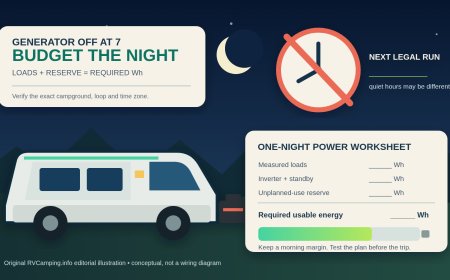
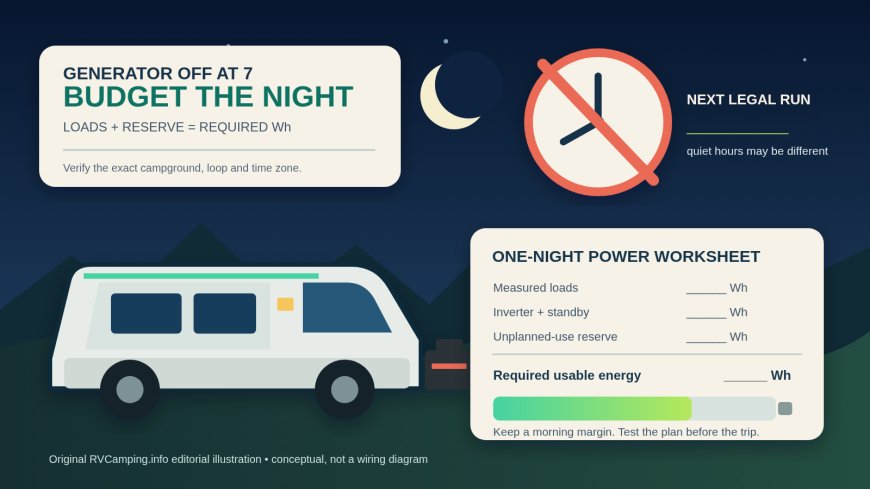
One-night RV power worksheet
Start the interval at the last permitted generator shutdown. End it at the next legal start, or later if you do not intend to run the generator as soon as hours open.
| Load | Source of number | Volts | Amps or watts | Expected run time | Night Wh |
|---|---|---|---|---|---|
| LP/CO alarms and required controls | ______ | ______ | ______ | ______ | ______ |
| Refrigerator controls or compressor | ______ | ______ | ______ | ______ | ______ |
| Furnace blower and controls | ______ | ______ | ______ | ______ | ______ |
| Lights | ______ | ______ | ______ | ______ | ______ |
| Water pump | ______ | ______ | ______ | ______ | ______ |
| Vent fan | ______ | ______ | ______ | ______ | ______ |
| Phones, radios and mobility devices | ______ | ______ | ______ | ______ | ______ |
| Medical equipment, per its manual and care plan | ______ | ______ | ______ | ______ | ______ |
| Inverter idle draw | ______ | ______ | ______ | ______ | ______ |
| Other | ______ | ______ | ______ | ______ | ______ |
| Planned load subtotal | ______ Wh | ||||
| Unplanned-use reserve | ______ Wh | ||||
| Required usable energy | ______ Wh |
Do not trim safety alarms from the budget. Do not assume propane appliances need no electricity; check the manuals for the installed refrigerator, furnace and water heater. If powered medical equipment is involved, use its manufacturer’s battery guidance and the user’s clinical backup plan. A camping worksheet is not an adequate basis for changing therapy or betting on an untested battery.
Work from usable capacity, not the biggest label number
Write down the exact battery chemistry, model, quantity, age and connection arrangement. Then find the manufacturer’s allowed discharge limit and capacity rating. Do not apply a lithium percentage to lead-acid batteries, or one maker’s recommendation to another product.
Trojan’s lead-acid FAQ is a useful warning against treating an amp-hour label as fixed fuel in a tank. It says capacity depends on discharge current and recommends using 20% to 50% of rated capacity for optimum life and performance, even though its batteries can be cycled more deeply.[4] Temperature, battery condition and load rate can reduce what the bank delivers. Lithium batteries have different controls and limits; use the battery and battery-management-system documentation for the installed model.
Use this capacity block:
| Capacity item | Your number |
|---|---|
| Published bank capacity at the applicable rating | ______ Ah or ______ Wh |
| Manufacturer-permitted planning fraction | ______ % |
| Capacity after that limit | ______ Wh |
| Adjustment for age, cold or documented test result | − ______ Wh |
| Conservative usable capacity at shutdown | ______ Wh |
| Required usable energy from load table | − ______ Wh |
| Projected morning margin | ______ Wh |
If capacity is stated only in amp-hours, a rough nominal conversion is:
nominal watt-hours = rated amp-hours × stated nominal voltage
That is a bookkeeping conversion, not a promise of delivered energy. Keep the manufacturer’s discharge-rate basis, temperature limits, low-voltage cutoff and battery-monitor instructions attached to the number.
A hypothetical example
Suppose an owner measures and estimates 420 Wh of overnight loads. They add a 25% reserve, making the requirement 525 Wh. Their documented conservative usable capacity at generator shutdown is 800 Wh.
420 Wh × 1.25 = 525 Wh required
800 Wh − 525 Wh = 275 Wh projected margin
The margin is the decision point. If the same bank is cold, partly charged or aging, 800 Wh may be too optimistic. If the furnace runs longer than the test night, the load can rise. The correct response is to revise the inputs or choose a powered site, not to plan an illegal 2 a.m. generator run.
Test the plan before the trip
A paper budget should survive a driveway test.
- Fully charge the house bank by the approved method.
- Turn off shore power and the generator at the same time as the campground cutoff.
- Configure the RV as it will be used overnight. Do not disable required alarms.
- Record battery-monitor energy or state of charge at shutdown, bedtime, overnight if practical, and the planned morning endpoint.
- Repeat in weather that reasonably represents the trip, especially if heat is expected to cycle often.
- Investigate a larger-than-planned draw before departure. Check forgotten inverter loads, tank heaters, entertainment gear, chargers and appliances that behave differently off shore power.
Do not perform improvised battery rewiring, protection changes or high-current measurements to complete the worksheet. Batteries can supply dangerous fault current. Use installed shunt-based monitoring or have a qualified RV electrical technician inspect and test the system.
If the numbers do not work
Change the reservation or the loads before relying on wishful charging. Practical options include booking an electric site, moving out of a generator-free loop, traveling in weather that does not demand heavy overnight heating or cooling, or reducing discretionary loads. Solar production can help replace daytime energy, but do not enter an unverified forecast as guaranteed overnight capacity. Shade, season, clouds, panel angle, controller limits and battery acceptance all affect the result.
Air-conditioning is a hard boundary for many battery systems. Do not infer overnight capability from inverter wattage alone. Starting surge, continuous draw, battery current, wiring, protection, temperature and usable energy all have to fit the installed system. If safe overnight temperature control or medical support depends on continuous power, reserve verified hookups or another engineered backup rather than treating campground generator hours as flexible.
Before bed, compare the live battery reading with the worksheet. If the margin has already disappeared, act while legal options remain: charge during the open window if safe and permitted, move to the planned powered alternative, or reduce only nonessential loads. The generator cutoff is fixed. The plan should be flexible enough that nobody needs to break it.
Sources
- Campground Regulations — Yosemite National Park. Quiet hours and three daily generator windows. Accessed September 21, 2026.
- Campgrounds — Mount Rainier National Park. Quiet hours, generator windows and generator-free loops. Accessed September 21, 2026.
- Measuring electricity — U.S. Energy Information Administration. Definitions of watts, watt-hours and kilowatt-hours. Accessed September 21, 2026.
- Technical Support FAQs — Trojan Battery. Lead-acid capacity, discharge-rate and depth-of-discharge guidance. Accessed September 21, 2026.
- When the Power Goes Out, Keep Your Generator Outside — CDC. Portable-generator carbon-monoxide precautions. Accessed September 21, 2026.
What's Your Reaction?