





Your generator's exhaust doesn't stop at your campsite
How to place a portable generator at an RV campsite without exposing your rig or your neighbors to carbon monoxide.

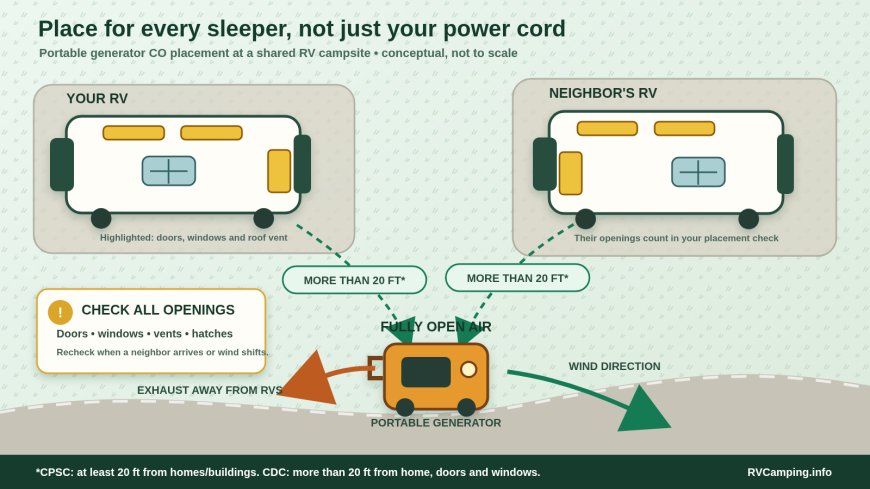
A practical placement guide for protecting your RV, the rig next door, and everyone sleeping nearby.
The generator is outside. That does not automatically make the setup safe.
At an RV campsite, "outside" can still mean under an awning, beside an open storage bay, a few steps from a bedroom window, or pointed at the neighbor's roof vent.[1][3] Carbon monoxide (CO) has no color or smell, and generator exhaust can kill before people recognize what is happening.[1][3]
The placement decision has to account for the whole campsite, not just the electrical cord running back to your rig.[1][2][3]
The 20-foot rule applies beyond your own RV
CPSC requires outdoor operation with at least 20 feet separating the generator from a home or building; the exhaust must face away from windows, doors and vents.[1] CDC's current generator fact sheet says "more than 20 feet" from the home, doors and windows.[2]
Those federal pages were written around homes, not a row of campsites.[1][2] Our conservative campsite reading is simple: treat every occupied RV, tent-camping area and campground building as a potential exposure point.[1][2][3] Measure the separation to your own rig and the neighbor's.[1][2] Check openings on every side, including roof vents and pop-out sleeping areas.[2][3] Twenty feet from your door does little good if the generator is closer than the federal guidance allows to somebody else's open window.[1][2]
The exact generator manual still matters; CPSC tells operators to follow the labels, instructions and warnings for their machine.[1] So do your RV manuals and the campground's posted rules.[1][3][4] They may add model-specific clearance, weather and operating requirements.[1][3] A compliant spot must satisfy all of them.[1][3] If the pad is too tight, an extension cord does not create more campsite.
Walk the site before pulling the starter
A two-minute walk can catch a bad setup before the generator starts.[1][2][3] Do it after both rigs are parked and again if a neighbor arrives later.[1][2]
- Find every occupied space. Include your RV, adjacent RVs, tents, cabins, bathhouses and other buildings.[1][2][3] Do not assume an empty pad will stay empty.
- Mark every air opening. Look for entry doors, crank-out windows, furnace or appliance openings, roof vents, cab windows, tent doors and hatches.[1][2][3] Honda's EU3200i manual specifically warns against operating near open doors, windows, vents or hatches.[3]
- Measure; do not pace it off. Use a tape measure. For this campsite plan, keep the unit more than 20 feet from every nearby RV or building and its openings, following the more conservative wording in the CDC fact sheet.[1][2]
- Trace the exhaust path. Aim the muffler away from occupied structures and vehicles.[1][3] The Honda manual says to orient the muffler with the wind and send exhaust away from buildings, structures and vehicles.[3]
- Check the cord route. Keep cords where they will not invite someone to move the generator closer, create a trip hazard or be damaged by traffic. Follow the generator and cord manuals for electrical rating, grounding and wet-weather protection.[1][3]
- Ask the neighbor. Confirm which windows and vents are open and where people will sleep.[1][2][3] If their answer changes the safe placement, move the generator or leave it off.[1][2]
Wind deserves a second look after startup because the Honda manual ties muffler orientation to wind direction.[3] Flags or leaves can help show direction. If the wind shifts toward an RV or swirls between rigs, shut down and reassess.[3] Exhaust direction helps; it does not cancel the federal separation guidance.[1][2][3]
Places that are still unsafe even though they feel "outdoors"
A portable generator does not belong inside an RV, trailer, van, truck, tent, shed or other enclosed or partly enclosed space.[1][3] Opening a door or window does not fix that hazard.[1][2][3]
Do not run a portable unit in an exterior storage compartment or RV generator bay.[3] Honda's manual specifically includes RV generator bays among the forbidden storage, cargo and security enclosures, and says to remove the EU3200i completely from a vehicle before operation.[3]
An awning, pop-up shelter, improvised plywood box or sound-dampening tent can also create an enclosed or partly enclosed setup.[1][3] Honda bars makeshift covers such as boards or a tent around the EU3200i, even outdoors.[3] A rain plan must come from the manual for your exact model; do not invent one with a tarp.[1][3]
Truck beds need the same caution.[3] A portable generator in a covered bed, under a cap or close to the tow vehicle can put exhaust near the cab, the RV and neighboring sites.[3] The portable model cited here must be completely removed from the vehicle for operation.[3]
Do not confuse fire clearance with CO distance
Manuals can contain several clearance numbers for different hazards. Honda, for example, gives its EU3200i a three-foot clearance from building walls, vehicles and equipment to reduce fire risk.[3] That is not a three-foot CO rule.
For CO placement, CPSC's minimum separation from a home or building is 20 feet, while CDC calls for more than 20 feet from the home, doors and windows.[1][2] Satisfy the longer CO separation as well as any fire, cooling and service clearances in your model's manual. Never choose the smallest number on the page without checking what hazard it addresses.
Your neighbor's CO alarm is not your placement plan
A working CO alarm is the backup that may catch a failure. It is not permission to send exhaust toward a rig.
CDC advises placing a battery-operated or battery-backup CO detector near every sleeping area and checking it regularly.[2] RVs use alarms listed and installed for that environment, so follow the RV and alarm manufacturers' instructions rather than transplanting a household mounting rule. The 2025 Winnebago Towables manual, for example, calls for testing the RV alarm after storage, before each trip and at least weekly during camping season.[4]
Newer portable generators may have an automatic CO shutoff. CPSC recommends looking for that feature.[1] Buy it as another layer of protection, then place the machine as carefully as a model without it. Honda states that its CO-MINDER system cannot prevent every CO danger.[3] If a CO shutoff trips, turn the generator off, move everyone away from the area and correct the location before considering a restart. Honda's manual says a CO-MINDER stop calls for changing the operating location.[3]
If an alarm sounds or people feel sick
Honda lists nausea, dizziness, fatigue, headache and shortness of breath among the early symptoms. Continued exposure can progress to loss of coordination, unconsciousness and death.[3] Because CO has no warning smell, do not wait for everyone to agree that something is wrong.
Get everyone into fresh air immediately and call 911. CPSC says never to ignore a CO alarm: get outside, then call 911.[1] Winnebago's towable manual likewise says to exit the vehicle immediately when the alarm sounds and warns that a drop in CO after leaving may be temporary.[4]
Do not spend time searching for the source before leaving. Shut the generator down only if that can be done without delaying escape or going back into a contaminated area. Keep the RV empty until emergency responders say it is safe, and have the cause corrected before using fuel-burning equipment again.
When the campsite is too small
Some campsites simply do not have a place that clears nearby rigs and openings. That is common in packed loops, rally fields and parking-lot-style overnight areas. The safe answer is not to shave the distance or point the muffler into an unoccupied-looking corner.
Ask the campground host whether there is an approved generator area. Otherwise, use shore power, reduce loads, rely on a properly designed battery/solar system, or move to a site where the generator can be operated within the rules and manuals. Air conditioning may feel urgent, especially with pets or vulnerable travelers aboard, but an unsafe generator setup trades heat risk for CO risk. Relocate to a powered site or another safe place instead.
A start-up card for the glovebox
Before every run:
- Confirm the campground allows the generator at that location and time.
- Read the exact generator, RV, CO alarm and accessory instructions.
- Place the generator fully outdoors and out of every vehicle, compartment, bay, tent and improvised enclosure.[1][3]
- Measure more than 20 feet to your RV, neighboring RVs/buildings and their openings.[1][2]
- Aim exhaust away from doors, windows, vents, hatches, vehicles and occupied areas.[1][3]
- Check wind direction and recheck it during operation.[3]
- Verify the RV's CO alarm is powered, in date and passes its prescribed test.[2][4]
- Stop and reassess if another camper arrives, opens a window or parks within the planned clearance.
- If any CO alarm sounds or anyone develops possible symptoms, move to fresh air immediately and call 911.[1][3][4]
A portable generator can be useful at a dry campsite. It also turns a neighbor's open window into part of your safety check. If you cannot protect both rigs, leave the generator off.
Sources
What's Your Reaction?