









Reheating campsite leftovers safely when your RV kitchen has limited power
A one-portion stove or microwave workflow for reheating RV leftovers to 165°F, then serving promptly or holding at 140°F or warmer.

Reheating campsite leftovers safely when your RV kitchen has limited power
By Romana Category: Cooking
A weak shore-power connection, a small battery bank or generator restrictions can turn a simple second-night dinner into an appliance puzzle. The food-safety target does not change with the electrical situation: a saved meal must have a trustworthy storage history, and the portion being reheated must reach 165°F throughout.[1][2]
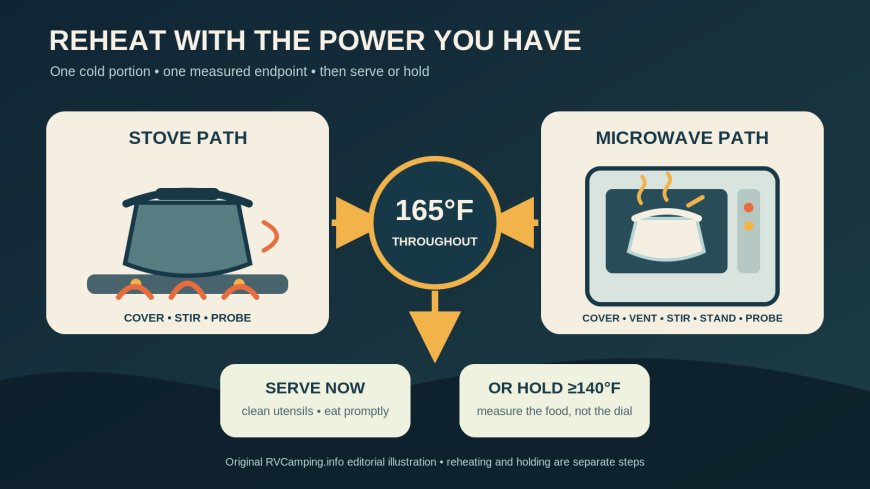
The short answer: Keep leftovers at 40°F or colder until you are ready to use them. Reheat only the amount you expect to eat, using either a covered pan on the stove or a microwave-safe covered dish. Stir or rearrange the food, then check several places with a clean food thermometer until every measured area reaches 165°F. If service is delayed after reheating, that is hot holding, not more reheating; keep the food at 140°F or warmer and verify it with the thermometer.[1][2][3]

First decide whether the leftovers still qualify
Heat is the final checkpoint, not a reset button. Before opening the container, confirm that the meal was refrigerated within two hours after cooking or leaving active warming equipment; that window shortens to one hour when exposure is above 90°F. It should have remained at 40°F or colder and, for most refrigerated leftovers, should still be within USDA’s three-to-four-day storage interval.[1][2]
Discard the food when its time or temperature history is missing. A hard boil, an extra microwave cycle or a normal smell cannot reconstruct an afternoon spent on a picnic table. FDA warns that some organisms can create toxins in unrefrigerated food that may survive later cooking.[2] Reheating is for properly handled leftovers, not for rescuing a questionable container.
Also check the handling history. Raw-meat leakage, dirty serving utensils or cooler meltwater are contamination problems, not low-temperature problems. Do not treat 165°F as permission to ignore them.
Reheating and holding are two different jobs
Reheating takes a cold cooked portion to 165°F for eating. Hot holding keeps food that is already hot at 140°F or warmer while it waits for service.[1][3] Those numbers describe different stages and should not be blended into one vague “warm” setting.
That distinction matters in a power-limited RV. A warmer, insulated vessel or low appliance setting should not be assumed to perform the reheating step. First use a suitable cooking method to reach 165°F throughout. Then, if dinner cannot be served immediately, move into a holding plan and measure that the food remains at least 140°F. FDA notes that some warming equipment may operate below that holding threshold, so the label and the food thermometer—not the glowing indicator—decide whether the setup is adequate.[3]
If you cannot provide verified hot holding, serve as soon as the reheat is complete. Do not let a pan drift slowly downward while people finish setting up camp.
Make a one-portion power plan
Limited power is a planning constraint, not a reason to lower the temperature target. Before taking food out of cold storage:
- Choose the portion. Keep the rest at 40°F or colder. A smaller meal-size amount is easier to stir, rearrange and measure than the full storage container.
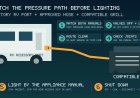
- Choose one appliance path. Use the propane stove when electrical capacity is tight, or the microwave only when the RV’s electrical system can support that appliance according to its manuals and current power source. Do not improvise electrical loads or run a generator where campground rules prohibit it.
- Choose the vessel. Use a covered saucepan or skillet for the burner; use a microwave-safe dish and vented microwave-safe cover for the microwave.
- Set out the thermometer. The cycle is finished by measured food temperature, not by a timer, steam on the lid or the wattage printed on an appliance.
- Choose the destination. Plan to eat immediately or have verified 140°F-or-warmer holding ready.
There is no universal safe number of burner minutes or microwave seconds. Appliances differ, portions differ, and dense food can hide a cool center. The reliable endpoint is 165°F at the coolest places you can find.[1][2]
Stove workflow: covered, stirred and measured
A propane burner lets an RV use a non-electric heat source, but the flame does not guarantee an even food temperature. Follow this sequence:
- Transfer one meal portion to a saucepan or skillet. Break apart dense clumps before heating.
- Add a small amount of water, broth or sauce only when the food needs moisture to move and heat without scorching. This is a texture and heat-distribution step, not a substitute for the thermometer.
- Cover the pan. USDA advises covering leftovers during reheating to retain moisture and help heat travel through the food.[1]
- Heat according to the cookware and appliance instructions. Stir from the bottom and sweep the edges into the center. Turn large pieces so a cool surface is not protected from the hot pan.
- Pause to probe thick pieces and several zones without resting the thermometer tip on the pan. Continue the heat-stir-check cycle until all measured areas are at least 165°F.[1][2]
- For leftover sauces, soups and gravies, bring the liquid to a rolling boil as USDA directs, while still treating 165°F throughout as the leftover endpoint.[1]
- Serve immediately, or transfer the food to a setup that can demonstrably hold it at 140°F or warmer.[1][3]
A tight lid and a pan matched to the portion can reduce unnecessary heat loss, but they do not prove safety. If the RV stove has poor ventilation, unstable cookware or a damaged burner, stop and use a safe alternative that follows the equipment manufacturer’s instructions. Never move a fuel-burning camp stove inside the RV unless it is installed and approved for that use.
Microwave workflow: cover, interrupt, stand and probe
A microwave may be the shortest practical path when shore power, a generator window or the RV electrical system can support it. Microwave energy can leave cold spots, so the workflow must deliberately redistribute the food.[1][2]
- Spread one portion in a microwave-safe glass or ceramic dish rather than leaving it in a deep mound.
- Add liquid if the food needs it, then cover with a microwave-safe lid or wrap. Vent the cover so steam can escape.[1]
- Begin reheating according to the appliance and food instructions.
- Stop partway through to stir, rotate or turn the food. A turntable does not eliminate the need to mix thick foods.[1][2]
- Continue heating, then observe the appliance or food instructions for standing time. USDA explains that heating continues during this rest.[1]
- After standing, use a clean food thermometer in several locations—especially the center, dense pieces and any area that was formerly frozen. Every check must reach at least 165°F.[1][2]
- If one location is below the target, stir or rearrange again, apply more heat, repeat the standing period and recheck.
Do not declare success because the sauce bubbles while a chunk of meat or a compact center remains cooler. FDA specifically advises testing microwave-heated food in two or three areas because hot and cold spots can coexist.[2]
Frozen portions: thaw only if it helps the plan
USDA says frozen leftovers can be reheated safely without thawing in a saucepan or microwave, although the process takes longer.[1] That option can be useful when a planned portion is already frozen, but it still ends at 165°F throughout.
If you thaw first, use the refrigerator, cold water or the microwave—not the counter. Food thawed by microwave should continue directly through heating to 165°F.[1][2] In a limited-power kitchen, refrigerator thawing may make the later reheat easier to manage, but only when the refrigerator is actually holding 40°F or below and there is enough lead time.
After 165°F: serve now or hold on purpose
Once every measured spot reaches 165°F, make a clean handoff:
- Serve now: portion the food with clean utensils and eat it while hot.
- Hold for later service: maintain at least 140°F and check the food itself with a thermometer.[1][3]
- No verified holding available: do not park the dish on an unmeasured “warm” setting. Adjust the meal schedule so people are ready when reheating finishes.
Keep the unreheated supply refrigerated. This prevents the entire batch from entering another warm-up and cooldown cycle merely because one person wanted dinner. If the reheated portion will not be eaten, do not casually mix it back into the cold container; keep histories simple and avoid reheating more than needed.
The low-power galley card
Tape this four-line card inside a cabinet:
- QUALIFY: known history, stored at 40°F or colder, normally no more than three to four refrigerated days.[1][2]
- CHOOSE: one portion, one safe appliance path, one suitable covered vessel.
- REHEAT: stir or rearrange; measure at least 165°F in several places.[1][2]
- SERVE OR HOLD: eat promptly, or maintain a measured 140°F or warmer.[1][3]
The card separates the decisions that limited power tends to blur. Electrical capacity determines which safe method is available. It does not change the 165°F reheating endpoint, turn a warming mode into a reheating method, or make uncertain leftovers safe.
Evidence note: USDA and FDA provide the temperature, storage, reheating, microwave and holding guidance. The one-portion power plan, stove sequence, microwave sequence and galley card are original RVCamping.info editorial workflows. Readers should follow their RV, generator, inverter, microwave, stove and cookware manuals for equipment limits.
Sources
What's Your Reaction?