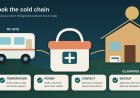






Glamping with refrigerated medication: book the cold chain, not just the bed
A booking checklist for mixed RV and glamping groups that need reliable medication refrigeration, transport cooling and an outage backup plan.

By Romana
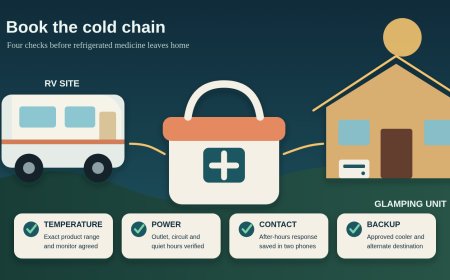
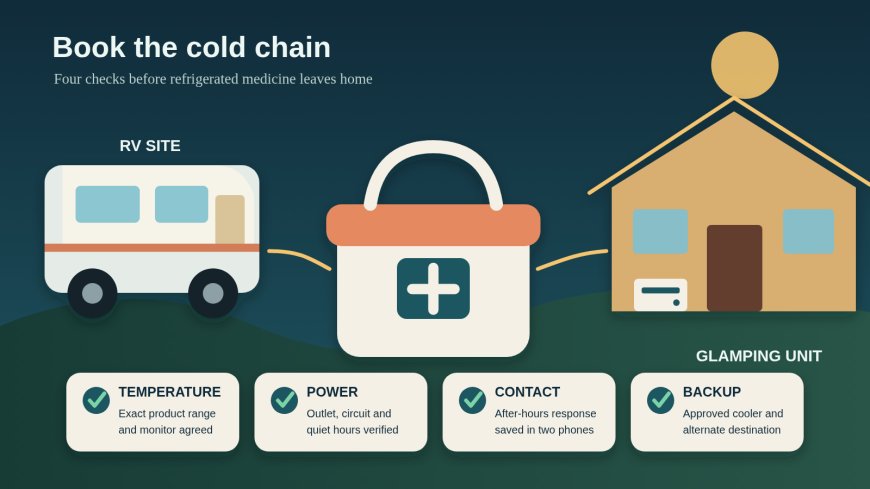
A mini-fridge icon is not a medication-storage promise. For a mixed group using RV sites and glamping units, the person who needs refrigerated medicine should have a confirmed chain from home to the campsite, a written outage response and a way to reach qualified help. Book the glamping unit only after the property confirms the exact appliance, power arrangement and after-hours procedure. Treat the RV as a separate system, even when it is parked next door.
FDA advises travelers to follow the medicine's labeled storage instructions and have a cooler with ice or frozen gel packs available when needed.[1] That is the planning baseline, not a universal packing recipe. Different products can have different temperature, freezing, light and time-out-of-refrigeration limits. The label and product-specific guidance control.
Source note: This is a booking and logistics framework, not medical advice. It does not decide whether a medicine remains usable after a temperature excursion, change a dose or recommend a substitute. Take product-specific questions to a pharmacist, prescriber or manufacturer.
Start with a one-page medication travel brief
The traveler, caregiver or other designated adult should prepare the brief before anyone pays a nonrefundable deposit. Keep private health details on a need-to-know basis. The reservation organizer only needs the operational requirements that affect the booking.
Record:
- the medicine name, presentation and current pharmacy label instructions;
- the required storage range and every warning copied from the current label, including "do not freeze," light protection or handling limits;
- the pharmacist's packing directions for the drive and the exact cooler setup;
- the allowed time and temperature conditions outside refrigeration, if the pharmacist or manufacturer has confirmed them;
- pharmacy, prescriber and manufacturer contact numbers;
- the quantity carried, refill constraints and nearest practical pharmacy;
- who owns the cooler, thermometer, check log and overnight response.
FDA explains that prescription labeling includes special storage and handling conditions, such as refrigeration or protection from light, and directs medicine questions to a doctor or pharmacist.[5] CDC also recommends discussing an emergency supply with a doctor or pharmacist and keeping a medicine list that includes dosage, frequency, medical needs and allergies.[2]
Do not turn a familiar number into a group rule. A food-safe refrigerator target, an insulin rule remembered from another trip or a different traveler's biologic instructions do not establish the range for this product. Copy the current product-specific instructions. If the wording is incomplete, call before departure.
Clear the booking gate in writing
Send the property a short operational request for the exact unit number or unit type. Avoid asking, "Does the cabin have a fridge?" That usually earns a yes/no answer and leaves the useful questions unanswered.
Ask the property to confirm:
- The exact appliance. Is it a compressor refrigerator, thermoelectric cooler, beverage cooler or another type? Is there a freezer compartment that could create a freezing zone? Is it inside the booked unit, shared, or staff-only?
- Temperature evidence. Does the property publish an operating range, keep a refrigerator thermometer or permit the guest to place a compact thermometer inside? Will staff let the guest check the empty unit before storing medicine?
- Continuous power. Is the appliance energized around the clock, including quiet hours? Is power ever switched off between stays, by an occupancy switch or at a site pedestal?
- The outlet and circuit. Is a nearby outlet continuously powered for an approved personal cooling device? What receptacle and circuit limits apply? The answer must come from the property; a photo of an outlet proves only that an outlet exists.
- Outage notification. Who notices a trip, pedestal fault or property-wide outage, and will staff contact the guest? Who answers after the office closes?
- The backup destination. Can staff move the medicine to verified powered storage, provide approved ice or relocate the guest? How quickly can that happen, and who authorizes it?
- Guest equipment rules. Are coolers, compact medical refrigerators, battery power stations or generators restricted? Are extension cords prohibited? Get any generator location and hours in the same reply.
A rental mini-fridge is not suitable for medication merely because it feels cold or appears in the amenity list. Suitability remains unverified until the required range, monitoring method, freeze risk, power continuity and outage response all fit the product-specific plan. If the property cannot answer, book a different unit or use another pharmacist-approved arrangement.
Give the RV and glamping unit separate answers
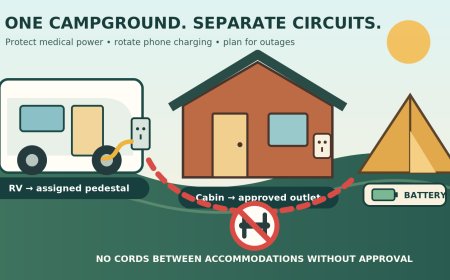
The two households can share a picnic table. They should not share assumptions about power.
| Booking path | Verify before paying | Verify on arrival | Failure route |
|---|---|---|---|
| Glamping tent, yurt or cabin | Exact fridge type and location; temperature-check permission; 24-hour power; after-hours contact; guest cooler and backup-power rules | Appliance is running; thermometer placement is allowed; outlet behavior matches the written reply; staff contact works | Move to the pre-approved cooler or verified alternate storage, record the event and call the appropriate pharmacy or manufacturer contact |
| RV on a powered site | Hookup amperage and connector; site-specific power availability; campground generator rules; RV refrigerator operating mode; approved backup equipment | Pedestal and surge-protection indications; refrigerator has stabilized under the owner's manual; monitoring device works | Use the RV household's preplanned backup or move to verified alternate storage; do not assume a neighboring cabin can accept the medicine |
| RV on a no-hookup site | Battery capacity under the actual refrigerator load; charging plan; generator permission and hours; non-generator fallback | Starting state of charge, expected loads and legal generator location/hours | Preserve the medicine with the pharmacist-approved transport setup or leave for verified storage before the backup margin disappears |
Official campground rules show why "we will run the generator" is not a complete plan. Capitol Reef's developed campground lists no utility hookups, limits generator use to short windows and says generators may not run outside approved hours for any reason.[4] A different campground will have different rules, but the booking lesson holds: verify the exact site and dates rather than importing a policy from somewhere else.
A battery power station is not automatically compatible either. Match the cooling device's voltage, continuous draw, startup surge and connector to the power source specifications. Include conversion losses and other loads in the estimate. If nobody in the group can verify that setup from the equipment manuals, use a qualified technician or choose lodging with a documented solution. This electrical check does not replace product-specific temperature guidance.
Pack a transport system, not loose ice
CDC includes a cooler and chemical ice packs in its prescription preparedness list.[2] FDA likewise tells travelers to prepare an insulated carrier and an appropriate cold source when the label requires them.[1] Those agencies establish the need to plan. The pharmacist or manufacturer should settle the details for the exact product.
Before the drive, ask:
- May this product travel in the planned cooler?
- May its carton touch a frozen pack, or does it need a barrier?
- What thermometer or temperature logger should be used, and where should it sit?
- What readings, timestamps or alarms should be recorded?
- How long may the medicine remain in that setup?
- What should happen if it freezes, warms beyond the stated limit or the temperature history is missing?
Keep the medicine in its labeled packaging unless the dispensing pharmacy gives different instructions. Put the written contacts and storage limits somewhere accessible without unlocking the medicine container. Secure the cooler where passengers cannot crush it and where sun through a window will not heat it. Do not leave it in a parked vehicle.
Carry enough prepared cold source for the travel plan and the first property response window, but do not improvise by adding ice directly around the medicine. Cold damage can matter too. The right barrier, pack condition and arrangement are product-specific questions.
Run a five-minute arrival check
The group's first walk should include the sleeping units and the medication setup. Do this while the office is open.
- Compare the booked appliance and outlet with the property's written reply.
- Start the thermometer or logger exactly as planned and let the appliance stabilize before placing medicine inside.
- Check for an exposed freezer plate, ice buildup or a shelf that could put the carton against a very cold surface.
- Confirm the medicine remains protected from children, pets, food spills and accidental removal.
- Put the transport cooler, spare cold source and contact sheet where the responsible adult can reach them quickly.
- Call or text the after-hours number once if the property invites a test. Otherwise, save it in two phones.
If the measured conditions do not meet the pre-agreed plan, keep the medicine in the verified transport setup while the traveler contacts the property and pharmacist. Do not place it in the rental fridge "for now" and hope it settles later.
Decide the outage sequence before bedtime
Ready.gov says people who use refrigerated medicine should make an alternate refrigeration plan and ask their medical provider how long the medicine can be stored at higher temperatures.[3] Turn that advice into a short call tree.
- Protect the temperature record. Note the time, last known in-range reading, current reading and any alarm. Keep the refrigerator closed unless the approved plan calls for a move.
- Call the property contact. Ask whether the fault is limited to the unit, site pedestal or whole property, and request the promised backup action.
- Move only to verified storage. Use the pharmacist-approved cooler or an alternate refrigerator whose range and power are confirmed. "The office fridge is colder" is not enough.
- Escalate product questions. Contact the dispensing pharmacy, prescriber when clinically appropriate, or manufacturer. Give them the recorded temperatures and times. FDA says to consult the storage instructions after a temperature miss. If that does not resolve the question, ask a pharmacist, health care provider or the product manufacturer whether it remains usable.[1]
- Replace or relocate as directed. If the site cannot support the plan, leave for the preselected pharmacy, lodging or other verified destination rather than waiting out an open-ended outage.
Do not discard, use, change, double or substitute a dose based on this article. Do not judge potency from appearance. FDA notes that temperature-sensitive medicines may lose potency and says to replace medicine that can no longer be used as soon as possible.[1] The qualified contact makes the product-specific call.
Copy-and-send booking message
We are considering [unit/site] for [dates]. One guest travels with medicine that has product-specific storage requirements. Before we book, please confirm the exact refrigerator or cooler type in this unit; whether it operates continuously; whether we may place our thermometer inside; whether a continuously powered outlet is available for approved guest equipment; who answers after hours; how guests are notified of an outage; and what verified backup storage or relocation is available. Please also send rules for personal coolers, battery power stations, extension cords and generators. We are not asking staff to assess the medicine. We need the property and power facts in writing so the guest's pharmacist can approve the storage plan.
Save the reply with the reservation. Recheck it if the property changes the unit, appliance or site assignment.
A booking passes only when the whole chain passes
The decision is simple even when the details are not. The transport cooler must work for the exact medicine. The assigned glamping unit or RV site must support the planned refrigerator and monitoring method. The property must have a reachable outage contact. A verified fallback must last long enough to reach qualified guidance or replacement.
If one link is missing, the booking is not ready. Choose another unit, another property or different dates. That is less exciting than improvising around a warm mini-fridge at midnight, and much better.
Sources
What's Your Reaction?