




















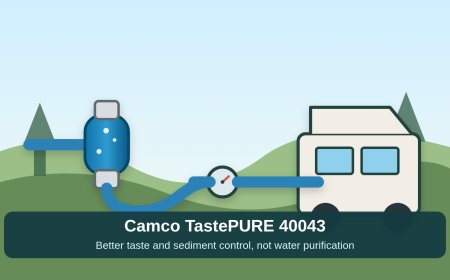





Camco TastePURE 40043 review: better taste, not water purification
The Camco TastePURE 40043 can improve taste and catch coarse sediment, but it is not a purifier. See who should buy it and how to use it safely.

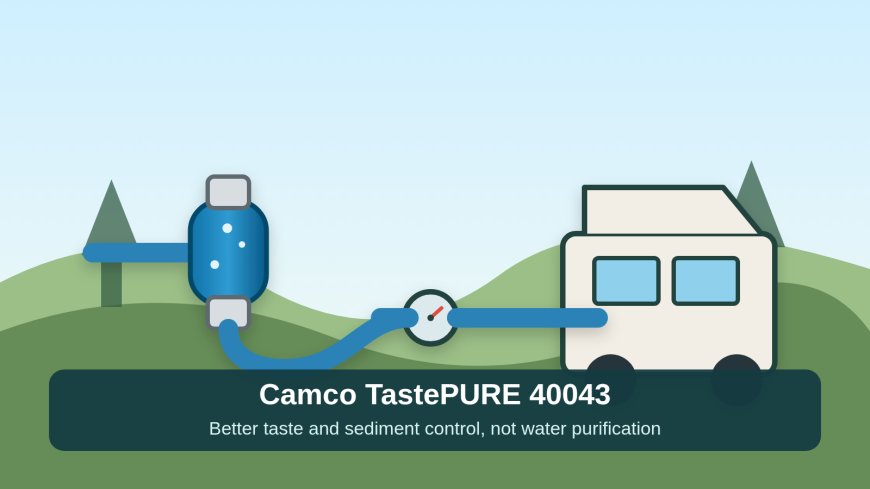
The Camco TastePURE 40043 is a sensible, low-cost inline filter for RVers who fill from a known potable campground supply and want less chlorine taste, odor, and visible sediment.[2] Skip it if you need protection from questionable water, meaningful hard-water treatment, or a filter that can be monitored by gallons.[3][5] The central tradeoff is convenience versus precision: it is easy to screw onto a hose, but its 20-micron sediment stage is far too coarse to serve as a microbiological purifier.[2][5]
This is a research-based review. RVCamping.info did not buy, install, or physically test this filter.
As an Amazon Associate, RVCamping.info earns from qualifying purchases. If you buy through an Amazon link in this article, we may earn a commission at no additional cost to you.
Check the Camco TastePURE 40043 on Amazon. The verified listing identifies model 40043, UPC 014717400435, and ASIN B0006IX87S; Camco's current product page uses the same model and UPC.[1][7]
The short verdict
Buy the 40043 for weekend trips and seasonal travel when the campground confirms that its hookup is potable.[2][4] It can improve the everyday nuisance problems that make park water unpleasant: chlorine taste, odor, and coarse sediment.[2] Its disposable inline format also avoids mounting a canister system.[1]
Do not buy it as your only answer to a boil-water advisory, an untested well, stream water, or a source described only as "water." Camco's instructions rule it out for water that may contain unsafe microbes or comes from a source of unknown quality.[3] CDC's RV guidance makes the same boundary practical: confirm that campground water is safe to drink before connecting, and check a filter's label for the specific germs or chemicals it removes because many taste filters do not remove germs.[4]
It also is not marketed as a water softener.[2] A carbon-and-sediment filter may change taste and catch particles without proving that it removes the dissolved minerals that cause hard-water scale.[2][6] An old owner report found a small initial flow reduction and believed the filter reduced spotting, while another commenter called it a basic filter that made little difference where spotting was already mild.[6] Those are personal observations from car washing, not lab evidence of hardness reduction.[6]
What model 40043 is supposed to do
Camco describes the current 40043 as a six-stage "Hex-Flow" design. The stages include a screened hose washer, foam prefilter, granular activated carbon, KDF media, another foam layer, and a 20-micron spun-polypropylene sediment layer.[2] The practical jobs are simpler than the stage count sounds:
- granular activated carbon addresses taste, odor, and chlorine;[2]
- the sediment media catches particles larger than its rated threshold;[2]
- the KDF component is described as controlling bacteria and mold growth while the filter is not in use.[2]
That last point needs careful wording.[2][3] Controlling growth inside stored filter media is not the same claim as disinfecting contaminated source water.[2][3] The instructions expressly exclude source water with uncertain safety or a known microbiological hazard.[3]
Camco lists model 40043 and UPC 014717400435 on its current product page.[1] Amazon's listing maps that model to ASIN B0006IX87S.[7] There are two nearby identities worth watching: 40045 is the two-pack, while 40019 is the larger XL version.[1][7] A marketplace variation or bundle can lead to a different ASIN, so verify that the cart still names 40043 before ordering.[7]
The 20-micron specification is a generation clue
Current Camco material calls the final sediment layer 20 microns.[2] Some older retailer copy for the same 40043 still says 100 microns.[8] That conflict may reflect old packaging or recycled catalog data; the available sources do not establish when the internal media changed.[2][8]
Use the current 20-micron figure for a newly packaged unit only after checking the label.[2][8] If an old-stock filter says 100 microns, believe the physical label rather than a marketplace bullet.[8] Neither figure is fine enough for germ removal.[5] CDC says a filter intended to remove parasites should have an absolute pore size of 1 micron or less or a specific NSF 53/58 cyst-reduction certification; 0.3 micron or smaller is the threshold it gives for bacteria and parasites, but not viruses.[5]
The word "NSF" also needs context.[2][5] A standard number alone does not tell you every contaminant a particular filter reduces.[4][5] Look for the exact reduction claim on the package or certification listing.[4] Do not stretch a taste, material-safety, or lead-content certification into a promise about bacteria, viruses, cysts, arsenic, or hardness.[4][5]
Who should buy it
The 40043 makes the most sense for:
- weekend and vacation RVers using established potable hookups;[2][4]
- owners who want one disposable exterior filter rather than a mounted housing;
- campers bothered mainly by chlorine taste, odor, or grit;[2]
- people willing to inspect the hose connection each time and protect the filter from freezing.[3]
A single filter can cover a season for light use, but that is not a guaranteed gallon rating.[3] Camco's instructions say filter life depends on water quality and call for replacement each camping season, when taste or odor becomes undesirable, or when flow drops significantly.[3] Sediment-heavy water may exhaust it sooner.[3]
Who should skip it
Choose another treatment plan if any of these describe your trip:
- The source is unmarked, under an advisory, untreated, or of unknown quality.[3][5]
- You need verified reduction of a particular contaminant or pathogen.[4][5]
- Hard-water scale is the problem you are trying to solve.
- You full-time and want replaceable cartridges, pressure gauges, or a measured service-life schedule.
- Freezing weather makes an exterior disposable filter hard to protect.[3]
For uncertain water, CDC recommends boiling as the best germ-control method. Its next-best general approach is filtration followed by disinfection, with the treatment selected for the organisms of concern.[5] Harmful chemicals cannot be made safe by boiling or disinfecting; use another water source instead.[5]
Setup that avoids the common mistakes
- Confirm with the campground that the connection supplies potable water. Do this before unpacking the hose.[4]
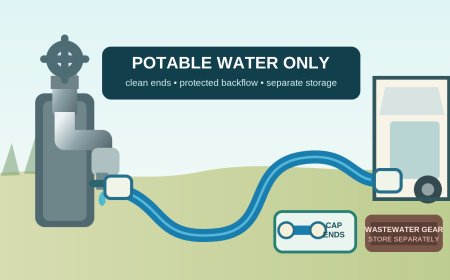
- Use a drinking-water-safe hose. Keep freshwater fittings separate from sewer-rinse gear.[4]
- Inspect the spigot, hose washers, filter body, and short flexible protector. Replace damaged washers rather than wrenching plastic threads tighter.
- Install a pressure regulator. Camco's instructions require limiting pressure to 60 psi or less.[3]
- Follow the flow arrow. The filter can sit at the faucet or near the RV, but support it so its weight does not lever against the city-water inlet.[3]
- Before the first RV connection, flush the new filter for one minute to clear carbon fines.[3]
- Pressurize slowly and look for drips at every joint. Check again after the hose has shifted or warmed in the sun.
- If filling the fresh tank, Camco says to restrict flow at the supply faucet so water has adequate contact time with the filter.[3]
- Record the first-use date. Replace the filter when flow falls, taste or odor returns, or the camping season ends.[3]
The first flush matters. Black or gray carbon dust from a new carbon filter can look alarming, but the manufacturer expects fines and specifies a one-minute flush.[3]
Storage, freezing, and sanitation
Drain the filter after disconnecting it, cap the ends, and keep the wet fittings away from sewer equipment. Camco says to protect the filter from freezing, never winterize it with antifreeze, and store it capped in a refrigerator.[3] A frozen exterior filter can crack even if the damage is not obvious at first.
The filter does not replace RV freshwater-system maintenance.[4] CDC says to follow the RV maker's instructions for draining, disinfecting, and flushing the water system, usually at least annually or after the RV has sat unused for a few months.[4] Stagnant tanks, hoses, faucets, and water heaters remain part of the water path after the campground spigot.[4]
Use extra care with water that goes into the nose or medical equipment. CDC says not to use water straight from an RV tap for sinus rinsing, contact-lens care, wound cleaning, or a CPAP humidifier; use the type of water or solution specified for each task.[4]
Is the Camco 40043 worth buying?
For potable campground water that tastes or smells off, yes.[2][4] The 40043 is compact and easier to live with than a canister rack.[1] The flexible protector and standard hose connections suit a temporary campsite setup.[1][3]
Its limitations are just as important as its convenience.[3][5] There is no useful basis for treating a 20-micron taste-and-sediment filter as a purifier, softener, or fix for a suspect source.[2][3][5] Buy it to improve acceptable water, not to make unsafe water safe.[3][5]
Before ordering, verify that the listing still shows model 40043 and ASIN B0006IX87S. Then read the label on the delivered unit for its micron rating and certified contaminant claims. Marketplace copy and older retailer pages do not agree on every specification.[2][7][8]
Sources
- Camco TastePURE Water Filter 40043 product page
- Camco: Clean Water on the Go with TastePURE
- Camco TastePURE RV Water Filter instructions
- CDC: Safe RV Water from Tank to Tap
- CDC: Water treatment while hiking, camping, or traveling
- Owner report: Camco 40043 flow and hard-water use
- Amazon: Camco TastePURE 40043, ASIN B0006IX87S
- Home Depot Camco 40043 reviews and legacy 100-micron listing
What's Your Reaction?