












Victron MultiPlus-II 2x120V review: can it supplement 30-amp shore power?
A research-based review of the Victron MultiPlus-II 12/3000 2x120V for 50-amp RVs using limited shore power, including battery demand, split-phase limits and installation safety.

Summary: The Victron MultiPlus-II 12/3000/120-50 2x120V can add battery power when a 50-amp RV is connected to a limited 120-volt source. It is a professionally installed inverter/charger, not a portable adapter, and its 2,400-watt continuous inverter output cannot turn a 30-amp pedestal into full 50-amp service.
Affiliate disclosure: As an Amazon Associate, RVCamping.info earns from qualifying purchases. If you buy through an Amazon link in this article, we may earn a commission at no additional cost to you.
Research disclosure: This is a research-based review using manufacturer documents, an installer account, marketplace identity data and owner reports. RVCamping.info did not buy, install or physically test this inverter/charger.
Quick verdict
Buy the Victron MultiPlus-II 12/3000/120-50 2x120V (UL), part PMP122305102, if you have a North American 50-amp RV, a properly designed 12-volt house-battery system and a qualified installer. Its PowerAssist function can combine a configured shore-power limit with battery power for a temporary shortage, then use spare incoming power to recharge the battery.[1][2]
Skip it if your RV has 30-amp service, you want a plug-in device, or you do not already plan a substantial battery and electrical upgrade. It is also the wrong purchase if the goal is to ignore a campground's air-conditioner restriction. PowerAssist manages the power available inside the RV; it does not change the pedestal rating or campground rules.
The central tradeoff is useful but easy to oversell. This unit really can supplement limited shore power.
The 12/3000 model is rated for 2,400 watts of continuous inverter output at 77°F, not 3,000 continuous watts, and PowerAssist is listed on L1.[2][3]
On a single-phase 120-volt hookup, the unit joins its two output lines so both sides of a typical 50-amp RV panel receive 120 volts, but 240-volt loads remain unavailable.[1][2]
Check the exact Victron MultiPlus-II 2x120V UL listing on Amazon
Exact model and Amazon identity
This review covers the 12-volt, 3,000VA, 120-amp charger, 50-amp-transfer version of the MultiPlus-II 2x120V. Victron's current product page names the configuration 12/3000/120-50 2x120V (UL).[1] A specialist dealer maps that configuration to manufacturer part PMP122305102.[4]
The Amazon listing used here is ASIN B0BZV4Z9TM. At retrieval, Amazon showed a 12-volt UL variant titled as a MultiPlus-II with a 3,000VA inverter, 120-amp charger and "2x" output, and the page's ASIN field returned B0BZV4Z9TM.[5] Check the ASIN, UL variant and part number before ordering because Amazon groups several voltages and one-line/two-line versions under similar titles.
That last check matters. A 120V-only MultiPlus-II and the 2x120V model are not interchangeable choices for a 50-amp RV panel.[1][4]
What PowerAssist does on a 30-amp hookup
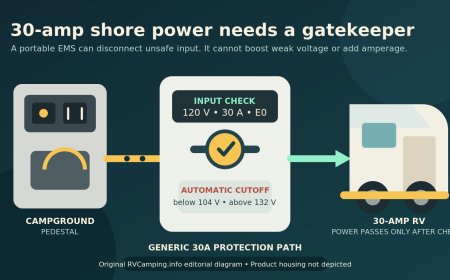
A 30-amp RV pedestal supplies one 120-volt leg, or 3,600 watts at the breaker rating. A standard 50-amp RV connection has two 120-volt legs and can supply up to 12,000 watts in total. A 30-to-50-amp adapter gives a 50-amp coach access to the one available 120-volt source. It does not create the missing capacity or produce 240 volts.
The MultiPlus-II sits in the installed AC path and monitors the configured input limit. It first reduces battery charging when RV loads approach that limit. If loads still ask for more, PowerAssist starts the inverter and draws the difference from the house battery.[2] When demand drops, the charger can refill the battery with whatever incoming capacity remains.[2][3]
This is different from an automatic transfer switch that merely chooses shore power or inverter power. PowerAssist can use both at once.[2] It is also different from an air-conditioner soft starter, which targets compressor startup current but supplies no energy of its own.
An RV solar installer reports using the 2x120V 3000VA model in fifth wheels and motorhomes and identifies PowerAssist as useful when temporary loads exceed the available shore or generator supply.[6] That is attributed field experience from an installer that also sells installation services, not controlled testing. The operating limits in Victron's manual and datasheet carry more weight.[2][3]
The split-phase boundary that buyers should understand
With a 120/240-volt split-phase source, the MultiPlus-II passes both incoming legs through and the output mirrors the source. Charging power is drawn from L1, and Victron lists PowerAssist on L1.[1][2]
With a single 120-volt source, the unit accepts that source on L1 and combines L1 and L2 on the output. Both halves of the RV panel then receive 120 volts from the same source/inverter combination.[1][2] There is no 240-volt potential between them in this mode. Victron designed the arrangement so 240-volt appliances cannot drain the battery when true split-phase power is absent.[2]
That makes the unit a strong architectural match for many 50-amp coaches that sometimes use 30-amp or 15/20-amp service. It does not mean every circuit can run at once. The shore breaker, inverter output, battery bank, DC wiring, branch circuits and load distribution all remain limiting parts of the system.[2][3]
How much assistance is realistic?
The model name says 3,000VA, while the current datasheet lists 2,400 watts continuous at 77°F, 2,200 watts at 104°F and 1,700 watts at 150°F.[3] Appliance power factor and temperature make VA and watts different measures, so planning around "3,000 watts extra" is not defensible.
A 2,400-watt AC contribution can require roughly 222 amps from a 12-volt battery at an assumed 90 percent conversion efficiency. Fifteen minutes at that draw consumes about 0.67 kWh before allowing for battery and cable losses. One hour is about 2.67 kWh. Those are RVCamping.info planning calculations, not Victron runtime promises.
The calculation explains the practical divide:
- A brief compressor start, microwave cycle or overlapping kitchen load may be a good PowerAssist job.
- Running two air conditioners above the shore limit for hours is a battery-capacity problem, a heat problem and eventually a recharge problem.
- A nearly empty, cold or current-limited battery bank cannot deliver the inverter's advertised output merely because PowerAssist is enabled.
Victron's manual recommends a 400- to 1,200Ah battery capacity range for the 12/3000 model and specifies substantial parallel DC conductors and a 400-amp DC fuse in its sizing table.[2] Those values show the scale of the installation. They are not a universal shopping list; cable length, battery chemistry, BMS limits, installation method and local code still control the design.
PowerAssist, soft start or ordinary load management?
Choose based on the problem you are solving.
A MultiPlus-II with PowerAssist is for an RV that needs an installed inverter/charger, whole-coach power architecture and short-term battery support when the incoming source is limited. It can address both startup and short sustained deficits, within its inverter and battery limits.[2][3]
An air-conditioner soft starter is narrower and often cheaper. It reduces compressor inrush but does not supplement a microwave, water heater or long-running air conditioner after startup. A soft starter may still be useful with PowerAssist because lowering the starting peak reduces stress on the inverter and battery.
Manual load management costs nothing. Turn off the electric water heater before using the microwave, run one air conditioner, and let the refrigerator use propane where lawful and appropriate. For occasional 30-amp stays, that may be more sensible than rebuilding the RV's electrical system.
A plug-in adapter or whole-RV soft-start controller is not a battery. If a seller does not identify a DC battery connection and an inverter/charger capable of co-supplying AC loads, do not assume the device creates extra sustained power.
Setup and inspection plan
Victron says this product may be installed only by a qualified electrical engineer.[2] A competent RV installation plan should cover all of the following before equipment is ordered:
- Confirm the RV has North American 50-amp 120/240-volt split-phase service and document the existing transfer switch, inverter, converter/charger, energy-management system and generator topology.
- Match the exact unit: 12/3000/120-50 2x120V (UL), part PMP122305102, ASIN B0BZV4Z9TM.[1][4][5]
- Verify battery voltage, chemistry, usable energy, continuous and surge BMS current, fault-current protection and the charger's approved voltage settings.[2]
- Size DC conductors, lugs, fuse, disconnect and busbars for the actual cable run. The current manual calls for two positive and two negative cable runs on the 12/3000 model, with sizes depending on distance.[2]
- Provide a dry, cool, ventilated mounting location near the battery, with service access and no nearby combustible materials.[2]
- Preserve chassis grounding, neutral switching and overcurrent protection exactly as the system design and applicable electrical codes require.[2]
- Configure the AC input current limit for the source in use. The 3000VA model's PowerAssist range is 9.5 to 50 amps, and the manual lists a 30-amp factory setting.[2]
- Decide which loads belong on AC-out-1 and AC-out-2. AC-out-2 disconnects during battery operation and reconnects about two minutes after AC input returns.[2]
- Commission the installation under measured loads. Check transfer behavior, shore current, L1/L2 load balance, DC current, cable and terminal temperature, battery state of charge and every protective shutdown.
- Label operating limits for anyone who uses the RV. Change the input limit when moving between 50A, 30A and household sources rather than assuming the system knows the pedestal breaker rating.
The manual calls for checking connections annually and keeping the unit clean and away from moisture, oil, soot and vapors.[2]
Safety and campground limits
PowerAssist should protect a correctly configured input limit. It should not be treated as permission to load a damaged receptacle, low-voltage pedestal or undersized extension cord. Stop if a plug, adapter or receptacle becomes hot, discolored, loose or smells scorched.
The inverter can keep interior loads running after shore power is disconnected, and a battery remains a permanent energy source. Victron warns that dangerous voltage may remain at terminals even when the equipment is switched off and requires both AC and battery isolation before maintenance.[2]
Campground restrictions still apply. If management prohibits air-conditioner operation, a battery-assisted inverter does not make the prohibited load acceptable. If the rule is a breaker limit rather than a usage ban, set the input limit correctly and still leave margin for pedestal condition and voltage drop.
Who should buy it, and who should skip it?
The MultiPlus-II 12/3000/120-50 2x120V makes sense for owners who:
- have a 50-amp RV and want both panel legs supplied with 120 volts during inverter or single-phase operation;[1][2]
- need battery support for short deficits on 30A, household or generator power;[2]
- already have, or are budgeting for, a large compatible house-battery system;
- want one installed device to handle inversion, charging, transfer and input-current management; and
- will pay for qualified system design, installation and commissioning.[2]
Skip it if you have a 30-amp-only RV, need only easier air-conditioner starts, expect a portable box, or plan to run sustained loads that exceed both shore and battery capacity. Also skip it if you cannot dedicate the space, ventilation, cable routing and protective equipment that a roughly 48-pound high-current inverter/charger requires.[2][3]
Bottom line
The Victron MultiPlus-II 2x120V is one of the few products that matches the original question honestly: it can combine limited shore power with battery power inside a properly designed 50-amp RV system.[1][2] That makes it more capable than an adapter or soft starter, but much more demanding to install.
Its limit is just as important as its capability. The reviewed 12/3000 model contributes up to 2,400 watts continuously at 77°F according to the current datasheet, draws very high DC current under load and cannot provide 240 volts when the incoming source is only 120 volts.[2][3] Buy it as the center of a planned electrical upgrade, not as a workaround for campground rules or a promise of full 50-amp service from a 30-amp pedestal.
View Victron MultiPlus-II 2x120V UL ASIN B0BZV4Z9TM on Amazon
Sources
- Victron Energy MultiPlus-II 2x120V product page
- Victron Energy MultiPlus-II 2x120V manual
- Victron Energy MultiPlus-II 2x120V datasheet
- Inverters R Us model listing for PMP122305102
- Amazon listing for Victron MultiPlus-II 12V 2x120V UL, ASIN B0BZV4Z9TM
- Cascade RV Solar Solutions MultiPlus-II 2x120V installer review
What's Your Reaction?