


Jumbo Rocks vs. Black Rock vs. Cottonwood: Which Joshua Tree campground fits your RV?
Compare Jumbo Rocks, Black Rock, and Cottonwood for RV site limits, dry-camping services, water and dump access, reservations, and arrival roads.


Quick answer: Choose Jumbo Rocks for the easiest campground base inside Joshua Tree's main road network, as long as you can arrive with full fresh water and leave without an on-site dump. Choose Black Rock when potable water, a dump station, and Yucca Valley access matter more than being connected by road to the park interior. Choose Cottonwood for an I-10 approach, southern-park trails, and the same water-and-dump convenience as Black Rock. None of the three has campsite hookups, and every RV reservation still depends on the limits of the exact site.
Joshua Tree's campground page lists 124 sites at Jumbo Rocks, 99 at Black Rock, and 62 at Cottonwood. It places them at roughly 4,400, 4,000, and 3,000 feet, respectively.[1] Elevation is only part of the choice. Water, sewage handling, the arrival road, and what Recreation.gov says about one particular parking space matter more once an RV is involved.
The comparison at a glance
| Decision point | Jumbo Rocks | Black Rock | Cottonwood |
|---|---|---|---|
| Best for | Camping inside the main park road system near the boulder country | Water and dump access near Yucca Valley | An I-10 arrival and a southern-park base |
| Campsite hookups | None | None | None |
| Campground water and toilets | No drinking water; pit toilets | Potable water; flush toilets | Potable water; flush toilets |
| Dump access | No nearby dump station | Dump station near site 6; separate $5 use fee | Dump station between visitor center and campground; separate $5 use fee |
| Published RV boundary | Some sites allow a combined RV-and-towed-vehicle length up to 35 feet | Campground maximum is 35 feet, but many sites are shorter | NPS says some family sites allow a combined length up to 35 feet; one Recreation.gov listing currently conflicts by showing 42 feet |
| Reservation pattern | Required year-round; same-day to six months ahead | Required year-round; same-day to six months ahead | Required year-round; same-day to six months ahead |
| Main access issue | 18 miles from West Entrance or 8 miles from North Entrance on park roads | Joshua Lane approach ends at the campground; no through road into the main park circuit | Enter from I-10 exit 168; do not route to the park headquarters mailing address |
NPS identifies Black Rock and Cottonwood as the park's two RV water-fill and dump locations. The dump fee is $5 at either facility.[1]
Recreation.gov confirms that the sites themselves remain nonelectric and have no water or sewer connections.[2][4][6]
First, understand the no-hookup reality
"Water available" does not mean a water hookup at the pad. Black Rock and Cottonwood provide shared potable water and flush toilets, while their individual campsites have no electric, water, or sewer service.[4][6] Jumbo Rocks is more basic: no hookups, no campground drinking water, pit toilets, and no dump station close by. Its Recreation.gov page directs campers to potable water at the Oasis Visitor Center, 11 miles away.[1][2]
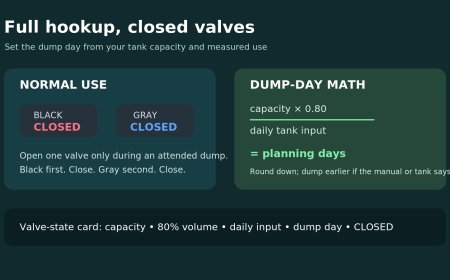
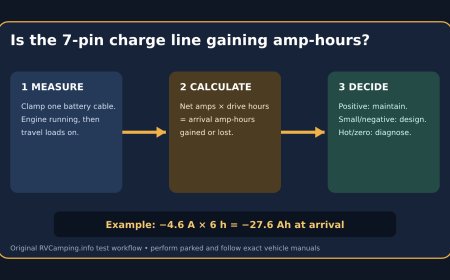
That makes all three dry-camping reservations. Fill the fresh tank before leveling, arrive with enough battery and propane capacity, and plan tank volume around the stay. Black Rock and Cottonwood reduce the water and wastewater logistics, but they do not turn into full-service RV sites.
Generator hours are the same at all three: 7-9 a.m., noon-2 p.m., and 5-7 p.m.[1] A camper who needs continuous shore power should use a private RV park outside Joshua Tree instead of treating those windows as all-day electrical service.
Jumbo Rocks: best position, fewest RV services
Jumbo Rocks is the geographic winner for a trip built around the park interior. Recreation.gov places it about 18 miles from the West Entrance and about 8 miles from the North Entrance.[2] Once camp is set, you are already on the paved park network rather than commuting in from a gateway town.
The trade is self-sufficiency. Jumbo Rocks has no potable water in the campground and no nearby dump. It also has no overflow parking, and a trailer counts as one of the vehicles assigned to a site.[2] A travel trailer plus tow vehicle can therefore consume the two-vehicle allowance before a friend arrives in another car.
Do not read the 35-foot figure as permission for every pad. NPS says only some Jumbo Rocks sites can take a combined RV setup, including a towed vehicle, as long as 35 feet.[3] Site 085 shows how detailed the listing can get: Recreation.gov currently allows an RV up to 35 feet there, but a trailer only up to 20 feet; it shows a 40-foot parallel driveway and warns of erosion and a drop beside the road.[10] The equipment field, driveway field, and site notes all need to work for the same rig.
Jumbo Rocks fits a van, truck camper, small motorhome, or carefully matched trailer setup whose crew values location over plumbing support. It is the weakest choice for a long stay with small tanks or for anyone planning to fill and dump after settling in.
Black Rock: easiest resupply, separate from the park circuit
Black Rock is the service-friendly choice near Yucca Valley. Recreation.gov lists potable water, flush toilets, and a dump station, with showers and laundry available in town about five miles away.[4] Campsites are still nonelectric, so the advantage is water, waste handling, and nearby errands rather than shore power.
The road layout surprises first-time visitors. The official NPS Black Rock Canyon page says the approach road terminates at the campground.[15] Recreation.gov routes arrivals south from Highway 62 on Joshua Lane.[4] You cannot continue through Black Rock into the main park road system. Touring Hidden Valley, Keys View, or Jumbo Rocks by vehicle means returning to the highway and entering elsewhere.
Black Rock's 35-foot campground maximum is not a promise that a 35-foot coach fits any open listing. NPS explicitly warns that longer RVs do not fit every site.[5] Recreation.gov site 093, for example, permits a 24-foot RV, allows one vehicle, uses a gravel back-in, and warns that the parking area is not very level.[11] Site 013 permits an RV up to 35 feet, but its notes identify a roughly 10-foot-wide entrance, tight turns, low vegetation, a 12-foot height limit, and no guarantee of a level pad.[12]
Those two listings make the buying decision plain: filtering for "RV allowed" is not enough. Check length, height, entry type, vehicle count, grade, and the free-text warnings. Black Rock works well when the exact pad has comfortable clearance and the outside-the-main-circuit location matches the itinerary.
Cottonwood: best southern approach, with a length conflict to resolve
Cottonwood sits near the park's southern entrance. Recreation.gov tells drivers to use I-10 exit 168 and warns that the headquarters address is not the campground's physical location.[6] This is the cleanest of the three approaches for travelers already crossing Southern California on I-10, and it avoids towing through the busier Highway 62 gateway towns before check-in.
Facilities resemble Black Rock: shared drinking water, flush toilets, and a nearby dump station, but no campsite utilities.[1][6] The campground has little vegetative shade and sits lower than Jumbo Rocks, so heat planning deserves extra weight even outside midsummer.[6]
Cottonwood has the most important specification conflict in this comparison. NPS says some individual family sites can handle a combined RV length, including a towed vehicle, up to 35 feet.[7] Recreation.gov site B14 is much smaller, with a 20-foot RV limit and a note that it suits camper vans and pickup campers.[13] At the other end, site A25 currently displays a 42-foot RV and vehicle limit.[14]
A 42-foot listing does not erase the NPS campground guidance. The two official records disagree, and a long-rig owner should not guess which field staff will enforce. Before reserving A25 or any other listing above 35 feet, contact the park or Recreation.gov with the exact motorhome or trailer-and-tow-vehicle dimensions and save the answer. For rigs within 35 feet, confirm whether that NPS figure applies to the combined setup, then verify slide clearance; Recreation.gov warns that most Cottonwood parking areas cannot accommodate slide-outs.[6][7]
Cottonwood makes sense for a southern itinerary and for travelers who want on-site access to water and dumping without Black Rock's Yucca Valley orientation. It is less convenient when most days will be spent in the park's northern boulder and Joshua tree areas.
Reservations are year-round, but summer capacity changes
All three Recreation.gov facility pages say reservations are required throughout the year and may be made on the day of arrival or as far as six months ahead.[2][4][6] That is the booking window, not a guarantee that every loop stays open every day.
For 2026, NPS scheduled summer reductions from June 1 through August 28 at Black Rock sites 21-87 and Cottonwood Loop B. Jumbo Rocks was not included in that partial-closure list.[9] Those dates had passed by this article's September 11 publication date, but they matter to anyone using this comparison for a future summer trip. Inventory can shrink even while the campground remains reservable.
NPS also says September-through-May weekends commonly fill, and cell coverage inside the park is limited.[1] Reserve before driving through the gate, download the confirmation and site details, and take a screenshot of the campground map. Check the NPS alerts page again before towing; it directs visitors to the current closure map for roads, trails, campgrounds, and backcountry areas.[16]
Current Recreation.gov notices also show fire restrictions at all three campgrounds. The notices prohibit charcoal and wood-burning equipment while allowing gas or propane stoves.[2][4][6] Verify that notice near departure because restrictions can change with conditions.
A site-by-site RV booking check
- Measure the traveling setup. Record the motorhome length, or the trailer and tow vehicle separately and together. Add height, width with slides, and the number of vehicles. NPS regulations make the Recreation.gov site specifications controlling details for the booking check.[8]
- Read the individual listing, not only the campground card. Compare permitted equipment, maximum vehicle length, driveway length, entry style, surface, grade, and site notes. NPS warns that an RV extending into the road creates a collision risk and should be assigned another site.[1]
- Choose a water and waste plan. Jumbo Rocks requires pre-arrival water and an off-site dump plan. Black Rock and Cottonwood provide fill and dump facilities, not hookups.[1][2]
- Map the correct entrance. Route Jumbo Rocks through West or North Entrance, Black Rock through Yucca Valley and Joshua Lane, and Cottonwood from I-10 exit 168.[2][4][6]
- Resolve conflicting limits before paying. Cottonwood A25's 42-foot Recreation.gov field conflicts with NPS's 35-foot combined-length guidance. Written confirmation is safer than assuming the larger number controls.[7][14]
Bottom line
Jumbo Rocks is the best all-around base for park sightseeing if the RV fits a specific site and can operate without campground water or dumping. Black Rock is the better resupply base near Yucca Valley, but its dead-end access road puts it outside the main driving circuit. Cottonwood pairs I-10 convenience with potable water and a dump station, while placing you at the park's southern end.
None is a hookup campground. The right reservation is the one where the exact site's dimensions, the rig's power and tank plan, and the arrival road all agree. If any one of those three is vague, keep looking.
Sources
- Campgrounds - Joshua Tree National Park (accessed September 11, 2026)
- Jumbo Rocks Campground - Recreation.gov (accessed September 11, 2026)
- Jumbo Rocks Campground - Joshua Tree National Park (accessed September 11, 2026)
- Black Rock Campground - Recreation.gov (accessed September 11, 2026)
- Black Rock Campground - Joshua Tree National Park (accessed September 11, 2026)
- Cottonwood Campground - Recreation.gov (accessed September 11, 2026)
- Cottonwood Campground - Joshua Tree National Park (accessed September 11, 2026)
- Camping Regulations - Joshua Tree National Park (accessed September 11, 2026)
- Summer Seasonal Closures and Restrictions - Joshua Tree National Park (accessed September 11, 2026)
- Jumbo Rocks Site 085 - Recreation.gov (accessed September 11, 2026)
- Black Rock Site 093 - Recreation.gov (accessed September 11, 2026)
- Black Rock Site 013 - Recreation.gov (accessed September 11, 2026)
- Cottonwood Site B14 - Recreation.gov (accessed September 11, 2026)
- Cottonwood Site A25 - Recreation.gov (accessed September 11, 2026)
- Black Rock Canyon - Joshua Tree National Park (accessed September 11, 2026)
- Alerts and Conditions - Joshua Tree National Park (accessed September 11, 2026)
What's Your Reaction?