





Hot-weather RV storage between trips: a safe reset checklist
Store an RV safely between hot-weather trips with manual-led battery, propane and refrigerator steps, a heat-sensitive-item sweep, ventilation choices and a restart checklist.


By Romana | September 11, 2026
For a few hot weeks between trips, an RV needs more than locked doors and a battery switch flipped at random. Empty and dry the refrigerator, remove anything with a storage-temperature limit, shut off propane at the boundary specified for your rig, and put each battery bank into the storage state its manufacturer requires. Then decide whether ventilation is worth the water-intrusion and security exposure at your storage site.
There is no universal switch sequence. RVs mix chassis and house batteries, solar controllers, inverters, converters, battery-management systems, alarms and appliances in different ways. The owner manuals and component manuals for your exact RV control every switch position, charging method, valve boundary and restart step. This checklist is a way to organize those instructions, not replace them.
First, define what "between trips" means
A weekend at home and six weeks on an exposed storage lot are different jobs. Before unloading, write down:
- the expected storage dates;
- whether shore power is available and reliable;
- whether solar will remain active;
- the installed house-battery chemistry and model;
- whether a chassis-battery maintainer is permitted;
- which alarms lose power when the battery disconnect is off; and
- the facility rules for propane, roof vents, tire covers and periodic access.
That small inventory prevents two common mistakes: treating every battery as lead-acid, and assuming the coach disconnect removes every load. In the 2026 Winnebago Solis manual, for example, the propane detector draws from the house batteries, stops working when the battery disconnect or cable removes power, and can drain the bank during storage.[1] Your RV may be wired differently.
Battery storage is a system decision
Start with four documents: the RV manual, chassis manual, battery manual and charger/converter manual. If solar or an inverter/charger is installed, include those manuals too. Confirm the battery model at the case label rather than guessing from the monitor panel.
Lead-acid: charge, isolate and check on schedule
A stored lead-acid bank should not be left partially discharged. Trojan's current maintenance guidance reports faster self-discharge above 80°F (26.6°C). It calls for a full charge before storage, monitoring voltage or specific gravity during storage, and a boost charge at 70% state of charge or below.[2] Those figures apply to the Trojan products covered by that guidance; use the thresholds and intervals specified by your battery maker.
The 2026 Solis manual gives a model-specific example of why a generic "leave it plugged in" rule fails. It says to charge the batteries, switch the house/coach disconnect off to reduce parasitic drain, check and recharge at least monthly during long storage, and not leave shore power connected continuously.[1] Another RV may have a converter designed for continuous maintenance. Follow the manuals for the installed system.
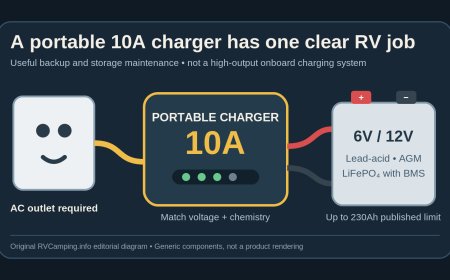
If the manuals direct cable removal, shut down all 12-volt equipment and shore power first, and use the stated cable order and safety precautions. If they call for a maintainer, verify that it matches the chemistry and bank voltage. Do not improvise a charging voltage from an article.
Lithium: storage mode and state of charge are product-specific
"Lithium" is not one storage setting. Some packs have a physical power button, a remote switch, a BMS sleep mode or a manufacturer-defined storage state. Some RV disconnect switches leave the inverter, solar controller or safety equipment connected.
Trojan says its OnePack lithium battery can be stored for up to six months in storage mode above 25% state of charge, while temperatures above 77°F (25°C) can shorten that period. The same page says charging is temporarily disabled above 113°F (45°C) for that product.[3] Those are useful examples of heat sensitivity, not settings to copy to another brand. Look up the storage state of charge, wake/sleep procedure, inspection interval and charging-temperature window for the battery actually installed.
Do not forget the chassis battery
A coach-battery disconnect may do nothing to the engine-starting battery. Chassis computers, keyless entry and other standby loads can continue drawing power. Use the chassis manual's storage procedure and any RV-maker instructions that modify it. The 2026 Solis manual, for example, recommends disconnecting its chassis battery when the motorhome will be unoccupied for two weeks or more.[1]
Before walking away, record the date, measured state of charge or rested voltage if the manual uses it, which disconnects are off, whether solar remains connected and the next inspection date. A photo of switch positions is more useful than memory three weeks later.
Propane: shut off supply, but respect the system boundary
Turn off propane appliances before closing the supply. Then use the shutoff identified in the RV manual, whether that is a cylinder service valve, a permanently mounted tank valve or a manufacturer-installed remote shutoff. The 2026 Solis storage procedure begins by turning off its propane tank, and its propane section says to turn the supply valve off when the system is not in use.[1]
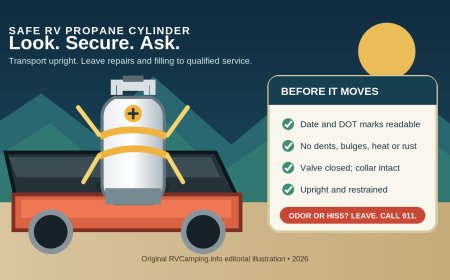
Stop there unless the manual specifically assigns another owner task. Do not loosen fittings, remove a regulator cover, bypass a solenoid, disconnect a permanently mounted tank or try to prove a leak with a flame. Valve, regulator, piping and appliance service belong to a qualified propane technician.
The detector boundary matters too. Isolating a battery may disable the propane alarm. That does not make battery isolation wrong; it means the RV should be unoccupied, the propane supply should be off as directed, and nobody should enter expecting an unpowered alarm to protect them. On return, restore the alarm's power and test it according to its manual before opening propane.
If you smell propane, hear hissing or find tank, cylinder, regulator or line damage, keep ignition sources and electrical switches out of the response. Leave the area, contact the storage operator or emergency services as conditions require, and have the system inspected before use. Do not continue with a routine restart checklist.
Leave the refrigerator clean, dry and safely ajar
A closed, damp refrigerator can turn one forgotten spill into a hard-to-remove odor. The sequence is simple in concept: switch it off using its manual, remove food and ice, defrost without sharp tools or forced heat, clean approved surfaces, wipe everything dry, empty the drain or drip components the manual identifies, and secure the doors in the maker's storage position.
Dometic's operating manual for several DM-series absorption refrigerators says to defrost and clean the refrigerator, then place the doors in the airing position. For the listed models, its airing card keeps the doors latched but ajar during storage.[4] Use your refrigerator's latch or storage device. A loose towel or block that can fall out may let the door close, while a wide-open door can invite pests or create an entrapment hazard.
Check the freezer, ice bin, produce drawers, door pockets and exterior access area. Dry the door seal folds. Do not assume a box of baking soda compensates for moisture or food residue. If the refrigerator will remain powered, that is no longer a drying procedure; follow its unattended-operation instructions and confirm a reliable energy source instead.
Make a heat-sensitive-item sweep
Treat the RV interior as a parked vehicle, not a pantry. Remove anything whose label gives a storage-temperature range that the coach may exceed. The sweep should include:
- medicines, insulin, test strips and medical devices;
- aerosol cans, pressurized cartridges and disposable lighters;
- loose lithium-ion batteries, power banks and battery-powered tools;
- sunscreen, cosmetics, adhesives, sealants and cleaning chemicals;
- candles, crayons and wax products;
- food, pet food, beverages and cooking oils;
- electronics, cameras, removable navigation units and data drives; and
- valuables, keys, documents and items attractive to thieves.
Read product labels rather than relying on category alone. FDA advises following labeled storage instructions for medicine and warns that excessive heat can reduce or destroy a medicine's effectiveness.[5] If a medicine or medical device may have exceeded its labeled range, ask a pharmacist, health professional or manufacturer whether it can still be used.
Also remove trash, damp towels, bedding that is not fully dry and anything with food residue. Open clean cabinet doors only if they can be secured against swinging and the RV manual permits it. Close blinds or shades in the configuration their maker recommends; some materials can be damaged by prolonged heat when tightly closed against glass.
Ventilation versus security: choose the failure you can control
Cracking a window may reduce stale air and moisture under the right conditions. It may also admit wind-driven rain, dust, insects and a pry tool. A powered roof fan can flatten the same battery bank you meant to protect. An open roof vent can be damaged by weather or violate storage-facility rules.
The 2026 Solis manual illustrates the tension. Its furniture-care section suggests opening several windows on dry days to move humid air out, preferably during periodic visits, while its storage-preparation checklist says to close all windows and roof vents.[1] That is a strong reason not to turn "crack the windows" into universal advice.
For an unattended outdoor lot, the conservative default is to close and lock exterior openings as the RV manual directs, dry the interior before storage, repair leaks and inspect periodically. Consider passive ventilation only when the exact vent is rated for the position, has appropriate rain and insect protection, the facility allows it, and the security tradeoff is acceptable. Do not leave an ordinary window unlatched just to chase a small temperature reduction.
Shade or covered storage can reduce solar loading, but inspect roof clearance and facility terms. Never use a cover that blocks a required appliance or battery vent, traps moisture, abrades the finish or conflicts with the cover and RV manuals.
The last five-minute walkaround
Work from the roofline down and use the same order every time:
- Remove food, trash, medicines, pressurized products, loose batteries, electronics and valuables.
- Switch off and dry the refrigerator; secure its doors in the specified airing position.
- Turn off water pump, water heater, furnace and other appliances according to their manuals.
- Close the propane supply at the manual-specified boundary; do not disturb system fittings.
- Put house and chassis batteries into their separate manufacturer-specified storage states.
- Record charge readings, switch positions and the next battery inspection date.
- Check for plumbing, roof, window and compartment leaks; remove damp material.
- Set approved ventilation or close and lock all openings, based on the manual and storage site.
- Lock cab, entry and baggage doors; account for every key.
- Photograph the interior, exterior, odometer, battery monitor and control panels.
Leave a dated storage card near the entry with the propane state, battery state, whether shore or solar charging is active, any open drain or valve, and the restart tasks that must happen before occupancy.
Return-to-service checklist
Do the restart in daylight with time to stop if something is wrong.
- Walk around before unlocking. Look for leaks, animal nests, damaged wiring, tire problems, disturbed covers and signs of forced entry.
- Air out the RV. Inspect inside for water intrusion, mold, pests, heat damage and odors.
- Check the house and chassis batteries before reconnecting or charging. Follow their manuals if voltage, state of charge, temperature or physical condition is outside limits.
- Restore battery power in the specified sequence. Confirm expected monitor readings and check for faults.
- Test smoke, carbon-monoxide and propane alarms according to their own instructions before occupancy or fuel use. Winnebago's model-specific return procedure also calls for airing out the motorhome and checking the LP system for leaks.[1]
- Inspect the propane compartment and appliance vents for obstruction or damage. If the manual calls for a leak check or professional inspection, complete it before opening the supply.
- Open propane only when the system passes its required checks. Light or start each appliance by its manual, never by a shortcut.
- Inspect the refrigerator's exterior vents, drain and interior. Remove the airing device, close the doors, start the unit and verify cooling before loading food. The 2026 Solis return procedure specifically calls for checking appliance vents and confirming refrigerator cooling.[1]
- Restore the plumbing system as its storage procedure requires. Close drains, add water, run the pump and inspect fittings before leaving it pressurized.
- Check lights, brakes, tire pressure when cold, wheel and underbody condition, fluid levels and chassis-service items before driving.
A stored RV should not wake up by habit. It should wake up by documentation: exact manuals, recorded switch states and a deliberate inspection. That takes longer than flipping the battery disconnect, but it is much faster than diagnosing a flat bank, propane fault or refrigerator odor on departure morning.
Source note: This original RVCamping.info guide uses a current 2026 RV operator manual plus primary component-manufacturer and FDA guidance to show why storage procedures vary. The manuals and labels for the exact RV, chassis, battery, charger, solar controller, propane system, alarms, refrigerator and stored products control the final procedure.
Sources
- 2026 Winnebago Solis Operator Manual (accessed September 11, 2026)
- Trojan Battery Maintenance (accessed September 11, 2026)
- Trojan Lithium Battery Resources & FAQs (accessed September 11, 2026)
- Dometic Absorption Refrigerator Operating Manual (accessed September 11, 2026)
- FDA: Safe Drug Use After a Natural Disaster (accessed September 11, 2026)
What's Your Reaction?