










Tekonsha P3 90195 review: smooth control, if the cab fit works
Research-based Tekonsha P3 90195 review covering tow-vehicle fit, trailer compatibility, gain and boost setup, diagnostics and mounting tradeoffs.

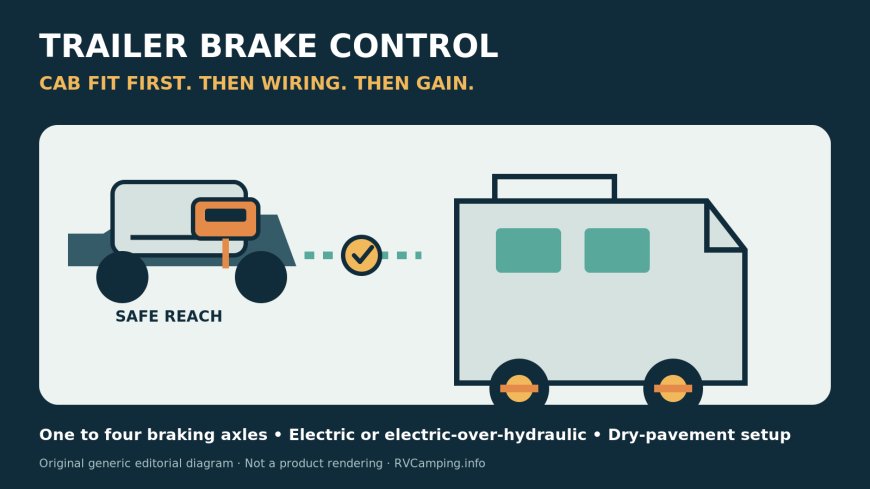
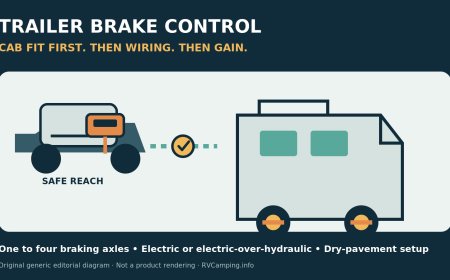
The Tekonsha Prodigy P3 90195 still makes sense for RV owners whose tow vehicle lacks a good integrated brake controller. It is especially appealing if you tow more than one trailer: the P3 can store five sets of preferences, operate electric or electric-over-hydraulic brakes, and control one to four braking axles.[1][2]
Buy it for a tow vehicle with a suitable brake-controller circuit, a working trailer-brake system and a safe place to put a small box where the driver can see it and reach the manual lever.[1][2] Skip it if your truck's integrated controller already works well, if the trailer has no compatible electric or electric-over-hydraulic actuation, or if the only mounting spot crowds a knee airbag, pedal movement or the driver's leg.
That mounting question is the central tradeoff. The P3 gives the driver a readable screen, direct buttons, useful fault messages and a long manual lever. Those controls occupy real space below or on the dash. A hidden-module controller may leave a cleaner cab, but it may also make manual trailer braking less natural to modulate. One owner who regularly used both styles preferred the P3's lever even though the competing controller had the tidier installation.[4]
This is a research-based review. RVCamping.info did not buy, install or road-test this controller.
As an Amazon Associate, RVCamping.info earns from qualifying purchases. If you buy through an Amazon link in this article, we may earn a commission at no additional cost to you.
The exact product reviewed is the Tekonsha Prodigy P3, part 90195, UPC 783192015686. The matching Amazon listing is ASIN B000P17NXQ: check the Tekonsha P3 90195 listing on Amazon.[1][3] Check the seller, model number and package contents before ordering. A vehicle-specific plug-in harness is normally separate, and the correct harness depends on the tow vehicle.[1][2]
An older design that still has a job
Tekonsha's current catalog still lists 90195, while the installation manual linked from that product page carries a February 2012 revision date.[1][2] That age is neither an automatic virtue nor a disqualification. It explains the P3's conventional under-dash form and separate wiring harness. It also means the operating behavior is documented in unusual detail.
The controller uses an inertial sensor to increase trailer-brake output as the tow vehicle decelerates. The power setting caps the output; the three boost levels change how aggressively braking begins. The manual lever lets the driver apply trailer braking without pressing the tow vehicle's brake pedal, but only up to the selected power setting.[1][2]
The color screen earns its space when something is wrong. The troubleshooting menu can show tow-vehicle battery voltage, stoplight-switch voltage, average brake-output voltage and brake current. On-screen warnings cover an open ground, excessive current, a shorted output and loss of trailer connection.[2] Those messages narrow a diagnosis. They do not prove that each magnet, drum, shoe, wire and connector is healthy.
Fit the tow vehicle before choosing a gain number
A P3 purchase has three separate compatibility checks.
First, the trailer must have compatible brakes. Tekonsha rates 90195 for two, four, six or eight brakes, equal to one through four braking axles, and provides electric and hydraulic modes for electric and electric-over-hydraulic systems.[1][2] A surge-brake coupler that works mechanically without an electric-over-hydraulic actuator is a different system.
Second, the tow vehicle needs a proper brake-controller circuit. The included pigtail can be hardwired, or a vehicle-specific Tekonsha harness can connect to a compatible factory tow-package plug.[2] Do not assume that the presence of a seven-way socket guarantees the in-cab plug, required fuse, powered circuit or correct adapter. Check the tow-vehicle owner's manual and Tekonsha's fit guide for the exact year, make, model and factory tow equipment. If the vehicle has sensitive stop-lamp electronics, unclear wiring or an occupied airbag zone, professional installation is the sensible route.
Third, the cab needs a mounting location that works while seated normally. The P3 can rotate through a wide vertical range, but its front must remain horizontal and the unit must be parallel with the direction of travel.[2] The screen and manual lever also need to be visible and reachable without leaning into the steering wheel. A technically correct bracket is still a bad installation if it obstructs a pedal, presses into the driver's leg or intrudes into an airbag deployment path.
That last issue appears in owner use, not just in theory. The long-term RVeeThereYet review praised the controls and diagnostics but identified scarce space in modern dashboards, especially around knee airbags, as the main buying problem.[4] The same review found the display's voltage and current information useful for tracing wiring trouble.[4]
Tekonsha also says not to mount or operate RF-generating devices within 12 inches of the controller.[2] Before drilling, mock up the bracket, sit in every normal driving position, move through both pedals, locate airbags and check the planned location against phones and two-way radios. Mount the bracket to a solid surface only after that dry fit.
The first parking-lot setup matters more than the feature list
The P3 is not ready merely because its screen lights up. Tekonsha starts the power-setting procedure at 6.0, then calls for a test on dry, level pavement at 25 mph using the manual lever. If the trailer wheels lock, power comes down. If braking is weak, power goes up. The target is maximum useful trailer braking just below wheel lock, followed by several low-speed checks with the brake pedal.[2]
The manual also calls for warming the trailer brakes before adjustment and warns that power and boost may need to change with load and road conditions.[2] That is the part owners can miss when a saved profile makes the controller feel set-and-forget. A lightly loaded trailer and the same trailer near its gross weight may not want the same response. Wet, loose or icy pavement changes the margin again.
Boost deserves restraint. B1 starts with about 13 percent of the selected power; B2 and B3 start at about 25 percent, then output rises with sensed deceleration.[2] Tekonsha says boost must not stand in for brake adjustment or repair and should not be used on icy roads.[2] In a Jayco Owners discussion, several P3 users reported that high boost made lighter combinations grabby in stop-and-go traffic, while lower boost or no boost produced smoother stops after the main power setting was tuned.[5] That is owner experience, not a controlled test, but it matches the reason to begin conservatively instead of treating B3 as the "safer" choice.
A useful departure check is short and repeatable: connect the trailer, confirm the P3 recognizes it, inspect the seven-way connection, test the manual lever at very low speed in a safe area, and make a few gentle pedal stops before joining traffic.[2] A "No Trailer Connection" warning can point to a disconnected or corroded connector, an open brake circuit or loss of brake-magnet ground.[2] If the trailer will not brake firmly even at a high power setting, investigate the brakes and wiring rather than continuing to add boost.
Tekonsha's manual says electric drum brakes should be adjusted after their first 200 miles and then at 3,000-mile intervals, or as use and performance require.[2] Follow the axle and trailer manufacturer's current service instructions; the controller cannot compensate for contaminated linings, poor grounds, damaged wiring or brakes that are out of adjustment.
Where the P3 is better than a phone-based portable controller
RVCamping.info's CURT Echo 51180 review covers a different compromise: the Echo plugs into the seven-way connection and moves routine control to a phone. The P3 requires an in-cab installation, but it keeps the display, gain buttons, boost control and proportional manual lever in the driver's physical reach.
For a household that changes trailers, the P3's five stored preference sets are genuinely useful.[1][2] Treat them as starting points, not proof that the current load and brake condition still match the last trip. The profile does not inspect tire grip, connector corrosion, brake temperature or cargo weight.
The diagnostics are another practical advantage over a controller that only reports a generic connection failure. Seeing battery, stoplight, output-voltage and current readings can help an installer separate a tow-vehicle input problem from a trailer-output problem.[2] Still, a dashboard number is not a brake inspection. An intermittent warning, hot connector, weak braking, unexpected lockup or changed stopping feel deserves attention before highway travel.
Who should buy the Tekonsha P3 90195
The P3 fits RV owners who need a proven wired proportional controller, want a real manual lever, tow trailers with different brake settings, and have room for a correct, reachable mount. Its broad vertical mounting range helps, but the horizontal face and fore-aft alignment rules still govern the installation.[2]
It is less compelling in a newer truck with a well-integrated factory controller, in a cab where every safe mounting point is awkward, or for someone who wants a nearly invisible control knob. It is also the wrong answer to weak or poorly maintained trailer brakes. Fix the brake system first.
For the right tow vehicle, 90195's age is part of its appeal: the controls are direct, the setup procedure is explicit, and the fault display tells the driver more than a single status light. The purchase decision turns on the space around the driver's knees and pedals. If the controller can sit solidly, straight, visible and within easy reach, the P3 remains a strong RV-towing choice. If it cannot, choose a controller whose physical installation suits the cab rather than forcing this one into a bad location.
Sources
- Tekonsha Prodigy P3 90195 product page (accessed 2026-10-22)
- Tekonsha Prodigy P3 installation and operation manual (accessed 2026-10-22)
- Amazon listing for Tekonsha 90195 Prodigy P3 (accessed 2026-10-22)
- RVeeThereYet long-term Tekonsha P3 owner review (accessed 2026-10-22)
- Jayco Owners discussion of P3 power and boost tuning (accessed 2026-10-22)
What's Your Reaction?