




Smokemont or Cades Cove: which Smokies RV base still works after fall?
Choose between the Smokies two year-round RV bases by winter loop availability, exact-site fit, dry-camping services, generator rules, and same-side road access.

Smokemont or Cades Cove: which Smokies RV base still works after fall?
By Romana | Operating details checked October 23, 2026

Once the Smokies' seasonal campgrounds shut their gates, the in-park RV choice gets much smaller.[1] Cades Cove and Smokemont are the two frontcountry campgrounds that remain open year-round; the other eight close seasonally.[1] That sounds like a simple two-column comparison. In winter, it is really an approach-road decision.[5][6]
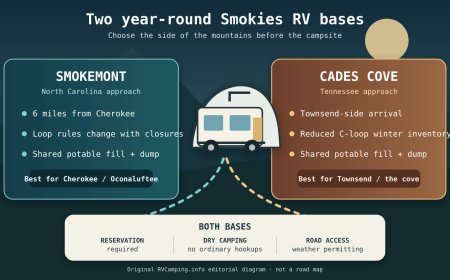
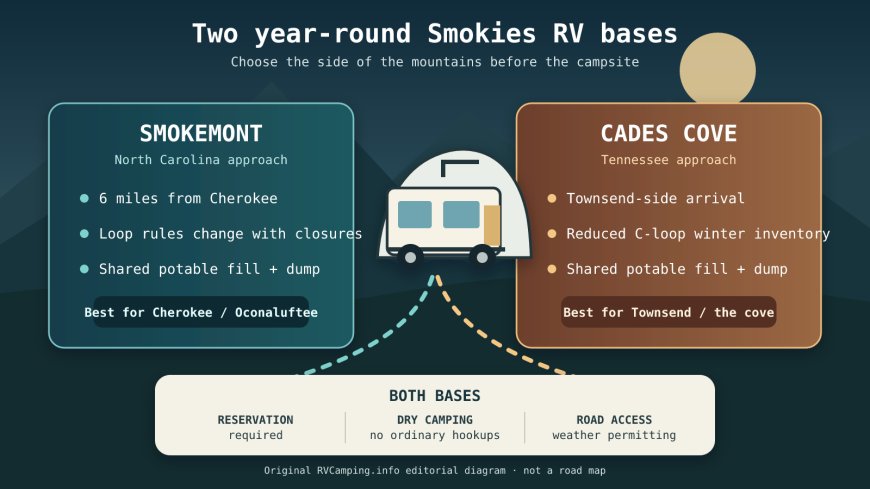
Choose Cades Cove when the trip is built around Townsend, the west side of the park, and the Cades Cove loop.[4] Choose Smokemont when Cherokee and the North Carolina side are the anchor.[3] Neither has ordinary RV hookups.[2][3][4] Both require reservations, both have a dump station with potable water, and both can be affected by winter weather.[2][3]
The weak plan is to book whichever campground shows a green availability button and then cross the park in a motorhome. The stronger plan keeps the RV on the same side of the mountains as its campground and treats Newfound Gap Road as a sightseeing route only when conditions cooperate.
The year-round label comes with less inventory
NPS lists both campgrounds as year-round, and Recreation.gov says reservations are required and may be made up to six months ahead.[1][3] "Open" does not mean that every summer loop, store, or service is operating.[3][4]
Cades Cove states the off-season arrangement plainly: only C1-C12 and C26-C61 remain open, by reservation.[4] That changes both rig fit and generator planning.[4] A roomy site visible in the campground's full inventory is irrelevant if it sits outside the winter section.[4]
Smokemont's booking page also describes loop-dependent generator rules.[3] When D and F are closed, generator use moves into A, B, and C; when D and F are open, A, B, and C are generator-free.[3] The reservation result for the actual dates decides which loop is usable.[3] Do not build a winter electrical plan around a summer loop map.[3]
The campground offices may be staffed only intermittently from November through April.[3][4] Recreation.gov directs campers to keep proof of occupancy available and to complete check-in according to the posted late-arrival procedure.[3][4] Save the confirmation and site number before entering the park, where a weak signal can turn a routine arrival into a search for information.
Rig fit belongs to the site, not the campground name
Both campgrounds accept RVs, trailers, pop-ups and other camping units, but there is no useful campground-wide maximum that replaces the individual listing.[3][4][7] Smokemont site F041, for example, lists a 40-foot maximum for an RV and 32 feet for a trailer, with a 50-foot back-in driveway.[7] Cades Cove site C39, within the numbered C-loop range used off-season, lists a 34-foot maximum vehicle length and a 45-foot driveway.[8]
Those examples are not recommendations and do not promise availability. They show why a general claim such as "Smokemont fits 40-foot RVs" or "Cades Cove fits 34-foot rigs" would be misleading.[7][8] Equipment type, maximum length, driveway length, grade, width, and seasonal loop availability all belong to the exact site record.[7][8]
For a towable, check the trailer against the permitted-equipment field and then account for the tow vehicle.[7][8] The park allows two vehicles per site but only one RV or trailer at an RV site.[2] A long paved pad does not automatically mean the connected truck-and-trailer combination can stay hitched or that slide-outs clear every obstruction.[7][8]
Both are dry-camping bases, even with water nearby
Neither campground supplies normal electric, water, or sewer hookups at the campsite.[2][3][4] NPS says all frontcountry campgrounds have cold running water and flush toilets, while Cades Cove and Smokemont have only limited 5-amp outlets reserved for medical equipment at certain accessible sites.[2] That is not shore power for an RV.[2]
Both campgrounds have dump stations with potable water.[2] The useful distinction is between a shared service point and a hookup:
| Planning item | Smokemont | Cades Cove |
|---|---|---|
| Ordinary site hookups | None | None |
| Dump and potable fill | Shared campground station | Shared campground station |
| Winter reservation | Required | Required; reduced C-loop inventory stated for the off-season |
| Generator hours | 8 a.m.-8 p.m. where the currently open loop permits it | 8 a.m.-8 p.m.; C Loop permits generators after B Loop closes |
| Best arrival side | Cherokee, North Carolina | Townsend, Tennessee |
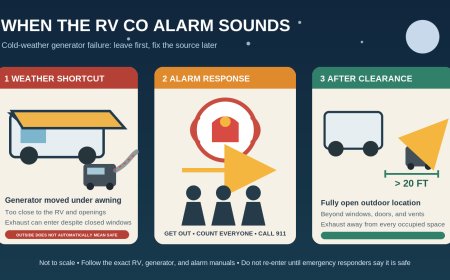
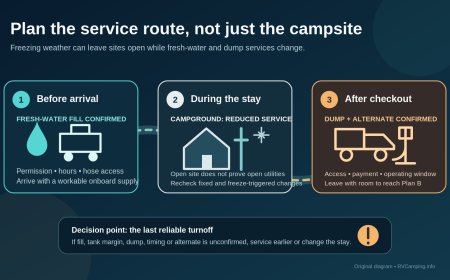
Fill before settling in if breaking camp for a dump-and-fill run would be awkward.[2] Arrive with enough battery and propane margin for a freezing night, and read the exact loop rule before assuming the generator can recover a low battery.[3][4][6] Quiet hours run from 10 p.m. to 6 a.m.; generator use is prohibited from 8 p.m. to 8 a.m.[2][3][4]
This is where Cades Cove becomes easier to read in deep off-season: the listed winter C-loop inventory gains restricted-hour generator use after B closes.[4] Smokemont can work just as well, but its generator zone changes with D and F loop status.[3] A camper who wants silence should make the opposite check and select a currently generator-free area rather than relying on the campground name.
Winter access breaks the tie
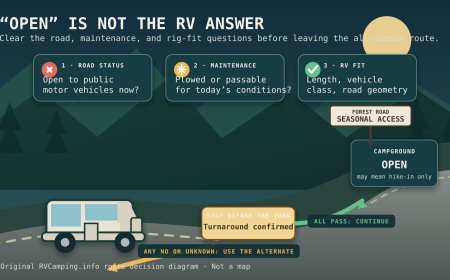
The primary roads named by NPS, including Newfound Gap Road, Little River Road, and Cades Cove Loop Road, stay open year-round only when weather permits.[5] Secondary roads have dated seasonal closures, and several prohibit trailers or motorhomes longer than 25 feet even while open.[5] Those touring roads are not RV shortcuts.
Smokemont sits about six miles north of Cherokee on US 441.[3] Recreation.gov warns that the section of US 441 through the park may close for snow, wind, or other severe conditions, but says other routes to Smokemont are available.[3] For an RV arriving from North Carolina, the practical route is the short Cherokee approach.[3] A Gatlinburg arrival would require the much longer mountain crossing on Newfound Gap Road.[3]
Cades Cove is approached from Townsend on the Tennessee side.[4] That keeps the campground reachable without crossing Newfound Gap, but the final park roads remain weather-dependent.[4][5] The Cades Cove Loop Road itself is open sunrise to sunset, weather permitting.[5] A campground reservation does not guarantee that every scenic drive or secondary-road outing will be open.[5]
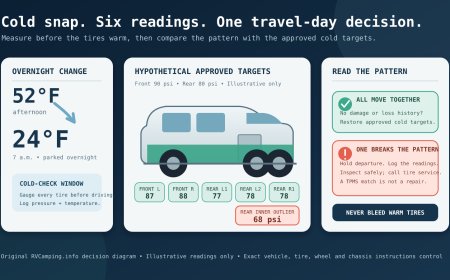
The park's weather page explains why route geography matters.[6] Temperatures can differ by 10 to 20 degrees between the mountain base and top.[6] By November, overnight lows are usually near freezing, and higher elevations can receive snow even when low elevations are warm.[6] A clear campsite is not evidence that the pass is clear.[6]
For a winter travel day, use this order:
- Pick the side of the park that matches the trip's arrival corridor and most important activities.
- Reserve an exact site that permits the RV or trailer type and length for those dates.[7][8]
- Save the reservation, site dimensions, loop generator rule, and campground phone offline.[3][4]
- Fill fresh water and plan the dump stop as shared services, not hookups.[2]
- Check live road and weather status before entering the park, then avoid rerouting a large rig onto secondary roads that prohibit it.[5][6]
Which base still works?
Cades Cove is the better winter base for a Tennessee-side trip centered on Townsend and the cove, especially when its reduced C-loop inventory contains an exact site that fits.[4][8] Smokemont is the better base for Cherokee, Oconaluftee, and a North Carolina arrival.[3] Its proximity to Cherokee also reduces dependence on the high Newfound Gap crossing.[3][5]
There is no facilities winner. Both are reservation-only dry campgrounds with flush toilets, drinking water, and shared dump-and-fill service rather than campsite hookups.[2][3][4] The deciding advantage is avoiding an unnecessary mountain crossing with the RV.
If the itinerary needs both sides of the park, park the RV at the campground that matches the arrival corridor and make the cross-park drive only after checking conditions, preferably in a smaller vehicle.[3][4][5] In late fall and winter, a site that remains open is useful only if the rig fits, the electrical plan matches the active loop, and the approach remains practical in the day's weather.[3][4][6]
Source credit: RVCamping.info reviewed current National Park Service operating, camping, road, and weather pages plus Recreation.gov campground and site records on October 23, 2026. The same-side arrival strategy is original editorial analysis.
Sources
- Seasonal Facility Schedule - National Park Service ↩
- Frontcountry Camping - National Park Service ↩
- Smokemont Campground - Recreation.gov ↩
- Cades Cove Campground - Recreation.gov ↩
- Seasonal Road Schedule - National Park Service ↩
- Weather - National Park Service ↩
- Smokemont site F041 - Recreation.gov ↩
- Cades Cove site C39 - Recreation.gov ↩
What's Your Reaction?