












Test whether the 7-pin connection is charging your trailer battery
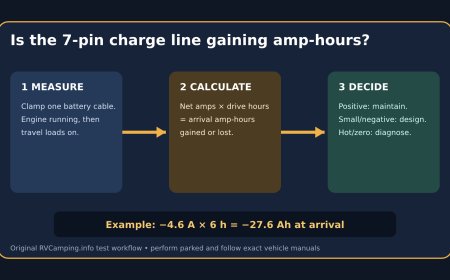
Measure charging current at the trailer battery, subtract travel loads, and decide whether the 7-pin charge line maintains, gains, or loses amp-hours.
Test whether the 7-pin connection is charging your trailer battery
Seeing 12 volts at a tow vehicle’s socket does not prove the trailer battery gains energy on the road. The result that matters is current at the trailer battery after the refrigerator, breakaway charger, lights, and other travel loads take their share.
Confirm the circuit before judging it
Charge-line behavior varies by vehicle. One Ford manual lists a 30-amp trailer-tow battery-charge relay “if equipped,” plus a separate relay arrangement on vehicles without the factory trailer-brake controller.[2] A Ram body-builder instruction warns that its battery line can charge a trailer battery but may also discharge the truck battery with the engine off because an isolator is not supplied.[1]
Start with the exact tow-vehicle owner’s manual and fuse chart. Identify whether the auxiliary pin is supposed to be live only with the engine running, requires a fuse or relay, or remains live after shutdown. Do not copy another truck’s pinout, fuse size, or relay behavior.
Inspect the plug and socket for heat damage, looseness, dirt, or corrosion. If anything is burned, melted, or intermittent, stop. Connector and charging-circuit repairs belong with a qualified technician; a larger fuse is not a diagnostic tool.
Run a parked current test
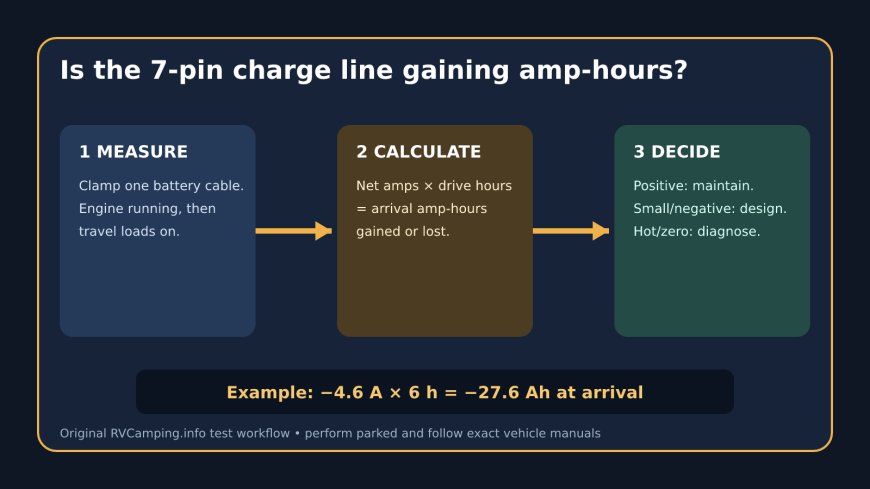
Use a DC clamp meter that can resolve low current. Clamp around one battery cable, not the whole paired cable. Follow the meter and battery manuals, keep clear of moving engine parts, ventilate lead-acid battery compartments, and do not disconnect a battery while the engine is running.
- Fully connect the trailer, chock it, set both parking brakes, and switch off nonessential trailer loads.
- With the tow vehicle off, note trailer-battery voltage only as a baseline. Voltage by itself is not the verdict.
- Start the vehicle outdoors. After its charging system settles, measure current at the trailer battery. Mark current flowing into the battery as positive.
- Switch on each load that will operate in transit, one at a time. Record the new battery current.
- Shut the engine off and watch whether current reverses. If the trailer begins drawing from the starting battery, unplug according to the vehicle instructions and have the isolation strategy checked.[1]
If meter direction is unclear, reverse the clamp orientation and confirm the sign changes. Do not infer current by comparing two handheld voltage readings taken minutes apart.
Convert the reading into an arrival estimate
Use the stabilized net current, not a connector’s fuse rating:
net amp-hours = net battery current × driving hours
In a worked example, the battery receives 5.2 amps with travel loads off. A 12-volt refrigerator mode and controls together change the reading to negative 4.6 amps. Over six hours:
-4.6 A × 6 h = -27.6 Ah
That setup arrives about 28 amp-hours lower than it left, despite an active charge line. It is a loss system for that travel load.
Now suppose a correctly specified DC-to-DC installation delivers 11 amps at the auxiliary battery while the same 9.8-amp load operates:
(11.0 A - 9.8 A) × 6 h = +7.2 Ah
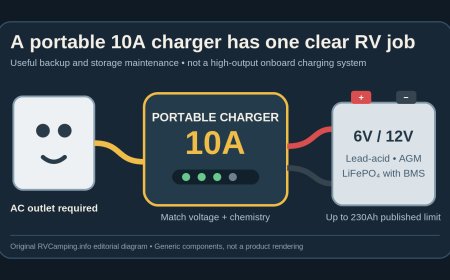
REDARC lists one trailer charger as 12-amp input-current-limited with an 11-amp maximum output on a 12-volt vehicle.[3] Those figures belong only to that model and installation. Charging tapers, temperature, battery acceptance, and vehicle operation can reduce the day’s actual gain.
Choose maintain, upgrade, or repair
A positive net reading large enough for the planned drive is a maintain result. Record the test with the battery state, loads, engine speed, and drive time. Recheck after wiring, battery, refrigerator, or tow-vehicle changes.
A small positive or negative reading with a sound circuit is a capacity problem, not proof of failure. A DC-to-DC charger may be appropriate, but it must match the alternator strategy, battery chemistry, cable run, fusing, and allowed charge current. Victron notes that smart-alternator voltage can vary from roughly 12.5 to 15 volts and that cable voltage drop affects charger shutdown settings.[4] That is installation-design work, not a reason to twist a threshold until charging stays on.
Zero current, a hot connector, unstable readings, or a missing factory feed calls for diagnosis. The decision tool is simple: measure net current under the real travel load, multiply by hours, then compare the result with the amp-hours you can afford to lose before arrival.
Source credit: RVCamping.info reviewed the linked vehicle and charger manufacturer materials on 2026-10-26. The parked test and net-amp-hour worksheet are original editorial analysis.
Sources
- Ram trailer tow/brake jumper instruction card — Accessed 2026-10-26.
- Ford fuse specification chart — Accessed 2026-10-26.
- REDARC BCDC Trailer charger specifications — Accessed 2026-10-26.
- Victron Orion-Tr Smart automatic engine shutdown detection — Accessed 2026-10-26.
What's Your Reaction?