



Half-cook now, grill later? Not at an RV campsite
A partially cooked campsite meal is safe only as one continuous cook. Use this ready-gate and backward schedule before moving meat from microwave to grill.
Half-cook now, grill later? Not at an RV campsite
By Romana | Information checked 2026-10-27 UTC | Cooking
Partially cooking chicken or burgers in the RV microwave can shorten the time over a smoky grill. It cannot create a make-ahead meal. USDA and FDA allow this two-appliance method only as one continuous cook: the food moves immediately from the first heat source to a grill that is already hot.[1][2][3]

The first appliance may start the cook. It may not become a morning prep step. Original RVCamping.info workflow.
That distinction matters at camp, where “I’ll finish it when the fire catches” can turn into a long hunt for charcoal, a propane problem or a conversation across the loop. If the grill is not ready, raw meat stays cold. The microwave does not start.
Treat both appliances as one cooking line
USDA rejects storage between the partial cook and the finish. If a microwave starts the cook, the food must transfer to the grill or conventional oven immediately.[1] Its grilling guidance makes the order just as plain: preheat the grill first, then move partially precooked food straight onto it. Partially grilling meat or poultry and finishing later is also out.[2]
FDA’s outdoor-food guidance uses the same boundary. Partial cooking before grilling is safe only when the food can go onto the hot grill immediately.[3]
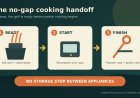
“Immediately” is not a published allowance of five, ten or twenty minutes. There is no federal grace-period number to calculate. The practical timing tool is therefore a gate, not a countdown:
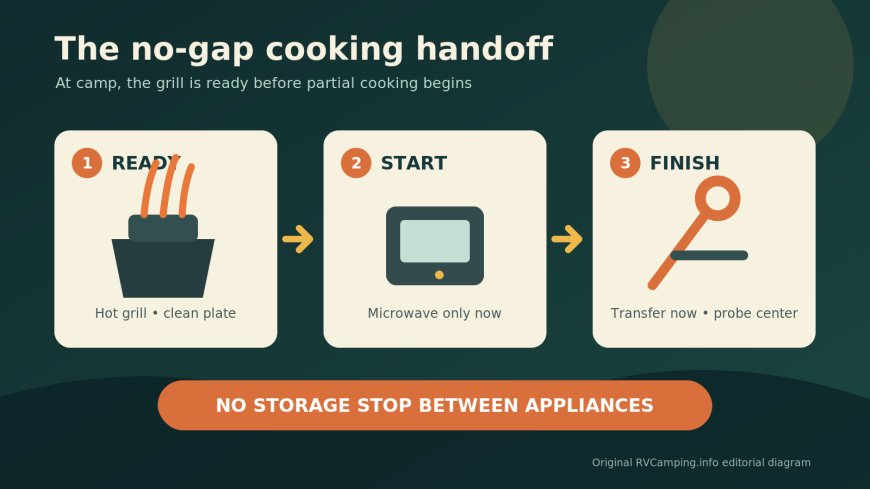
- Grill ready: fuel is connected or coals are ready, the grate is clean, and the cooking zone is hot.
- Finish tools ready: a clean plate, clean tongs and an instant-read thermometer are beside the grill.
- Microwave starts: only after steps 1 and 2 pass.
- Handoff: carry the food directly to the grill and continue cooking.
- Finish: use the thermometer endpoint for the actual food, then move it to the clean plate.[1][2]
This order solves the campsite failure that matters: the second heat source cannot still be “almost ready” after the first one has warmed the meat.
Build the schedule backward from dinner
The useful calculation is a readiness time, not a holding time. Work backward from the planned serving time:
grill-ready deadline = serving time - estimated grill finish - thermometer/rest allowance - microwave stage
Suppose dinner is planned for 6:30 p.m. Your recipe estimates 12 minutes on the grill after a 4-minute microwave stage, and you reserve 5 minutes for temperature checks and any required rest. The grill must be ready before 6:09 p.m.:
6:30 - 12 minutes - 5 minutes - 4 minutes = 6:09 p.m.
The arithmetic only protects the sequence. It does not predict doneness, grant 21 minutes outside temperature control or replace recipe instructions. Grill output, wind, food thickness and portion count can all move the finish. If the grate is not ready at 6:09, delay the microwave and accept a later dinner.
For a charcoal grill, “ready” means the coals have reached the recipe’s intended cooking condition, not that a match has been struck. For propane, it means the grill has lit and preheated rather than merely having a cylinder connected. The first appliance is the last thing to start.
Do not make a campsite interruption into storage
If shore power trips during the microwave step, the grill will not light, or weather makes the outdoor appliance unusable, do not put the partially cooked meat in the refrigerator to finish later. USDA explicitly warns against that storage step because bacteria may not have been destroyed.[1]
The safest practical branch is to keep cooking now on a working appliance that can take the food all the way to its safe internal temperature. If no cooking method is available, the planned partial-cook workflow has failed; do not save the partly cooked meat for tomorrow. This article cannot assign a universal discard minute because the agencies do not publish an “immediate” grace period for this handoff.
A simpler alternative avoids the handoff entirely: keep the meat at 40°F or below, then cook it from raw on one working appliance when dinner starts. FDA says the cooler must hold cold food at no more than 40°F before it is needed.[3]
The thermometer decides when the continuous cook ends
Fast browning is not proof that grilled meat is safe. USDA lists 165°F for all poultry, including ground poultry; 160°F for ground beef, pork, veal and lamb; and 145°F followed by a three-minute rest for whole cuts of beef, pork, veal and lamb.[2]
Check the thickest area and more than one piece when sizes vary. Food that spent a few minutes in the microwave can have hot and cold areas, so the first reading is not automatically representative. USDA advises stirring, rotating or turning microwave-cooked food where possible to reduce cold spots, following the appliance or recipe instructions, and using a food thermometer.[1]
Keep raw-contact equipment on the raw side of the line. The tongs or plate that carried uncooked or partly cooked meat do not become the serving tools unless washed in hot, soapy water. USDA tells grill cooks to use a clean platter and utensils for cooked food.[2]
Put one card by the microwave
Write this on an index card before the trip:
HOT GRILL + CLEAN PLATE + THERMOMETER first.
Start partial cooking only when all three are ready.
Transfer immediately. Finish now. Check the center.
This workflow is narrow on purpose. It does not tell you how many microwave minutes a particular cut needs, because appliance wattage, food mass and the recipe determine that. It answers the decision that comes before the timer: unless the second appliance is hot and the finish station is ready, do not begin a partial cook.
Source credit: RVCamping.info reviewed the linked USDA and FDA guidance on 2026-10-27. USDA pages were read through dated Wayback snapshots after the live pages returned 403. The ready-gate workflow, backward schedule and 6:09 p.m. example are original editorial synthesis.
Sources
- Cooking with Microwave Ovens — USDA Food Safety and Inspection Service — immediate transfer, microwave technique and thermometer guidance; live page blocked automated retrieval, evidence read in the October 4, 2026 Wayback snapshot.
- Grilling and Food Safety — USDA Food Safety and Inspection Service — preheated-grill sequence, minimum temperatures and clean serving equipment; live page blocked automated retrieval, evidence read in the October 4, 2026 Wayback snapshot.
- Handling Food Safely While Eating Outdoors — U.S. Food and Drug Administration — outdoor partial-cooking and cold-holding guidance; live page accessed October 27, 2026.
What's Your Reaction?