







Cades Cove vs. Elkmont vs. Smokemont: Which Smokies Campground Fits Your RV?
A rig-first comparison of three popular Great Smoky Mountains campgrounds, with published length limits, dry-camping utilities, generator constraints and approach notes.

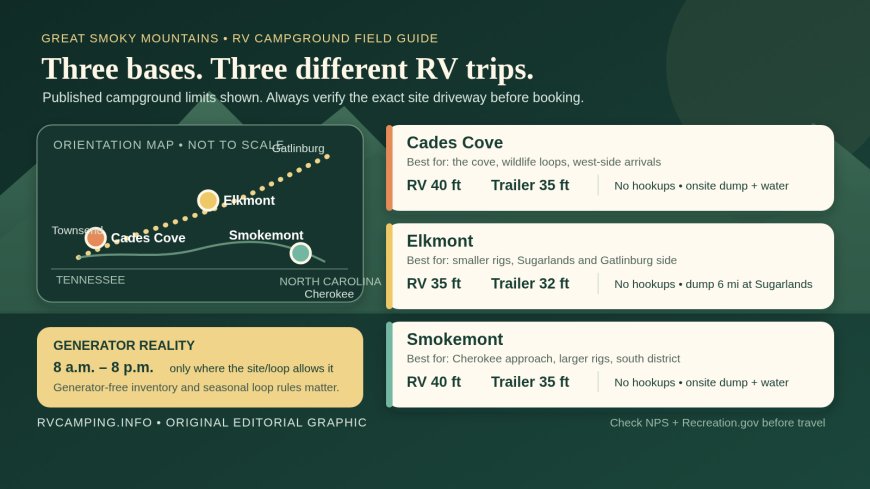
Three of the best-known campgrounds in Great Smoky Mountains National Park ask RV travelers to make the same trade: a wooded campsite inside the park, but no normal electric, water or sewer connection at the pad. The useful differences show up in rig length, dump access, generator zoning and which side of the mountains you want to call home.
Cades Cove is the destination-first choice. Elkmont suits smaller rigs and campers who want the Gatlinburg side of the park. Smokemont is the practical North Carolina base, especially for a longer motorhome or trailer that fits one of its RV sites.
The quick comparison
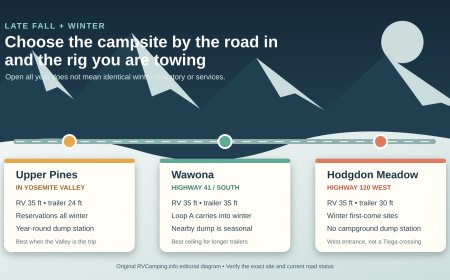
| Campground | Published campground maximum | Hookups at the site | Dump and water plan | Generator plan | Best fit |
|---|---|---|---|---|---|
| Cades Cove | RV 40 ft; trailer 35 ft | None; limited 5-amp medical outlets are not camping hookups | Dump station with potable water at campground | Generator use only 8 a.m.–8 p.m.; confirm a generator-permitted site | Wildlife and historic-cove days, west-side arrivals, self-contained rigs |
| Elkmont | RV 35 ft; trailer 32 ft | None; limited 5-amp medical outlets are not camping hookups | No campground dump; use Sugarlands, about 6 miles away | Generator use only 8 a.m.–8 p.m.; many listings are generator-free, so filter carefully | Smaller rigs, Gatlinburg/Sugarlands access, creek-and-trail camping |
| Smokemont | RV 40 ft; trailer 35 ft | None; limited 5-amp medical outlets are not camping hookups | Dump station with potable water at campground | 8 a.m.–8 p.m. in permitted loops; loop rules change when seasonal loops close | Cherokee/Oconaluftee trips, larger rigs, an onsite dump |
Those length figures are campground limits, not promises that every driveway will fit. Cades Cove lists a 40-foot RV maximum and a 35-foot trailer maximum; its campground roads and site driveways are paved.[2] Elkmont drops those limits to 35 feet for an RV and 32 feet for a trailer.[3] Smokemont returns to 40 feet for RVs and 35 feet for trailers, also on paved campground roads and driveways.[4]
The reservation page for the exact site is the final check. Read the driveway length, site type and generator designation before paying. A 35-foot trailer limit does not mean a 35-foot trailer plus tow vehicle will settle comfortably into every site.
What all three have in common
All three have drinking water, flush toilets and RV-capable campsites, but no showers and no standard hookups.[1] The park notes that Cades Cove, Elkmont and Smokemont have 5-amp outlets for medical equipment only.[1] Do not build a power budget around those outlets as if they were 30- or 50-amp pedestals.
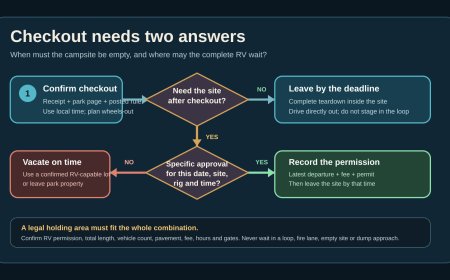
The shared park generator window is 8 a.m. to 8 p.m.; general quiet hours run from 10 p.m. to 6 a.m.[1] Generator-free loops and seasonal loop changes make the site label just as important as the clock. If battery charging is essential, choose inventory explicitly marked for generator use rather than assuming every nonelectric site allows it.
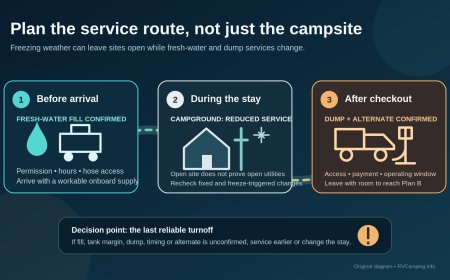
Potable water at a campground means you can fill containers and use the developed water system. It does not mean a hose connection waits beside the RV. Arrive with a workable tank strategy, then use the designated fill and dump facilities without blocking campground traffic.
Cades Cove: camp for the cove itself
Cades Cove works best when the 11-mile loop road, historic buildings and early or late wildlife outings are the center of the trip. The campground is open year-round, has drinking water and flush toilets, and has no hookups or showers.[1][2] Its onsite dump station with potable water makes a several-night dry-camping stay easier than it would be at Elkmont.[1]
The campground's 40-foot motorhome and 35-foot trailer limits put it in the same broad rig-size class as Smokemont.[2] Still, book by site dimensions. The safest habit is to compare the driveway measurement with the entire parked combination, including any vehicle that must remain at the site.
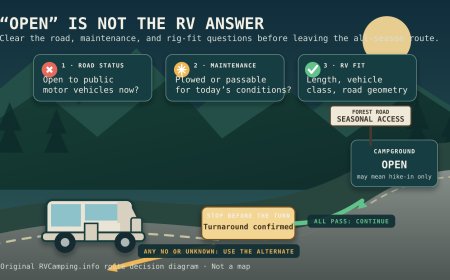
For towing, the sensible western approach is through Townsend rather than using the campground as the end of a long cross-park sightseeing drive. Mountain roads are a poor place to discover that a route looked short only on the map. Check current park road conditions before departure, arrive in daylight, and save the Cades Cove Loop for the tow vehicle after the trailer is unhitched.
Generator users need to pay close attention to the loop attached to the reservation. The park-wide 8 a.m.–8 p.m. window still applies, but a generator-free designation means the generator stays off.[1] A quiet-loop site is a feature for solar-equipped campers and anyone who would rather hear the campground than a charging cycle.
Choose Cades Cove if you can dry camp, want an onsite dump and expect to spend much of the trip in the cove. Skip it if most of your plans sit around Gatlinburg, Newfound Gap or the North Carolina side; the daily driving will eat into the advantage of camping in the park.
Check Cades Cove reservations and individual site details on Recreation.gov.
Elkmont: the smaller-rig, north-district base
Elkmont is the closest of the three to Sugarlands Visitor Center and is the natural choice for travelers building a trip around the Gatlinburg side of the park.[3] It has drinking water, flush toilets and no hookups or showers.[1][3]
Its published limits are the tightest in this comparison: 35 feet for an RV and 32 feet for a trailer.[3] That alone does not make Elkmont difficult, but it does remove some longer fifth wheels, travel trailers and motorhomes before the site search begins. Recreation.gov also warns in the facility description that driveway length or slope makes some sites better for tents, so the individual listing deserves more than a glance.
Elkmont has no dump station at the campground. The NPS places the nearest dump across from Sugarlands Visitor Center, about six miles away, and the station has potable water.[1][3] Dump before entering when practical. That avoids breaking camp later for a utility run, especially if the gray tank is the limiting factor.
Approach from the Sugarlands/Gatlinburg side with time to spare. The last segment is paved, but darkness, rain and a campsite with a short or sloped driveway make a poor combination. A compact motorhome, camper van or modest travel trailer will have more choices and less backing drama than a rig near the published ceiling.
Elkmont fits campers who value trail access, river sounds and proximity to Sugarlands more than onsite dumping. It is the weakest of the three for a long rig with small holding tanks. It may be the strongest for a quiet, generator-free trip if the battery and solar setup can carry the load.
Check Elkmont reservations, driveway measurements and generator labels on Recreation.gov.
Smokemont: easiest from Cherokee, friendliest to RV-focused planning
Of these three campgrounds, Smokemont sits nearest Oconaluftee Visitor Center on the park's south side. NPS lists 44 RV-only sites, no electric hookups, and an onsite dump station available year-round.[1][4] The 40-foot RV and 35-foot trailer limits match Cades Cove.[4]
That combination makes Smokemont the cleanest fit for travelers approaching through Cherokee who want fewer utility errands. Fill and dump at the campground, then treat the campsite itself as dry camping. Cherokee is also the easier supply side for many North Carolina arrivals.
Travelers coming from Gatlinburg need to account for the US 441 crossing over Newfound Gap. Recreation.gov warns that this section may close for snow, wind or other severe conditions and says other routes to Smokemont are available.[5] Check the park's current road status before towing. If conditions are uncertain, the lower approach through Cherokee can be the less stressful choice even when it adds miles.
Generator rules at Smokemont deserve a fresh read for the booked dates. Recreation.gov states that use is limited to 8 a.m.–8 p.m. and that permission in A, B and C loops changes depending on whether D and F loops are open; it also lists a 60-decibel ceiling.[5] Book the loop rule you can live with rather than hoping the seasonal configuration works in your favor.
Smokemont is the best match here for a larger self-contained rig arriving from North Carolina, a traveler who wants an onsite dump, or anyone concentrating on Oconaluftee and the Cherokee side. It is less appealing if every day starts with a drive toward Cades Cove.
Check Smokemont reservations, loop status and site dimensions on Recreation.gov.
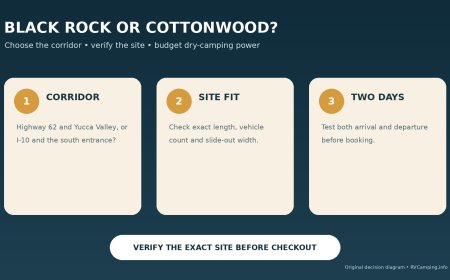
Pick by constraint, not reputation
Start with the hard limit. A trailer longer than 32 feet removes Elkmont under the published campground maximum, while Cades Cove and Smokemont allow trailers up to 35 feet.[2][3][4] A motorhome over 35 feet points the same way, provided the exact site fits.
Next, decide whether an onsite dump matters. Cades Cove and Smokemont have one; Elkmont sends you to Sugarlands.[1] Then choose the park district that reduces daily driving. West-side cove plans favor Cades Cove, Gatlinburg and Sugarlands plans favor Elkmont, and Cherokee or Oconaluftee plans favor Smokemont.
Power comes last because none of the three supplies normal campsite hookups. Match the reservation's generator designation to your batteries, solar, medical needs and expected weather. A generator-permitted site is useful only during the permitted hours; a generator-free site is a poor surprise if the rig depends on daily charging.
Do not use this comparison as an availability report. Operating dates, loop openings, road conditions and site inventory can change. Recheck the official NPS page and the linked Recreation.gov listing before reserving and again before leaving home.
Source credit: RVCamping.info reviewed the National Park Service's current Great Smoky Mountains frontcountry camping page and current NPS pages for Cades Cove, Elkmont and Smokemont, plus the official Recreation.gov Smokemont listing. The comparison, rig-planning recommendations and original graphic are RVCamping.info editorial work.
Sources
[1] Frontcountry Camping - Great Smoky Mountains National Park
[2] Cades Cove Campground - Great Smoky Mountains National Park
[3] Elkmont Campground - Great Smoky Mountains National Park
[4] Smokemont Campground - Great Smoky Mountains National Park
[5] Smokemont Campground, Great Smoky Mountains National Park - Recreation.gov
What's Your Reaction?