




British Columbia winter-tire rules for RVs: plan the route before the border
Use a route-level matrix to find where British Columbia's winter-tire rule starts, which date applies, and what changes for a towable RV.

British Columbia winter-tire rules for RVs: plan the route before the border
By Romana
A legal tire in Vancouver can become the wrong tire a few kilometres into an RV trip. British Columbia exempts many roads around metropolitan Vancouver and southeast Vancouver Island from its seasonal winter-tire requirement, but most highways beyond those coastal pockets are designated routes. The useful planning unit is therefore not the province or even the destination. It is the first signed highway segment on the route.
Source credit: This route-and-equipment model was developed from current Province of British Columbia transportation rules and the province's South Coast designation map.
The border check is not the decision point
British Columbia's designated-route season starts October 1. Most signed routes keep the requirement through April 30; selected routes outside mountain-pass or high-snowfall areas end March 31. The posted regulatory sign controls, and the province can restrict travel at other times when conditions warrant it.[1]
That creates an easy trap for an RV entering at a coastal border crossing. A driver may see bare pavement around Vancouver and assume the same equipment is legal for a run toward Whistler, the Interior or central Vancouver Island. It is not a safe assumption. The province exempts many roads around Vancouver and the southeastern portion of Vancouver Island, while specifically naming the Malahat as a South Coast location where winter tires are needed.[1]
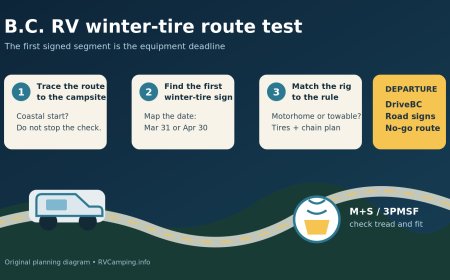
Use the border as a paperwork stop. Use the first designated segment as the equipment deadline.
A four-case route matrix
| Planned movement | Legal planning assumption | Equipment decision before departure |
|---|---|---|
| Stay entirely inside the coastal non-designated area | A provincial winter-tire sign may not apply, but municipal or private-road rules still can | Read the South Coast map and check every road beyond the provincial highway network |
| Leave the Lower Mainland or southeastern Vancouver Island | Expect a designated segment on most highway routes | Treat compliant tires as required unless the official map and roadside signs prove otherwise |
| Travel after March 31 | Some designations end; others continue through April 30 | Trace the exact route on the official regional map instead of using one province-wide end date |
| Tow a trailer or fifth-wheel | The tow vehicle and trailer need separate decisions | Check the drive axle markings, tread, chain fit and trailer-chain plan before crossing onto the signed segment |
This matrix is deliberately conservative. It prevents a route planner from treating a coastal exemption as permission for the whole itinerary. It also avoids the opposite mistake: claiming every road in British Columbia has the same rule.[1][5]
Motorhome and towable are not the same equipment problem
The province says the RV symbol on its tire-and-chain sign covers all classes of recreational vehicles, including units that resemble commercial buses. Its minimum stated RV tire requirement is M+S, while it recommends carrying chains or other traction devices for severe conditions.[2]
For a fifth-wheel or travel trailer, the official guidance becomes more specific. It calls for M+S or three-peak mountain snowflake tires on the towing vehicle's driven axle, plus trailer-tire chains carried for use against slippage on banked curves.[2] That is not the same as saying every trailer tire must wear a chain at all times. It means the towable setup needs a chain plan that a motorhome-only checklist could miss.
For a standard passenger vehicle, a tire counts as legal winter equipment when it has an M+S or three-peak mountain snowflake marking and at least 3.5 millimetres of tread depth. The province recommends the mountain-snowflake type for cold weather and severe winter conditions because M+S is the legal floor, not an equal-performance promise.[3]
For an RV trip, record four things before departure:
- the symbols on the driven tires;
- the measured tread depth at several points across each tire;
- which axle the chain manufacturer permits you to chain; and
- whether the chains physically clear suspension, brake and body components on the exact chassis.
The first two answer British Columbia's basic route rule. The last two answer whether the equipment can actually be used without damaging the RV. Follow the chassis and tire manuals when they are more restrictive.
The March 31 / April 30 split needs a map, not a memory
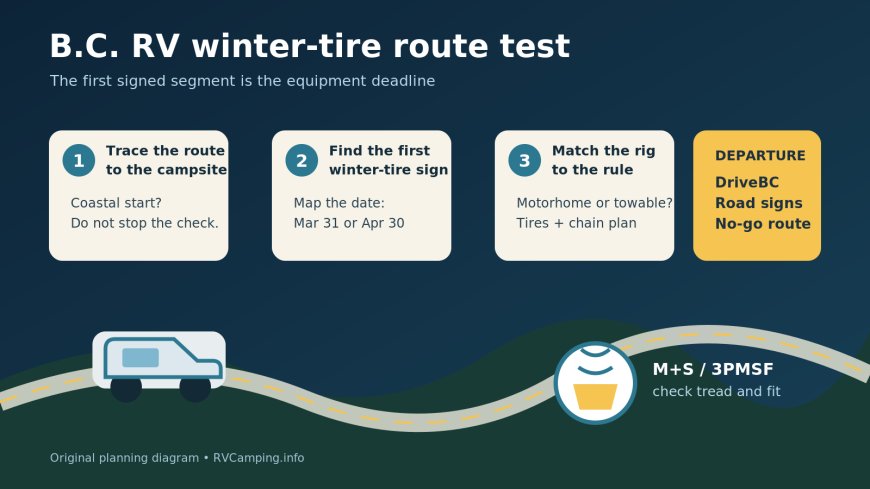
The official South Coast map uses separate route colors for October 1–March 31 and October 1–April 30 designations.[5] A trip on April 10 can therefore cross from an expired designation into an active one without crossing a provincial border. The date alone does not settle the question.
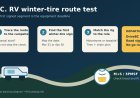
A workable pre-trip method takes about ten minutes:
- Plot the whole RV route, including the campground's final approach.
- Open the province's regional winter-tire map and mark each designated segment.[1]
- Write the applicable end date beside every marked segment.
- Check DriveBC for current closures and conditions on departure morning.
- Read roadside signs as the final authority and turn around if the vehicle is not equipped for the signed route.
Do not rely on a routing app's blue line to carry the designation data. Do not rely on a screenshot from a previous year. Save the current provincial map with the trip documents, then check the live road report before moving.
What the enforcement rule changes
Police and provincial enforcement officers can turn a noncompliant vehicle around. The current enforcement page lists a $121 penalty under section 125 when a passenger vehicle lacks required winter tires.[4] An RV traveler should not treat the fine as the main cost. Reaching the first signed segment with a trailer, no legal turnaround and the wrong tires can force a long retreat or strand the trip before the campground.
The route matrix turns that problem around: identify the first designation, then work backward to the last sensible tire shop, staging lot or alternate route. The cheapest place to discover a mismatch is at home.
Save this five-line route card
Write this beside the itinerary:
- first designated highway segment;
- season end date for that segment;
- driven-tire symbols and measured tread;
- chain location allowed by the chassis and chain instructions; and
- DriveBC check time plus a no-go alternative.
A coastal start does not make an Interior route a coastal drive. For an RV, the trip becomes a winter-tire trip at the first sign, not at the first snowfall.
Sources
- Province of British Columbia — Designated Winter Tire & Chain Routes (accessed October 26, 2026)
- Province of British Columbia — Recreational Vehicle & Trailer Tire and Chain Requirements (accessed October 26, 2026)
- Province of British Columbia — Passenger Vehicle Tire and Chain Requirements (accessed October 26, 2026)
- Province of British Columbia — Enforcement of Winter Tires & Chains Requirements (accessed October 26, 2026)
- Province of British Columbia — South Coast Winter Tire and Chain Route Map (accessed October 26, 2026)
What's Your Reaction?