








Lock the Smells Down: A Bear-Safe RV Camp Routine for Late Summer
A practical late-summer routine for securing food, trash, toiletries, pet supplies and cooking gear at an RV campsite in bear country.

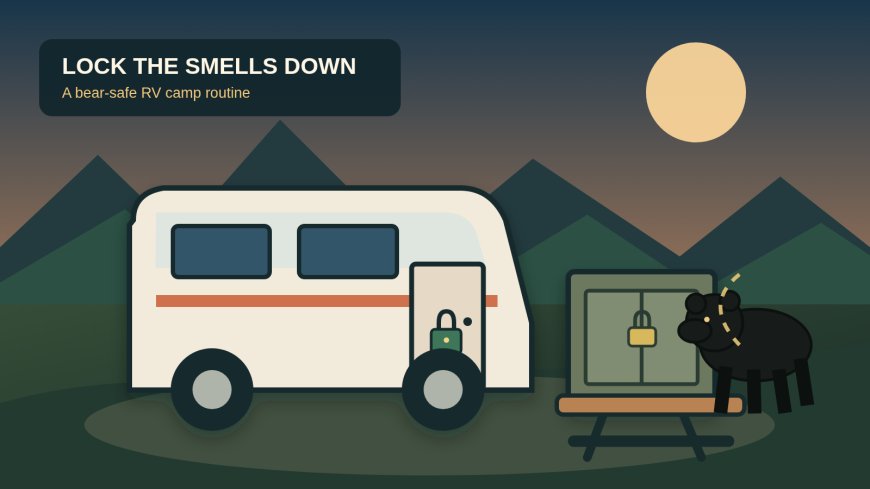
Late-summer camp has a familiar rhythm: dinner runs late, the light fades quickly, and everyone wants to leave the dishes until morning. In bear country, that last shortcut is the one to skip.
An August 26 Outdoors.com report on four separate Colorado bear attacks prompted this guide. The incidents did not all happen at campgrounds, and the story is not evidence that an RV campsite caused them. It is a timely reminder to tighten camp habits as bears enter their heavy-feeding season.[1]
Why late summer changes the stakes
Colorado Parks and Wildlife (CPW) calls the fall feeding period hyperphagia. Its guidance says bears may feed for 22 hours a day and seek about 20,000 calories daily before hibernation. A bear that finds an easy meal near a campground, vehicle, or home can remember the location and return.[2]
That does not mean every bear is headed for your cooler. It does mean a messy campsite is a stronger invitation at exactly the wrong time. CPW traces most human-bear conflicts to human food, garbage, pet food, bird seed, and other attractants.[2]
For an RVer, the job is broader than putting steaks in the refrigerator. The National Park Service (NPS) at Rocky Mountain National Park treats drinks, toiletries, cosmetics, pet food and bowls, coolers, dirty stoves, grills, cookware, garbage, empty cans, and wrappers as items that must be secured, cleaned, stored, or properly discarded.[4]
Start with the rule posted where you are camped
Food-storage rules vary by park, forest, campground, and current wildlife conditions. Read the reservation notice, entrance-board rules, and campsite placard before unloading. Ask the host or ranger if anything is unclear.
At Rocky Mountain National Park, campers must use food-storage lockers and may use specified vehicle-storage methods if lockers are full. The park tells visitors with soft-sided vehicles, vinyl or wood toppers, and convertibles to use bear boxes.[4] In Colorado's White River National Forest, the Forest Service summarizes its order as requiring food, drinks, garbage, coolers, and other bear attractants to be kept in a locked hard-sided vehicle, locked camper, provided food locker, or approved container.[5]
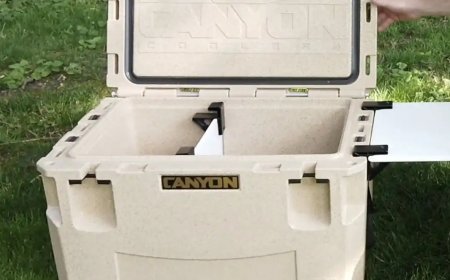
Those details matter. A cooler marketed as tough is not a universal substitute for a campground locker, and a fabric pop-out does not become hard-sided because it is attached to a motorhome. Follow the strictest instruction posted at your site.
Build one storage system, not six hiding places
The easiest routine is to put every scented item into the same mental category: "stored unless I am using it." Then give those items as few destinations as possible.
- Use the provided bear locker first when local rules call for it. Put food, drinks, toiletries, pet supplies, trash awaiting disposal, and clean-but-odorous cooking gear inside. Latch it every time, even if you will be back in a minute.[3][4]
- If local rules allow vehicle or RV storage, close and lock it. CPW says doors should be locked and windows closed. Keep coolers and baskets out of sight; campground bears can learn what those containers hold.[3]
- Treat soft-sided sections as tents. Do not store attractants in a tent, screen room, fabric pop-out, truck-bed tent, or other space a bear can tear into. Rocky Mountain National Park steers soft-sided setups toward bear boxes.[4]
- Use an approved bear-resistant container only where the local rule accepts it. Secure it exactly as its instructions require. "Bear-resistant" is a storage standard, not a reason to leave a cooler open beside the picnic table.[4][5]
Your refrigerator helps organize food, but the RV around it is part of the storage method. Before walking away or turning in, check the doors and windows rather than trusting the fridge latch alone.[3]
The five-minute reset after every meal
Do this while one person puts away the food and another handles cleanup:
- Return ingredients, condiments, drinks, and the cooler to approved storage as soon as serving ends. Food should not sit unsecured or unattended.[4]
- Wash dishes, cookware, the stove, and the grill. Rocky Mountain National Park says dirty cooking equipment must be washed and stored like food.[4]
- Wipe the table and cooking surface. Pick up dropped food, wrappers, bottle caps, and pet kibble.
- Empty pet bowls, store pet food with the other attractants, and do not leave water bowls mixed with food residue.[4]
- Put garbage in the campground's bear-resistant receptacle. If it is full, CPW says to double-bag the trash and lock it in the car or RV. Never leave it outside, bury it, or try to burn leftovers in the campfire.[3]
- Store toiletries and cosmetics. Toothpaste, lip balm, sunscreen, wipes, soap, and the shower bag do not belong on the picnic table overnight.[3][4]
This reset is easier if the dish tub, trash bags, and attractant bin live together. You are less likely to miss the half-empty cocoa mug on the step when cleanup has one finish line.
Give the RV a scent audit before bed
Walk the site once, starting at the picnic table and ending at the cab. Look low. A single dog treat under a chair is easy to miss in headlamp light.
Check the outdoor kitchen, grill tray, camp stove, side tables, cup holders, pet area, trash setup, and any bag carried on a day trip. Move scented items into the storage method required at that campground. Close the windows and lock every door used for food storage.[3][4]
Do not hang a trash bag from the ladder, leave a cooler beneath the awning, or set dirty cookware under the rig for "just one night." CPW warns that wildlife can see, smell, or reach food and toiletries left unsecured, and that bears recognize coolers as food containers.[3]
If you arrive after dark, resist the sprawling unload. Take out only what you need, make the quick meal, complete the same reset, and unpack the rest in daylight.
A departure check that protects the next camper
A clean site is not finished when the chairs are folded. Inspect the fire ring for food and partially burned trash. Check under the picnic table and around the grill for scraps. Dispose of garbage in the designated bear-resistant receptacle rather than stacking it beside a full bin.[3]
Tell the campground host or ranger if a bear enters camp or obtains food, and report a black-bear encounter to CPW. Never approach a bear for a photo or try to recover food from it.[2]
Save this checklist
Before leaving the site or going to sleep:
- Local food-storage rule checked
- Food, drinks, and cooler secured
- Toiletries, cosmetics, and pet supplies secured
- Stove, grill, dishes, and table cleaned
- Trash and recycling secured or discarded properly
- Ground checked for scraps and kibble
- RV or vehicle windows closed and storage doors locked
- Nothing scented left in a tent, fabric pop-out, or screen room
Hyperphagia explains the urgency, but the routine works in every season bears are active. Five deliberate minutes after dinner can keep a bear from learning that an occupied campsite is a dependable place to eat.[2][3]
Sources
- There Were Four Bear Attacks in Colorado Last Week https://outdoors.com/there-were-four-bear-attacks-in-colorado-last-week
- Living with Bears https://cpw.state.co.us/living-bears
- Protect Your Campsite from Wildlife https://cpw.state.co.us/protect-your-campsite-wildlife
- Food Storage at Campgrounds and Trailheads https://www.nps.gov/romo/planyourvisit/food-storage-at-campgrounds-and-trailheads.htm
- Forest officials offer tips for camping on the White River National Forest https://www.fs.usda.gov/r02/whiteriver/newsroom/releases/forest-officials-offer-tips-camping-white-river-national-forest-0
What's Your Reaction?