

















Grand Teton RV campgrounds compared: Colter Bay, Gros Ventre, or Headwaters?
Compare Colter Bay RV Park, Colter Bay Campground, Gros Ventre, and Headwaters by hookups, total rig length, generator rules, location, and 2026 dates.

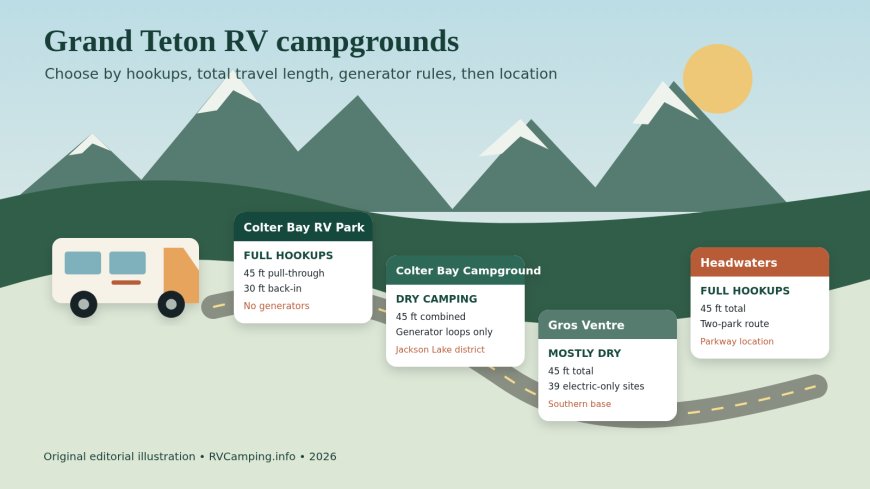
Grand Teton RV campgrounds compared: Colter Bay, Gros Ventre, or Headwaters?
By Romana | Updated September 13, 2026
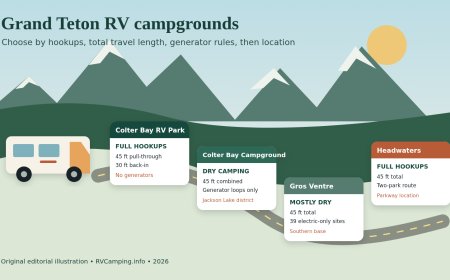
The best Grand Teton campground for your RV depends first on hookups, then on where you want to spend your driving time. Pick Colter Bay RV Park for full hookups in the Jackson Lake district, or Colter Bay Campground when the same location matters more than shore power.[3][4]
Gros Ventre is the useful southern dry-camping base, closest of these four to Jackson.[5] Headwaters makes sense for a two-park trip, with full hookups near Yellowstone's South Entrance in the federal parkway bearing John D. Rockefeller, Jr.'s name.[6]
Every option here requires an advance reservation through Recreation.gov. The official guidance says sites open on a rolling six-month basis, and campground dates remain subject to change.[1][2]
Date check: This comparison was verified September 13, 2026. For the remainder of the published 2026 season, NPS lists Colter Bay Campground through September 27, Headwaters through October 4, and both Gros Ventre and Colter Bay RV Park through October 10.[2] A listed closing date does not prove that a suitable site is available. Check the live calendar for your exact equipment and nights.
The short answer
- Need full hookups and want to stay near Jackson Lake? Start with Colter Bay RV Park. Its sites have water, sewer, and 20-, 30-, and 50-amp electrical outlets.[3]
- Want Jackson Lake without paying for a full-hookup site? Colter Bay Campground accepts RVs but is dry camping except for 13 electric-only accessible sites reserved for qualifying Access Pass users.[1][4]
- Approaching from Jackson or building a southern Grand Teton itinerary? Gros Ventre cuts the repeated drive back from the northern campgrounds. Most sites have no hookups. Of the 39 electric-only sites, ten are accessible.[1][5]
- Splitting time between Grand Teton and Yellowstone? Headwaters has full-hookup pull-through RV sites in the Parkway between the two national parks.[1][6]
Side-by-side comparison
| Decision factor | Colter Bay RV Park | Colter Bay Campground | Gros Ventre Campground | Headwaters Campground & RV Park |
|---|---|---|---|---|
| Best fit | Jackson Lake base with full hookups | Jackson Lake base for dry-camping RVs | Southern base near Jackson | Two-park route near Yellowstone |
| Location | Colter Bay Village, Grand Teton | Colter Bay Village, Grand Teton | Southeast Grand Teton | John D. Rockefeller, Jr. Memorial Parkway |
| Site utilities | Full water, sewer, 20/30/50-amp electric | No hookups at ordinary sites; 13 qualifying accessible sites are electric-only | Mostly no hookups; 39 electric-only sites | Full water, sewer, 20/30/50-amp electric at RV sites |
| Published length rule | 45 ft total at pull-throughs; 30 ft total at back-ins | 45 ft combined RV and tow vehicle | 45 ft total RV and tow vehicle | 45 ft total RV and tow vehicle |
| Generator rule | Not permitted at any time | Only loops H, J, K, M, O; 8 a.m.-10 p.m. | Only loops A, B, C; off 10 p.m.-8 a.m. | Off 10 p.m.-7 a.m. |
| 2026 published season | May 4-Oct. 10 | May 21-Sept. 27 | April 27-Oct. 10 | June 7-Oct. 4 |
| Reservation pattern | Recreation.gov, rolling six months | Recreation.gov, rolling six months | Recreation.gov, rolling six months | Recreation.gov, rolling six months |
| Dump/water plan | Full hookups; dump station listed | Complimentary dump and tank-fill stations | Dump station has limited-use availability | Full hookups; dump station listed by NPS |
| Showers | Nearby, extra fee | Nearby, extra fee | None | Included |
The comparison uses the National Park Service's 2026 operating calendar and current campground pages from the authorized concessioner.[2][3][4][5][6] Services can close before a campground does, so a shoulder-season reservation deserves a second check for fuel, groceries, showers, water, and dump access.
Colter Bay RV Park: hookups without generator backup
Colter Bay RV Park is the cleanest choice for an RV that needs shore power and wants the northern half of Grand Teton as its base. Water, sewer, and 20-, 30-, and 50-amp electrical service are provided at the sites. The village also puts paid showers, laundry, groceries, and other seasonal services nearby.[3]
Length is more specific than the NPS campground-wide 45-foot maximum suggests. The concessioner publishes a maximum total length of 45 feet for pull-through sites and 30 feet for back-ins, counting the RV and tow vehicle.[3] A 38-foot motorhome towing a car therefore needs a reservation record that fits the whole traveling setup, not merely a generic "45-foot" campground label.
There is an official inventory mismatch worth knowing about.[1][3] NPS lists 112 sites as 102 pull-throughs and 10 back-ins.[1] The concession page also says 112 total, but its facilities section says 102 pull-throughs and 12 back-ins, which would total 114.[3] Treat the live site record as the authority for availability and layout rather than using either split to estimate your odds.
Generators are prohibited at all times, not merely during quiet hours.[3] Full hookups make that manageable during normal service, but anyone who needs uninterrupted electricity for medical equipment should carry an independent contingency and confirm how the campground handles an outage. Colter Bay RV Park also prohibits tents and wood fires at sites.[3]
Colter Bay Campground: same district, different power plan
Colter Bay Campground shares the village's practical location but not the RV park's utilities. Standard RV sites are dry.[4] The campground has a dump station and potable-water filling station, while showers and laundry cost extra nearby.[4]
The published RV layout allows one camping rig plus its tow vehicle on a gravel back-in or pull-through pad. Together, they may measure no more than 45 feet.[4] A 30-foot trailer plus a 20-foot truck does not fit simply because each component is below 45 feet.
The 13 electric-only sites are accessible campsites associated with the Access Pass, not a small general-purpose hookup loop.[1][4] Travelers should not plan on obtaining one as an ordinary powered-site alternative. If your RV needs electric service, search Colter Bay RV Park or Headwaters instead.
Generator use is tightly mapped. It is permitted from 8 a.m. until 10 p.m., and only in five loops: H, J, K, M, or O.[4] A reservation in another loop is a generator-free reservation. Check the loop before paying if daily battery charging is part of the plan.
Choose this campground when Colter Bay's access to Jackson Lake, northern trailheads, and village services matters, and your tanks and batteries can support the stay. It is not a bargain version of the RV park for campers who still require shore power.
Gros Ventre: the southern base with limited electric inventory
Gros Ventre is the southern option in this comparison and the closest to Jackson. That can be a bigger advantage than a campground amenity if your itinerary includes town errands, the Moose district, or repeated trips along the park's southern roads.[5]
The campground is mostly dry camping.[5] Its official inventory includes 39 electric-only sites; ten are accessible.[1][5] The concessioner does not describe water or sewer hookups at those sites. Water comes from nearby spigots, there are no campground showers, and the dump station has limited-use availability that guests must confirm on arrival.[5] Book the exact electric category if electricity is required; do not infer power from a loop name or an old site review.
Each RV campsite accepts one camping unit and its tow vehicle. Their total may not exceed 45 feet.[5] Site-level records may be shorter, so 45 feet is the campground ceiling rather than a guarantee for every pad.
Generators are restricted twice: they are allowed only in loops A, B, and C, and they must be off from 10 p.m. to 8 a.m.[5] This makes loop selection part of the energy plan. Solar-dependent campers should also avoid assuming an open-sky site from general campground photos; tree cover and orientation vary by pad.
Gros Ventre is the practical pick when southern access beats full hookups. It asks for more tank, battery, and dump planning than either full-hookup park.
Headwaters: full hookups for a two-park route
Headwaters belongs in this comparison because it is part of the same NPS camping system and can solve a specific routing problem.[1][6] The campground occupies a Parkway site named for John D. Rockefeller, Jr., between Grand Teton and Yellowstone.[6] That is useful for travelers moving between the parks, but it is not a central Grand Teton base. A day focused on Moose, Jenny Lake, or Jackson starts with a longer drive south.
All 97 RV sites are described as pull-throughs with water, sewer, and 20-, 30-, and 50-amp electrical service. One camping unit and its tow vehicle must fit within 45 feet total.[6] Complimentary showers are included, and coin laundry, propane, limited cellular service, and Wi-Fi are listed among the campground or nearby lodge services.[6]
Headwaters permits generator use outside quiet hours, which run from 10 p.m. to 7 a.m.[6] That rule is more flexible than Colter Bay RV Park's total ban, although a camper on functioning full hookups should rarely need a generator.
Choose Headwaters for a Yellowstone-to-Grand-Teton handoff, an early Yellowstone start, or full hookups when Colter Bay has no suitable inventory. Skip it when most of the trip is in southern Grand Teton; the mileage saved at the campsite may return as daily driving.
Rig length: measure the traveling combination
All four options publish a 45-foot upper boundary somewhere, but the words around that number matter. Colter Bay Campground, Gros Ventre, and Headwaters describe a combined or total length for the RV and tow vehicle.[4][5][6] Colter Bay RV Park applies 45 feet to pull-throughs and only 30 feet to back-ins.[3]
Before opening Recreation.gov, write down:
- RV or trailer length in travel mode.
- Tow vehicle or towed car length.
- Total connected length from the front bumper to the rearmost point.
- Slideout width and which side needs clearance.
- Whether the site must hold a separate vehicle after unhitching.
Use those numbers against the individual site's equipment limits and driveway details. A campground maximum cannot enlarge a shorter site.
How to book without choosing the wrong loop
- Decide whether you need full hookups, electric-only service, or can dry camp. Full hookups narrow the list to Colter Bay RV Park and Headwaters.[3][6]
- Remove any site that cannot accept the complete RV-and-vehicle length. Apply Colter Bay RV Park's 30-foot back-in rule before treating its 45-foot pull-through ceiling as usable.[3]
- If a generator is necessary, remove Colter Bay RV Park. At Colter Bay Campground and Gros Ventre, search only the named generator loops.[3][4][5]
- Pick the district. Colter Bay favors Jackson Lake and northern Grand Teton, Gros Ventre favors the south, and Headwaters favors travel between Grand Teton and Yellowstone.[3][5][6]
- Reserve through Recreation.gov when the date enters the rolling six-month window. All four are reservation-only.[1]
- Read the exact site's equipment, driveway, hookup, loop, and generator fields before checkout. Save the confirmation offline.
- Recheck the NPS operating calendar shortly before departure. The park states that dates can change.[2]
Bottom line
Colter Bay RV Park wins for full hookups within Grand Teton and a Jackson Lake itinerary. Colter Bay Campground keeps the location but requires real dry-camping capacity and the right generator loop. Gros Ventre is the southern choice, with a small pool of electric-only sites but no water or sewer hookups. Headwaters is the route-planning choice for travelers dividing time between two parks.
Do not let the shared 45-foot headline flatten the differences. Back-in length at Colter Bay RV Park, loop-specific generator permissions, hookup type, and actual location can eliminate an option before scenery enters the discussion.
Source credit: RVCamping.info compared current National Park Service and authorized concessioner pages retrieved September 13, 2026. The constraint-first decision sequence and route analysis are original editorial work.
Sources
- Camping in Grand Teton National Park, National Park Service. Campground inventory, reservation policy, and overview restrictions; accessed September 13, 2026.
- Operating Hours & Seasons, National Park Service. 2026 operating dates; page updated September 10, 2026 and accessed September 13, 2026.
- Colter Bay RV Park, Grand Teton Lodge Company. Hookups, site lengths, generator rule, and facilities; accessed September 13, 2026.
- Colter Bay Campground, Grand Teton Lodge Company. Dry-camping facilities, length, generator loops, and booking details; accessed September 13, 2026.
- Gros Ventre Campground, Grand Teton Lodge Company. Utilities, total-length rule, generator loops, and facilities; accessed September 13, 2026.
- Headwaters Campground at Flagg Ranch, Grand Teton Lodge Company. Location, full hookups, length, generator rule, and facilities; accessed September 13, 2026.
What's Your Reaction?