








Pinnacles National Park RV Campground Guide: East Entrance, Exact Site
Pinnacles Campground is east-side only. Verify the exact site's rig limits, plan around 30-amp or no power, and remember that generators are never allowed.

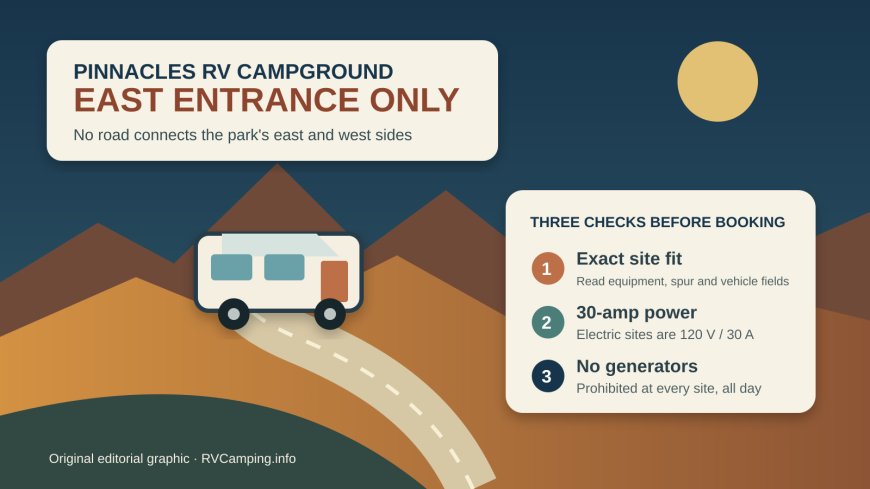
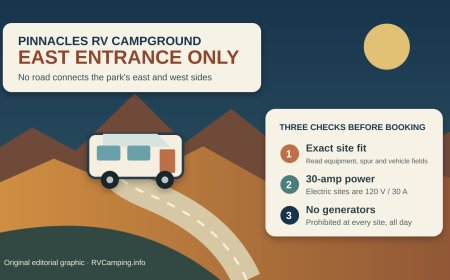
Quick answer: An RV stay at Pinnacles Campground starts with the correct entrance. The campground is on the east side. There is no road through the park between the east and west entrances, so an RV routed to the west side cannot simply cross the park to check in.[1][3] Use the east-side approach from Highway 25 and Highway 146.
Once the route is right, the campground can be a practical base for a motorhome or trailer. It is open year-round, has reservable electric RV sites, drinking water, showers and a dump station. The electric sites provide 120-volt, 30-amp service. Generators are prohibited at every site, at all hours.[2] The catch is that rig fit is site-specific. Recreation.gov shows a 27-foot equipment limit at one standard nonelectric site and a much larger stated equipment allowance at an electric site, with different spur and vehicle figures attached to each listing.[5][6] Book from the exact site record, not from a parkwide length claim.
| RV planning question | Verified answer |
|---|---|
| Which entrance serves the campground? | East entrance, reached from Highway 25 and Highway 146 |
| Can I drive across the park from the west entrance? | No; the entrances do not connect by road |
| Is the campground seasonal? | No; Recreation.gov lists it as open year-round |
| What power is supplied at RV electric sites? | 120-volt, 30-amp electrical service |
| Are generators allowed? | No, not at any site or time |
| Is there a single trustworthy RV-length maximum? | No parkwide number should replace the exact site's equipment, spur and parking fields |
| How far ahead can I book? | The authorized operator says individual tent and RV sites open up to six months ahead |
| Are walk-up or first-come sites offered? | The current booking notice says no; reserve through Recreation.gov or by phone |
The entrance mistake can cost most of a travel day
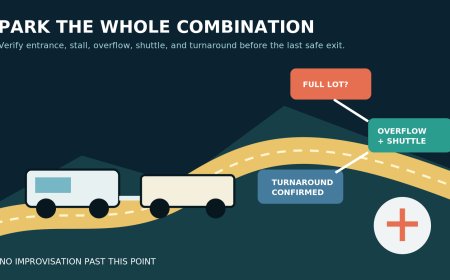
Pinnacles has two entrances that face different parts of the park. NPS says no road links them. The shortest drive between the two sides goes outside the park through King City on Highway 101.[1] That matters more in an RV than it does in a car: a wrong turn can turn into a long reroute, and the west approach includes narrow, one-lane portions of Highway 146.
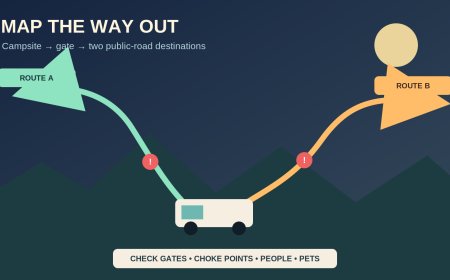
For campground check-in, choose the east entrance. From the north, NPS directs travelers through Hollister on Highway 25, then west on Highway 146 before turning into Pinnacles Campground. From the south, the official route leaves Highway 101 at King City, follows Bitterwater Road to Highway 25, then turns onto Highway 146 for the east side.[1]
Do not search only for "Pinnacles National Park" and accept the first pin. NPS warns that online mapping can select the wrong side and publishes separate coordinates for each entrance.[1] Put the campground address or east-entrance coordinates into the route, then compare every turn with the park directions. The west entrance is useful for west-side trail access, but it is not an RV check-in route and does not lead to the campground.
A sensible arrival plan also leaves daylight for the final miles and the campsite backing maneuver. Recreation.gov warns that busy weekends, holidays and favorable spring weather can create lines or access restrictions between 10 a.m. and 3 p.m.[2] That is not a reason to race the gate early. It is a reason to allow extra time and avoid arriving with an empty fuel tank, a tired driver and no room in the schedule.
RV length is an exact-site question here
Pinnacles is a good example of why "maximum RV length" can be misleading. The reservation system holds several measurements, and they do not necessarily describe the same thing.
At standard nonelectric site 40, Recreation.gov permits an RV or trailer up to 27 feet and identifies a 27-foot spur. It also lists a 25-foot maximum vehicle length and says a vehicle that does not fit must use overflow parking.[5] At electric site 90, the record permits RV or trailer equipment up to 54 feet, lists a 40-foot spur, and gives 45 feet as the maximum vehicle length. That site's note says rear overhang may extend beyond the bumper where unobstructed.[6]
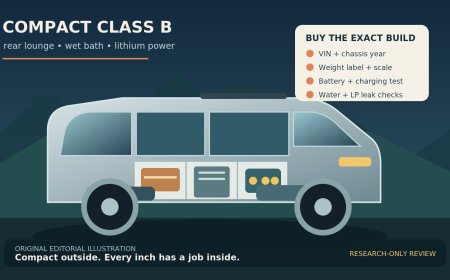
Those records are not a license to treat 54 feet as a campground-wide promise. They show the opposite: the booking fields vary, and the meaning of "equipment," "vehicle" and "spur" has to be read with the site's notes and photo. Before paying, record:
- motorhome length with racks or permanently mounted gear;
- trailer length, including hitch, plus tow-vehicle length;
- total connected combination length for arrival and backing;
- height, wheelbase, rear overhang and low-clearance components;
- space needed for slides, steps and safe door access;
- whether the tow vehicle can remain at the site without blocking the road.
Recreation.gov says one tow vehicle plus one trailer counts as two vehicles. It also requires wheels to remain on the provided parking surface and directs equipment that does not fit to overflow parking.[2] A long rear-overhang note solves only one dimension. It does not guarantee turning room, slide clearance, acceptable slope or room for the tow vehicle. If a field looks internally inconsistent, call the campground at 831-200-1722 before reserving and keep a copy of the exact site record.
Standard nonelectric sites can accept RVs where the individual listing permits them, as site 40 demonstrates.[5] That gives campers a dry-site option, but it does not mean every tent-oriented site works for every van, trailer or motorhome.
Electric means 30 amps, not a full-hookup site
The campground's designated RV electric sites have 120-volt, 30-amp service. Recreation.gov separately lists drinking water, showers and a dump station, rather than promising water or sewer connections at each pedestal.[2] The authorized concessioner describes easy access to water and publishes campground amenities that include flush toilets, hot showers, a pool, Wi-Fi and a store.[3]
Plan this as an electric-only hookup unless the exact reservation record explicitly says otherwise. Fill the fresh tank or use approved containers at the shared water supply instead of expecting a threaded water connection beside the power pedestal. Keep enough tank capacity to reach the dump station during its operating window; the concessioner's camping page says the key is obtained at the store and limits dump access to store hours.[3]
Thirty amps also calls for ordinary load management. An air conditioner, electric water heater, microwave and portable cooking appliance can exceed the available service when stacked together. Use the RV's own electrical limits, inspect the pedestal before connecting, and switch high-draw loads rather than assuming a breaker will handle everything at once. Recreation.gov prohibits EV charging at RV pedestals and directs drivers to the charger near the store.[2]
The generator rule is unusually simple: none are allowed at any time, in any site.[2] A reservation in a nonelectric site therefore requires enough battery, solar and propane capacity for the stay without generator recovery. If medical equipment or climate control depends on uninterrupted shore power, reserve an electric site and still prepare for an outage.
Reservations, arrival and campground rhythm
The authorized campground operator says individual tent and RV sites may be booked up to six months in advance. Group sites have a different, longer window, but group sites do not allow RVs or trailers.[4][2] Recreation.gov's current notice says there are no first-come, first-served sites.[2] The operator's FAQ contains older, conflicting wording about same-day walk-up reservations, then answers the next question by saying all sites must be reserved. The practical reading is to rely on the live Recreation.gov inventory and never arrive expecting an unreserved site.[4]
Campsite check-in is 1 p.m. and check-out is 11 a.m. Late arrivals can use the online check-in process linked from Recreation.gov.[2] Save the confirmation, site number and late-arrival instructions before losing service. Quiet hours run from 10 p.m. to 6 a.m., but the no-generator rule applies beyond quiet hours.[2]
The campground and store make this a softer landing than many park campgrounds, but supplies are still limited. The store is useful for basics, not a substitute for provisioning the RV in Hollister or King City. Arrive with fuel for the exit, drinking-water reserve, food, needed prescriptions and a waste plan.
Match the season to the RV, not just the calendar
Year-round operation does not mean identical conditions year-round. Spring is popular, which can tighten reservation availability and increase entrance traffic. Summer heat raises the value of an electric site because generator backup is unavailable. In an older 30-amp RV, that may still mean choosing between the air conditioner and another high-draw appliance.
Fall can be quieter, but hot, dry conditions may bring fire restrictions. Recreation.gov tells campers to check the park conditions page before arrival because restrictions may occur at any time of year.[2] Winter reduces heat stress, yet short daylight and cold nights put more pressure on batteries, propane and arrival timing. The pool is a seasonal extra, not a reason to count on a particular opening date; Recreation.gov's overview and notice currently publish different closing periods.[2]
For any month, check current NPS alerts, fire rules and the weather shortly before departure. A year-round campground can remain open while a service is unavailable or a restriction changes what may be used at the site.
A practical booking sequence
Start with the route, not the campsite thumbnail.
- Select the east entrance in the navigation app and compare it with NPS directions.
- Measure the RV as it will travel, including hitch and rear attachments.
- Filter Recreation.gov for the needed date and electric or nonelectric service.
- Open the individual site record. Read permitted equipment, spur length, vehicle limit, driveway entry, photo and every "Need to Know" note.
- Call the campground when the measurements conflict or leave little margin.
- Reserve through Recreation.gov, then save the confirmation and exact site page.
- Build the power plan around 30 amps or no electricity. Do not include generator hours because there are none.
- Recheck NPS conditions and fire restrictions before leaving.
- Arrive by the east entrance with enough daylight to back in and confirm pedestal placement.
Pinnacles Campground can work well for RV travelers who want trail access without moving the rig each morning. Its biggest planning hazards are administrative rather than exotic: the wrong entrance, a length number pulled out of context, or an electrical plan that quietly assumes generator use. Get those three decisions right, and the rest of the stay is much easier.
Sources
- Directions - Pinnacles National Park Retrieved October 5, 2026.
- Pinnacles Campground - Recreation.gov Retrieved October 5, 2026.
- Camping - Pinnacles Recreation Company Retrieved October 5, 2026.
- FAQ - Pinnacles Recreation Company Retrieved October 5, 2026.
- Site 40, Pinnacles Campground - Recreation.gov Retrieved October 5, 2026.
- Site 90, Pinnacles Campground - Recreation.gov Retrieved October 5, 2026.
What's Your Reaction?