




Devils Garden or Moab? The RV camping decision for Arches
Choose between Devils Garden and a Moab base by exact rig fit, hookups, tanks, generator hours, reservation certainty, and the real cost of driving back to town.


Devils Garden or Moab? The RV camping decision for Arches
By Romana
Category: Campgrounds
By Romana | September 24, 2026
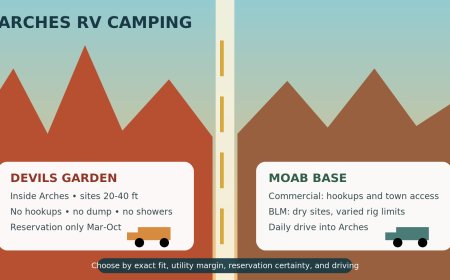
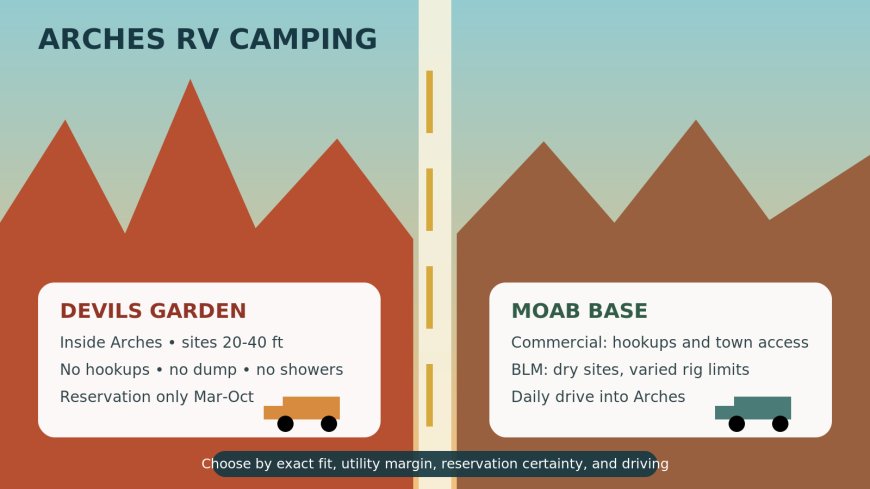
Devils Garden wins when the point of the trip is waking up inside Arches and your exact site fits a dry-camping rig. Stay in Moab when you need hookups, a dump station, showers, a longer or less maneuverable rig, or a reliable reservation after Devils Garden is full.
The distance trade is real. Devils Garden sits 18 miles inside the park and 23 miles from Moab.[2] That makes early access to the Devils Garden trail system easy, but every grocery, shower, dump, restaurant, or off-park errand becomes a long round trip. A Moab base adds a daily drive through the park entrance and up the park road, yet it puts utilities and town services close to camp.
Checked September 24, 2026: Arches does not require an advance timed-entry reservation in 2026, although vehicles can be diverted when congestion is high. A Devils Garden campsite reservation is still required for nights from March 1 through October 31.[1][3]
The short decision
Choose Devils Garden if all of these are true:
- the exact site accepts your RV or trailer;
- you can camp without electric, water, and sewer hookups;
- you can leave without an in-park dump station or shower;
- the limited generator windows suit your power budget; and
- your stay is primarily about Arches rather than a broader Moab itinerary.
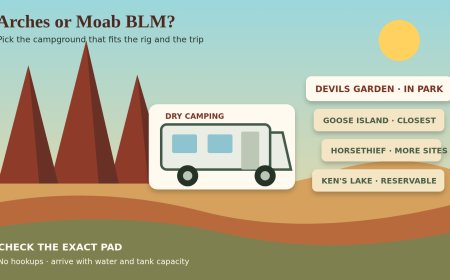
Choose a Moab commercial RV park if you want reservable full hookups, shore-power air conditioning, sewer at the site, Wi-Fi as an offered amenity, or easier access to groceries and services. One current local example, Moab Rim Campark, advertises pull-through sites with 30- and 50-amp power, water, sewer, cable, and Wi-Fi.[6] That is an example of the service class, not a blanket claim about every Moab park.
Choose a Moab-area BLM campground if you still want dry camping but Devils Garden is unavailable or the location fits a wider Canyonlands, river-corridor, or mountain-bike plan. BLM developed sites generally have no water or electricity; individual sites are usually first-come, first-served, and their published maximum RV lengths vary from no RV access to 50 feet.[4]
Comparison at a glance
| Decision factor | Devils Garden | Moab commercial RV park | Moab-area BLM campground |
|---|---|---|---|
| Setting | Inside Arches, 18 miles from entrance | In or around Moab | River corridors, desert, or trail systems around Moab |
| Exact rig fit | Site-specific; NPS range 20-40 ft | Property and site-specific; pull-through and larger-rig inventory may exist | Campground-specific, from no RVs to 50 ft in current BLM table |
| Electric, water, sewer at site | None | Often available; verify exact site and amperage | None in BLM developed campgrounds |
| Dump station | None in Arches | Often available or nearby; verify | Not in BLM developed campgrounds |
| Showers | None | Often available; verify | None listed as a standard BLM facility |
| Toilets and drinking water | Toilets and drinking water | Property-specific | Vault toilets; bring water |
| Peak-season booking | Reservation only, Mar. 1-Oct. 31 | Usually reservable; policy varies | Most individual sites first-come, first-served |
| Generator hours | 8-10 a.m. and 4-8 p.m. | Property-specific | 8 a.m.-8 p.m. under current BLM guide |
| Best use | Arches-first itinerary with a self-contained rig | Utility margin and town access | Dry-camping alternative outside the park |
Devils Garden: test the exact site, not the 40-foot headline
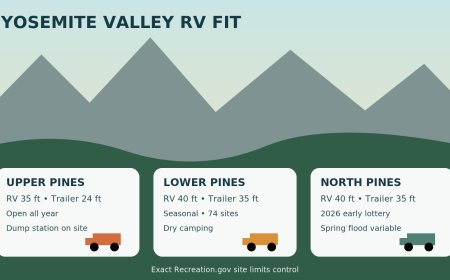
NPS says Devils Garden sites range from 20 to 40 feet and lists an RV maximum of 40 feet.[1] That number describes the longest end of the campground range. It does not make every site a 40-foot site.
Recreation.gov exposes the bookable site records, so screen by the equipment you will arrive with. Record the motorhome or trailer length, tow vehicle, connected length, height, width, slideouts, and whether the listing provides room for the tow vehicle after unhitching. Site photos can help with rock edges and parking orientation, but the dimensions and alerts carry more weight than a wide-angle image.
The campground has paved roads and parking spurs. Recreation.gov lists 51 campsites, including two group sites and one accessibility site.[2] Group sites are not an RV workaround; reserve an individual site that accepts your equipment.
If your combination is near the published limit, call the park or Recreation.gov contact before committing. A 38-foot motorhome and a 38-foot fifth-wheel combination impose different turning and parking demands. "RV allowed" is not the same as "your RV fits this pad."
What dry camping inside Arches requires
Devils Garden provides drinking water, picnic tables, fire rings, and toilets.[1][2] It has no electric, water, or sewer hookups, no dump station, and no showers.[2]
That service set favors an RV that arrives with:
- enough fresh water for the people, pets, cooking, and the planned stay;
- empty or nearly empty waste tanks;
- battery capacity for overnight and daytime loads;
- a charging plan that fits two generator windows;
- food and supplies for the stay; and
- a known dump and resupply stop after checkout.
Generators may run only from 8-10 a.m. and 4-8 p.m.[2] Six permitted hours do not mean six hours will be pleasant or necessary. Work backward from battery state, heat or furnace demand, refrigerator controls, medical equipment, water-pump use, and device charging. Solar output is site- and weather-dependent, so it should not be treated as a guaranteed daily amount.
The campground's distance from Moab amplifies a poor tank plan. It is 23 miles from town, not beside the entrance.[2] Driving to dump or shower consumes a meaningful part of the day and requires another drive back into the park if the campsite is still in use.
The reservation calendar changes in winter
For nights from March 1 through October 31, Devils Garden is reservation only. Walk-in sites are not available.[2] NPS says standard sites open at 10 a.m. Eastern six months in advance and can be booked as late as four days ahead if inventory remains.[1]
From November 1 through February 28, sites switch to first-come, first-served. Winter payment uses Recreation.gov Scan & Pay or self-registration, and limited cell service makes downloading the app before arrival sensible.[1][2]
Do not confuse the campground reservation with Arches' entrance policy. In 2026 the park suspended advance timed-entry reservations, but congestion can still cause entrance diversions.[3] Sleeping inside the park saves the entrance approach each morning, yet it does not guarantee an empty road or parking at every trailhead.
Devils Garden stays are limited to seven days per month and 14 days in a year under the current Recreation.gov notice.[2]
Staying in Moab: choose the service level first
"Stay in Moab" covers two very different RV experiences.
Commercial RV park
A commercial park is the cleanest alternative when utility margin matters. Moab Rim Campark's current RV page, for example, lists full-hookup pull-through sites with 30- and 50-amp power, water, sewer, cable, and Wi-Fi. It also lists a lower-service option with 30-amp power and water.[6]
Use that as a checklist for any private park:
- Is the reserved site full hookup, power-and-water, or dry?
- Is the amperage 30 or 50, and does it match the RV?
- What are the pad and total vehicle limits?
- Is the site pull-through or back-in?
- Are the dump station, showers, pool, laundry, or Wi-Fi included, restricted, seasonal, or separately priced?
- What is the cancellation policy for the exact rate?
Commercial service can preserve batteries and tanks and make hot-weather air conditioning practical. It also reduces the cost of a mid-stay resupply. The price is the daily park drive and the possibility of joining an entrance queue.
BLM developed campground
A BLM campground is not the hookup alternative. The current Moab visitor guide says developed campgrounds have no water or electricity, while vault toilets, fire rings, picnic tables, and dumpsters are standard. Generators may run from 8 a.m. to 8 p.m.[4]
Most individual sites are first-come, first-served. The guide identifies limited exceptions: Ken's Lake Loop A and Courthouse Rock sites 5 and 6 can be reserved through Recreation.gov.[4] Group-site reservations are a separate product and should not be treated as ordinary individual RV inventory.
Rig limits vary sharply. The current BLM table lists Goose Island, Big Bend, Gold Bar, Horsethief, and Ken's Lake at 40 feet; North Klondike at 30 feet; Sand Flats at 34 feet; Courthouse Rock at 50 feet; and several campgrounds with no RV access.[4] Road surface matters too. Some are reached by gravel roads, and a numerical site length does not certify that the approach suits every low-clearance or long-overhang RV.
Goose Island shows the practical compromise. BLM describes 20 individual riverside sites for tents, RVs, and trailers, with individual sites first-come, first-served. It has toilets but no water or hookups and typically fills in the morning from March through October.[5] The visitor guide gives Goose Island a 40-foot maximum.[4]
BLM's dry campgrounds can place you closer to another day's objective, but they do not solve an electric, water, shower, or dump need. They solve availability and geography only when the rig and resource plan fit.
The route-cost test
The right base depends on where the RV will move after setup.
Devils Garden is strong for a trip concentrated on the northern park road and the campground's nearby trailheads. It removes the 23-mile trip from Moab at the beginning and end of each Arches day.[2] Leaving a trailer in camp can also make daytime parking easier than towing it through the park.
Moab is stronger for a mixed itinerary. Canyonlands, Dead Horse Point, river activities, groceries, repair needs, restaurants, and a dump stop all pull travel back toward town or other highways. A campsite deep inside Arches can turn those errands into repeated backtracking.
Do not compare nightly rates without fuel, dump fees, generator fuel, tank capacity, and time. A cheaper dry site can cost more if it forces an extra 46-mile round trip to town. A full-hookup site can be wasteful if the rig is already self-contained and every planned day is in Arches.
Four booking scenarios
A 24-foot Class C for two nights, full tanks, no air-conditioning requirement: Devils Garden is the first search. The rig falls within the published range, and a short stay may fit the tank and battery budget. Verify the exact pad.[1][2]
A 39-foot motorhome in hot weather: Devils Garden is possible only at a qualifying site, but fit is not the only issue. Without shore power, air-conditioning demand can make a commercial full-hookup park the more workable choice.
A 30-foot travel trailer with a long tow vehicle: Do not compare the trailer box to the 40-foot maximum and stop there. Verify the site's equipment field, parking arrangement, and maneuvering room. If the reservation record is ambiguous, use a Moab site that confirms the whole setup in writing.
A flexible van arriving without a peak-season reservation: Do not drive to Devils Garden expecting a walk-in site from March through October. Search a commercial cancellation, a reservable exception, or arrive early enough to compete for an appropriate BLM first-come site. NPS warns that near-Moab first-come campgrounds can fill by mid-morning in busy periods.[1]
A booking sequence that prevents the wrong compromise
- Search Devils Garden for the exact dates and equipment.
- Reject any site whose dimensions or alerts do not clearly fit.
- Calculate fresh-water, waste-tank, battery, and generator needs for the full stay.
- If any resource margin fails, search Moab commercial parks by the required hookup level.
- If dry camping still works but Devils Garden is unavailable, use the BLM table to screen maximum RV length, road surface, water, and reservation status.[4]
- Save confirmations and screenshots of the exact site facts.
- Before departure, check Arches alerts, fire restrictions, weather, and the current reservation or entrance policy.
- Plan the dump and potable-water stop before arriving, not after a tank warning.
Bottom line
Devils Garden is a location choice, not a service choice. It puts camp inside Arches but asks the RV to supply nearly everything beyond drinking water and toilets.
Moab is the better base when the trip needs utility margin or town access. Separate its options clearly: a commercial RV park can supply hookups, while a BLM campground is another dry-camping choice with different rig limits and booking rules. Once that distinction is made, the decision becomes simple: exact fit, resource capacity, reservation certainty, then driving time.
Source credit: RVCamping.info compared current National Park Service, Recreation.gov, Bureau of Land Management, and campground-operator records on September 24, 2026. The resource-margin and route-cost tests are original editorial analysis.
Sources
- [1] Camping - Arches National Park (National Park Service; accessed September 24, 2026).
- [2] Devils Garden Campground (Recreation.gov; accessed September 24, 2026).
- [3] Plan Your Visit - Arches National Park (National Park Service; accessed September 24, 2026).
- [4] BLM Moab Visitor Guide (Bureau of Land Management; accessed September 24, 2026).
- [5] Goose Island Campground (Bureau of Land Management; accessed September 24, 2026).
- [6] RV Sites - Moab Rim Campark (campground operator; accessed September 24, 2026).
What's Your Reaction?