















Camco FasTen 21022 review: compact leveling, with a width catch
Camco's 10-piece FasTen kit packs neatly, but its 8.5-inch platform, unclear load rating and conflicting thickness copy demand a fit check.

This is a research-based review. RVCamping.info did not buy, handle or load-test this product.
The Camco FasTen 21022 makes sense for campers who need a compact set of stackable blocks for modest leveling corrections and whose tires or approved jack feet fit the platform.[2][3] Skip it if your tire tread is wider than the block, you need a published load rating before purchase, or the site would require a tall or unstable stack.[2][3]
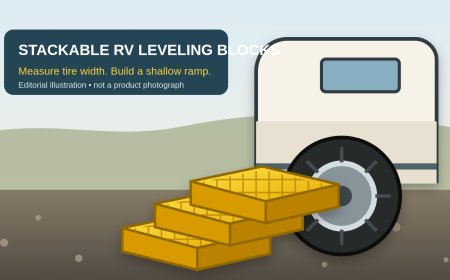
The central tradeoff is simple: ten separate pieces pack smaller and can be arranged under tires or compatible jack feet, but they give you stepped rather than continuous height adjustment.[2][3] A curved leveler is faster for fine tire-height changes.[3] A larger pad is the better starting point for a wide tire, dual-wheel position or large jack foot.[3]
As an Amazon Associate, RVCamping.info earns from qualifying purchases. If you buy through an Amazon link in this article, we may earn a commission at no additional cost to you.
Check the Camco FasTen 21022 listing on Amazon.
What the current model is
Camco's current product page identifies the yellow ten-pack as SKU 21022 with UPC 014717210225.[1] The Amazon listing at ASIN B07ZHP8XFD also names model 21022, so the affiliate link above points to the same model rather than a look-alike color or pack size.[2]
That identity check matters because older listings and Camco videos still circulate under 44512 and other FasTen numbers.[1][2] Treat 21022 and B07ZHP8XFD as the boundaries of this review.[1][2] Do not assume a brown, gray, 4-by-2 or older 2-by-2 set has the same dimensions or instructions.[1][2]
There is one specification conflict worth catching before checkout.[2] Amazon's title calls each block 8.5 by 8.5 by 1 inch, while the page's feature copy says 8.5 by 8.5 by 1.5 inches.[2] The same feature copy says not to stack higher than 4.5 inches.[2] Camco's current product page confirms the SKU but does not expose block dimensions in its readable product details.[1]
We would not turn that disagreement into a guessed layer count.[1][2] Check the label and instructions supplied with the set, measure the actual block, and keep the arrangement within the lower of the written limits that apply to the product and your RV.[2]
Who should buy it, and who should skip it
The 21022 is a reasonable match for a travel trailer, camper van or smaller motorhome when all of these are true:
- the tire tread fits fully on the usable platform;[3]
- the site needs a small correction rather than a tall tower;[2][3]
- you are willing to drive off, rearrange the blocks and try again;[3]
- your RV manual permits tire blocks in that position; and[3]
- you already carry proper wheel chocks.[3]
Lippert recommends measuring tire width before buying and choosing blocks wider than the tire.[3] It also notes that a twelve-piece set may be needed to put at least three blocks under each tire, depending on the trailer.[3] That makes Camco's ten-pack a more natural fit for one low corner or a single-axle setup than for every tandem-axle situation.[2][3]
Skip this kit if an 8.5-inch square cannot support the full tread or approved foot area.[2][3] Owners of wide motorhome tires and dual rear wheels should be especially careful.[2][3] Supporting one tire in a dual pair while leaving its mate unloaded is not a detail to improvise around.[3]
Also skip it when the ground is soft, sharply crowned or littered with stones that prevent a block from sitting flat.[3][5] Relocate if the blocks shift, sink, crack or change shape when weight is applied.[5] The cheapest leveling block is expensive if it damages a tire or lets an RV move.[5]
What ten interlocking blocks do well
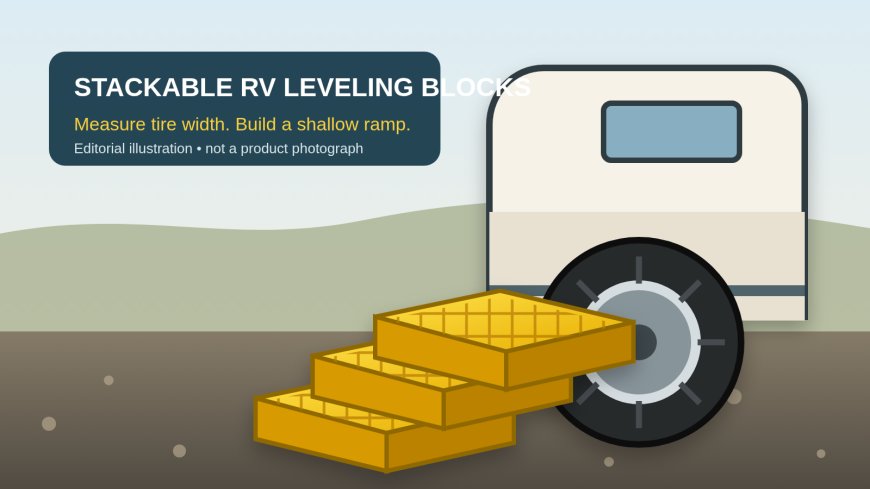
The format is the appeal.[2] Individual blocks can be laid into a shallow ramp, split between tire and approved jack duties, then locked together with the built-in handle for storage.[2][3] Amazon describes the kit as ten polymer blocks with a T-handle and lists it for single wheels, tandem axles and several jack types.[2]
That flexibility is useful, but the number of blocks disappears quickly.[2][3] A safe drive-on arrangement needs an approach rather than a vertical wall.[3] Lippert's setup guidance says to arrange stacker blocks in a ramp-like shape, drive onto them slowly and use a spotter when possible.[3] On a tandem axle, both low-side tires may need support.[2][3] Ten pieces can be enough for a modest correction, yet not enough for the shape, width and number of contact points your rig requires.[2][3]
The stepped adjustment is the second limitation.[2][3] If one layer leaves the RV low and the next leaves it high, the blocks cannot split the difference.[2] You can reposition the RV on the site, accept the tolerance allowed by the installed equipment manuals, or use a compatible continuous ramp.[3] Do not shim a leveling block with loose scrap.[5]
The load-rating gap changes the recommendation
The current Camco page does not publish a numerical load rating in the readable details we reviewed.[1] The Amazon page uses phrases such as "extreme load bearing" but likewise does not provide a test standard or rated capacity in the specifications shown.[2]
That is not proof the blocks are weak.[1][2] It means a buyer cannot compare the product's capacity with an axle or jack load from those two pages.[1][2] For a heavy motorhome, concentrated hydraulic-jack load or any setup where a documented rating is required, ask Camco for written model-specific guidance before buying.[1][2] Do not borrow a rating from a different FasTen product.[1][2]
There is also a reason to ignore popularity superlatives.[4] In January 2026, BBB National Programs reported that Camco permanently discontinued challenged "America's #1" claims for FasTen leveling blocks; the National Advertising Division did not review the merits of those claims.[4] A sales-ranking slogan would not answer the fit or load questions anyway.[1][2][4]
Setup sequence for a towable RV
Start with the RV manual.[3][5] The block maker's general compatibility statement does not override instructions for your tires, frame, stabilizers, landing gear or refrigerator.[2][3][5]
- Keep the trailer hitched while checking side-to-side level.[3][5]
- Inspect the proposed tire path. Every block should sit flat on firm ground without rocking.[3][5]
- Build a broad, shallow approach on the low side. Keep the tire centered and fully supported.[3][5]
- Have a spotter stand clear of the vehicle path, or stop and get out to check position. Move slowly.[3]
- Set the tow vehicle's parking brake, put it in Park and chock the trailer as its manual directs before unhitching.[3][5]
- Use the tongue jack or landing gear for front-to-back leveling only after side-to-side position is secured.[3][5]
- Extend stabilizers after leveling. Do not use ordinary stabilizer jacks to lift the trailer.[3][5]
Lippert separates these jobs: blocks establish side-to-side level, chocks restrain the trailer, front-to-back adjustment comes from the tongue jack, and stabilizers reduce movement after the trailer is secure.[3] Our full RV leveling and stabilizing setup guide covers system-specific exceptions and stop conditions.[5]
A motorhome with hydraulic or electric leveling needs its own documented sequence.[5] Do not copy the towable procedure.[5] Some systems require particular engine, parking-brake, suspension or tire-contact conditions.[5]
Inspection and campsite limits
Before each use, look for cracked grid walls, crushed edges, UV damage, distortion and a handle that no longer locks the stack together.[2][5] Clean embedded gravel out of the grid before stacking or storing.[2][5] Retire a damaged block rather than hiding it in the bottom layer.[5]
During setup, stop if:
- a tire overhangs the usable platform;[3][5]
- a jack foot is not flat and centered;[5]
- the arrangement needs more than the listed 4.5-inch maximum;[2]
- a block rocks, slides, sinks or deforms;[5]
- the RV would need its stabilizers to carry leveling load; or[3][5]
- the site angle would violate the RV or installed-equipment manual.[5]
Do not put any part of your body beneath the RV when leveling gear is its only support.[5] These are campsite leveling blocks, not service stands.[5]
Verdict
The Camco FasTen 21022 is a compact, flexible kit for small corrections on firm sites.[2][3] The storage handle is practical, and loose blocks can do more jobs than a one-piece ramp.[2][3] Still, the 8.5-inch platform sets a hard fit boundary, ten pieces may be tight for a tandem-axle ramp, and the current product pages do not give us a numerical load rating.[1][2][3]
Buy it only after measuring the tire or approved jack-foot contact area and confirming the instructions for your exact RV.[2][3] For wider tires, duals, heavy jack loads or sites that routinely need more lift, choose a larger model with a published capacity and enough pieces to support every required contact point.[1][2][3]
Sources
What's Your Reaction?