















Flojet 18555000A review: useful reach, with hose and heat limits
Research-based Flojet 18555000A review covering RV outlet fit, hose distance, 12-volt wiring, heat limits and sanitation.

The Flojet 18555000A makes sense for an RV owner who occasionally needs to move black or gray water to an approved sewer inlet that gravity cannot reach. It connects to a standard 3-inch RV waste outlet and pumps through a smaller discharge hose.[2] Skip it if you want a permanent full-hookup connection, lack a nearby 12-volt 20-amp power source, cannot identify a legal wastewater receiver, or expect the pump to swallow wipes and other trash.
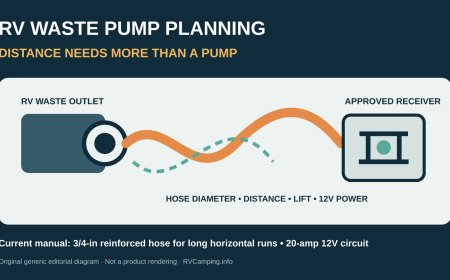
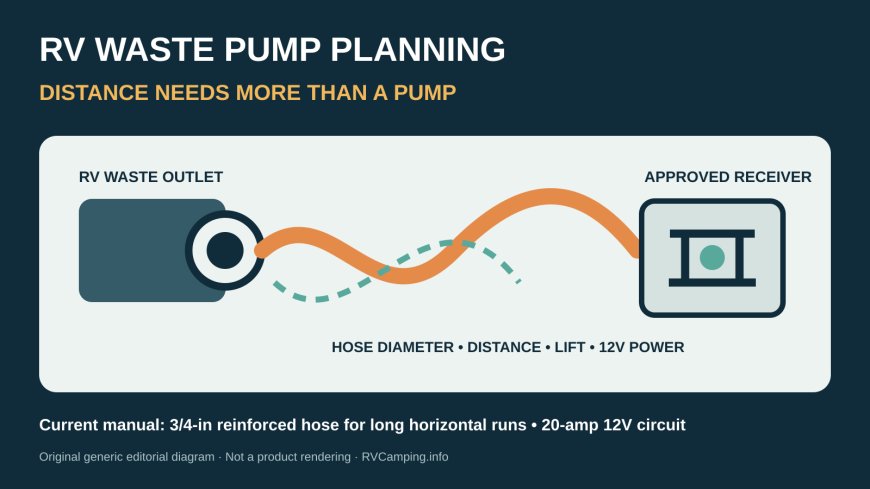
The central tradeoff is simple: a narrow hose is easier to route than a 3-inch sewer hose, but distance, lift, bends and low voltage increase the work the pump must do. The current manual allows a long horizontal run with the right 3/4-inch hose, yet the same table shows lower flow as the run grows.[2] Treat 150 feet as a controlled maximum under published test conditions, not a promise for an uphill campsite.
The exact product reviewed is the Flojet Portable RV Macerator Pump, manufacturer part 18555000A, UPC 042237109958, on Amazon ASIN B00E5URR02.[1][3]
The manufacturer page uses the 18555000A part number, while the current manual shortens the model on its cover to 18555000.[1][2]
This is a research-based review. RVCamping.info did not buy, install or pump waste through this unit. The assessment uses current manufacturer documentation, a documented owner test, public sanitation guidance, marketplace identity data and attributed owner reports.
As an Amazon Associate, RVCamping.info earns from qualifying purchases. If you buy through an Amazon link in this article, we may earn a commission at no additional cost to you.
Check the Amazon listing for Flojet 18555000A, ASIN B00E5URR02. Confirm the model and UPC on the listing and received package. Search results currently expose several Amazon product pages carrying similar Flojet titles, so the product name alone is not enough to identify this reviewed listing.[3]
Who should buy it, and who should pass
The Flojet is a plausible fit when all of these are true:
- the RV has a standard 3-inch bayonet waste outlet with room to attach the pump;
- an approved sewer cleanout, dump receptor or auxiliary waste tank is beyond practical gravity-hose reach;
- the route can use a dedicated reinforced discharge hose without kinks or traffic hazards;
- 12-volt power rated for a 20-amp circuit is available near the waste connection;
- pumping is occasional rather than a permanent, unattended sewer arrangement.
Choose a conventional 3-inch hose when gravity already reaches the campsite sewer. It is simpler, has no motor or fuse, and avoids pushing waste through a small hose. Choose a purpose-built permanent macerator system if this will be the RV's routine dumping method. Do not buy any pump until the property owner or wastewater authority confirms the intended receiver may accept RV holding-tank waste.
The pump is also the wrong workaround for a poorly maintained black tank. Flojet says it handles normal RV waste and tissue, but not hard solid objects, sanitary products, wet wipes or rags.[2] Maceration does not make prohibited tank contents safe for a sewer or septic system.
The current manual changes the old 50-foot story
Older product copy still circulates. One current retailer page describes a 15-minute continuous-run limit, a typical 40-gallon tank in under five minutes, and hose limits of 25 feet for 5/8-inch and 50 feet for 3/4-inch.[7] That matches an older Flojet instruction sheet, but it is not the whole current specification.
Xylem's current manual raises the continuous-run ceiling to 30 minutes and publishes four hose cases. It lists 5/8-inch hose only to 25 feet at 7.4 GPM. For reinforced 3/4-inch hose, it lists 50 feet at 7.8 GPM, 100 feet at 7.0 GPM and 150 feet at 5.1 GPM. All are based on water, 12-volt power, horizontal discharge and no bends or kinks.[2]
That conflict matters when shopping. A listing that says "9 GPM," an older page that says 50 feet, and a current manual that says 11 GPM maximum plus 5.1 to 7.8 GPM through specified hoses are not describing the same test point.[2][3][7] For planning an installation, the manual's hose table is more useful than the marketplace headline because it connects diameter and distance to measured open-water flow.
The current manual still calls the motor intermittent duty and warns that longer runs add resistance and may overheat it.[2] Thirty minutes is therefore an upper operating limit, not a recommended target.[2] If a normal dump repeatedly needs anything close to that long, the route, hose, voltage, tank contents or pump condition deserves attention.
One 150-foot test shows both the appeal and the catch
Changing Lanes documented a slightly uphill 150-foot test assembled from three joined lengths of 5/8-inch hose. The older production pump moved the waste but cycled off on thermal protection. A prototype supplied by Flojet completed the same test without a thermal shutdown.[4]
That is useful evidence, but it is not permission to copy the setup. The current manual limits 5/8-inch hose to 25 feet and reserves the 150-foot figure for reinforced 3/4-inch hose under horizontal conditions.[2] The video predates the current manual and involved a prototype, so it cannot establish what every retail unit now contains.
The lesson is narrower: long-distance pumping can work, but the hose and motor generation change the result. If the planned run is long or uphill, use the current instructions packed with the unit, choose the specified hose diameter, keep the path straight, and watch the first dump rather than walking away.[2]
Power quality is part of the plumbing
Flojet specifies a 12-volt DC, 20-amp source. Its wiring table calls for 12 AWG from the battery to the motor for a 1-to-10-foot connection and 10 AWG for 10 to 20 feet. The included control circuit uses a 20-amp automotive fuse.[2]
Those wire sizes are not decorative. A long, undersized or corroded circuit can drop voltage at the motor under load. In one RV Forum thread, the owner reported repeated thermal shutdown while pumping through about 75 feet of one-inch pipe. Respondents pointed to voltage at the running motor, wire gauge, battery state and dirty connections as possible causes rather than assuming the pump itself was defective.[5] That is owner discussion, not a controlled diagnosis, but it supports a sensible troubleshooting order.
Before the first waste connection:
- identify a 12-volt source that can support the specified 20-amp circuit;
- compare cable length with Flojet's wire-size table;
- inspect clamps, connectors, fuse holder and cable insulation;
- keep electrical connections out of standing water and away from a spill path;
- test the pump only as the manual permits, without running it dry for more than 30 seconds.[2]
Do not substitute a cigarette-lighter socket merely because it is nearby; the manual requires a 12-volt, 20-amp source and specified cable sizes.[2] Many accessory sockets and their wiring are not rated for this load. A qualified RV technician should install a fused connection if the battery location, chassis ground or conductor routing is uncertain.
Plan the discharge route before opening a valve
The receiving end deserves as much attention as the pump. Xylem illustrates discharge to a home sewer cleanout, a toilet bowl, a dump station or an auxiliary tank.[2] That drawing describes possible equipment arrangements. It does not override local plumbing rules, septic-system limits, campground rules or the property owner's permission.
Public-health rules show why improvised disposal is risky. Indiana requires campground dump stations to discharge to an approved wastewater system and calls for backflow protection at the adjacent flushing-water outlet. The outlet must be marked unsafe for drinking.[6] Rules vary by place, but the separation principle does not: waste equipment and potable-water equipment should not become interchangeable.
Use a dedicated discharge hose that is permanently marked for sewage service; the current manual identifies that hose as part of the waste-transfer path.[2] Keep it physically separate from the drinking-water hose and fittings. The fresh-water rinse inlet on the pump also creates a cross-contamination risk if a hose or faucet is handled carelessly. Follow the site's rules, use the required backflow protection, and never return a waste-contact hose to potable use.
A route check should answer these questions before the black valve opens:
- Does the receiving fitting stay secured against pressure and movement?
- Is the entire hose visible enough to spot a leak, bulge or loose coupling?
- Can vehicles, doors, pets or people disturb it?
- Will residual liquid drain into the approved receiver when the pump stops?
- Is the lift within what the current manual for the received unit permits?
- Is there a spill-response plan and a way to wash contaminated surfaces without polluting soil or storm drains?
The manufacturer's 150-foot table is horizontal. The current manual does not publish a vertical-lift performance curve for this portable kit.[2] If the destination is uphill, shorten the run, minimize fittings and ask Xylem for a supported limit rather than inventing one from the horizontal number.
A setup sequence that keeps mistakes small
First, dry-fit the pump to the closed RV outlet.[2] Confirm that the bayonet tabs lock fully, the O-ring is present, and the motor and hoses have clearance. Some RVs need an angle adapter because the outlet sits too close to the bodywork or ground. Support the assembly so the pump does not hang from the waste valve.
Attach and secure the discharge hose at both ends before opening a tank valve.[2] Route it to the approved receiver before connecting power or opening a tank valve. If the installation is new, test the path with gray water first. Gray water is still wastewater, but a loose coupling is easier to manage before black water enters the hose.
Flojet's current operating sequence starts with the black tank, then uses gray water in the rinse process. It limits rinse-water pressure to 40 PSI, directs the user to rinse the pump and discharge hose, and says to disconnect and store the pump after use.[2] Follow the manual supplied with the actual unit, since older and newer documents do not agree on every operating limit.
Stay at the controls during the entire transfer because the manual limits dry running and continuous runtime.[2] Watch hose movement and the receiver, listen for a change in motor tone, and stop for a leak, kink, loss of flow, blown fuse or thermal shutdown. Never open the pump while it is connected to waste or energized.
After pumping, close the RV valves, complete the instructed rinse, shut off water and power, and allow the dedicated discharge hose to drain into the approved receiver.[2] Cap every waste fitting before transport. Store the dry exterior of the pump and its waste-only accessories away from food, cookware and potable-water gear.
Jams, heat and long storage
The current manual includes an impeller-release slot for a pump that sticks after storage. It also lists replacement parts for the impeller, chopper plate, wear plates, seals, O-rings, motor and control assembly.[2] Repairability is a point in the Flojet's favor, but opening a sewage pump is maintenance work, not an in-place campsite adjustment.
Disconnect power, close tank valves and contain residual waste before servicing.[2] Use protective gloves and eye protection, follow the disassembly instructions, and disinfect tools and surfaces afterward. If a wipe, hair or foreign object caused the jam, removing the obstruction matters more than repeatedly replacing fuses.
Thermal shutdown is also a signal, not an operating mode to normalize. Let the unit cool, then check hose diameter, kinks, elevation, voltage under load and the impeller path. A pump that repeatedly overheats on a short, level, correctly wired run needs service rather than a longer wait between cycles.
The ASIN and model check
Amazon ASIN B00E5URR02 currently indexes as a Flojet 18555-000A/18555000A portable RV waste pump with UPC 042237109958.[3] Xylem's current product page identifies part 18555000A, while the downloadable manual says model 18555000.[1][2] Those formats appear to refer to the current kit family, but the received label and included manual remain the controlling evidence for the specific unit.
Do not transfer specifications from a similar Amazon page. Search results also surface other ASINs under nearly identical Flojet titles. Before keeping the shipment, compare the manufacturer part number, UPC, included 20-amp fused control, cable set, rinse connection, case and manual. If the paperwork still quotes only the older 15-minute and 50-foot limits, ask Xylem which motor and instructions apply to that serial or production lot.
Final assessment
The Flojet 18555000A is most convincing as an occasional problem-solver: a distant home cleanout, an awkward dump-station approach or an auxiliary tank that cannot sit below the RV outlet. It earns its storage space when those situations are common enough to justify a dedicated hose, a proper 20-amp circuit and careful cleanup.
It is a poor substitute for gravity at an ordinary full-hookup site. The motor, fuse, small hose and sanitation routine add failure points that a short 3-inch sewer hose avoids. Long-distance capability is real in the current manual, but only with the specified 3/4-inch reinforced hose and horizontal test conditions. Measure the route, verify the receiving system, wire it correctly and buy by part number and ASIN rather than title alone.
Sources
- Xylem: Flojet Portable RV Macerator Pump 18555000A
- Xylem/Flojet: Portable RV waste pump instruction manual
- Amazon listing: Flojet 18555000A, ASIN B00E5URR02
- Changing Lanes: FloJet macerator pump distance test
- RV Forum: Flojet portable macerator overheating discussion
- Indiana Department of Health: Sanitary dumping stations
- Fredwarner Marine: legacy Flojet 18555000A specifications
What's Your Reaction?