







RV ferry booking and boarding: a checklist for the whole rig
Measure the complete RV, declare propane correctly, protect the reservation check-in window and build a workable ferry route backup before departure.

RV ferry booking and boarding: a checklist for the whole rig
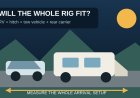
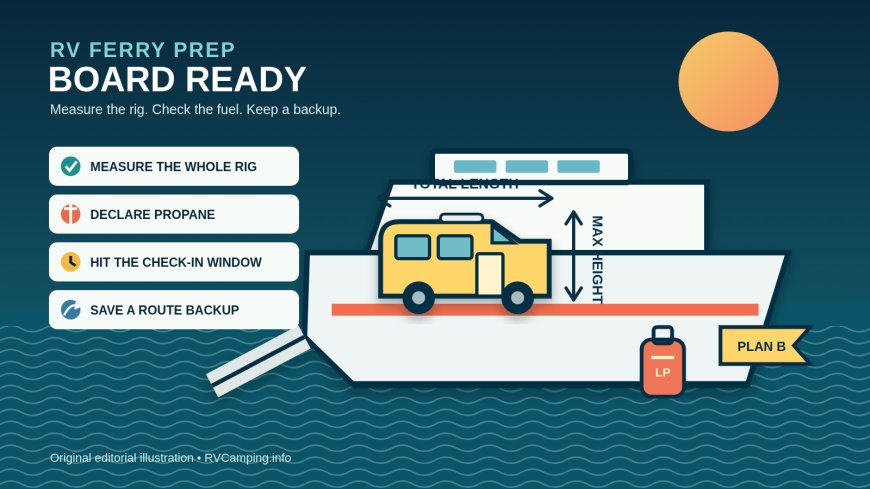
A ferry booking is a space claim for a particular vehicle, not a generic promise to carry "one RV." The useful numbers are the rig's travel-day length and height, plus any width, weight, ground-clearance or overhang detail the operator asks for. Record those numbers before opening the booking screen. Then prepare the propane system, the terminal arrival, and a route backup as separate jobs.
That distinction matters in the Pacific Northwest. Washington State Ferries (WSF) limits vehicle reservations to two corridors: Port Townsend/Coupeville and the service between Anacortes and the San Juan Islands.[1] BC Ferries recommends advance booking on bookable routes and otherwise loads vehicles in arrival order on the next sailing with space.[5] A reservation can solve a capacity problem, but it cannot correct a short vehicle declaration, a missed check-in window or a rig that will not clear the assigned deck.
Measure the RV as it will board
Measure on level ground with the trip load installed. Do not copy a bare chassis dimension or an old sales brochure without checking the finished rig.
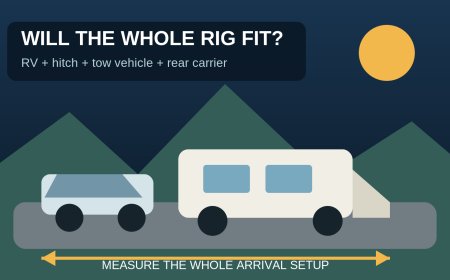
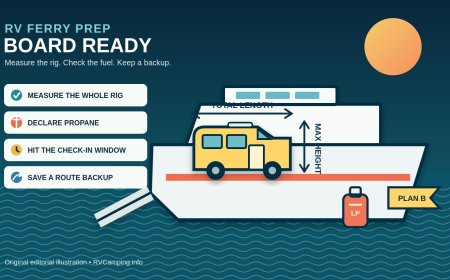
For length, start at the farthest fixed point in front and end at the farthest point behind. Include the tow bar, trailer tongue, rear ladder, spare tire, bike rack and loaded bikes when they project beyond the body. Measure the motorhome and towed vehicle as one connected combination if that is how they will board. Write down both the measured total and the configuration, such as "motorhome plus flat-towed car."
For height, measure from the ground to the highest travel-ready point. Roof air conditioners, vents, antennas, solar hardware and cargo can sit above the roofline printed in a brochure. Lower anything designed to travel folded. Add a small written margin for measurement error, but enter the actual category requested by the operator rather than rounding down to fit a cheaper class.
WSF bases fares on vehicle length. Its special travel-request triggers include more than 8 feet 6 inches of width, less than 14 inches of ground clearance, more than 13 feet 4 inches of height or more than 80,000 pounds GVW. The agency asks travelers who meet any trigger to submit its request form and allow two business days for processing.[2] Those thresholds are not a definition of every RV that needs extra deck space. They are the point at which WSF requires that additional request.
Vessel clearance is a second check. WSF lists Tillikum at 13 feet 6 inches, while the Kwa-di Tabil and Olympic classes reach 16 feet, and tells travelers to check the scheduled vessel's auto-deck clearance.[2] A booking confirmation does not make a tall rig shorter.
BC Ferries uses a different dividing line. A vehicle under 7 feet (2.13 m) high and under 20 feet (6.10 m) long is standard; a vehicle over 7 feet high or more than 20 feet long is oversized, which can affect both fare and deck placement.[5] A roof box or kayak that crosses the height line counts toward the travel profile. Enter the complete measurement, not the height of the van below it.
Make a rig card and keep a photo of it on the driver's phone:
| Booking field | Travel-day measurement |
|---|---|
| Complete connected length | ____ ft ____ in / ____ m |
| Maximum height | ____ ft ____ in / ____ m |
| Maximum width, if requested | ____ ft ____ in / ____ m |
| Ground clearance | ____ in / ____ cm |
| Rear overhang behind rear axle | ____ ft ____ in / ____ m |
| Vehicle and trailer plates | ____________________ |
| Propane cylinder count and marked capacity | ____________________ |
Re-measure after adding a cargo carrier, swapping trailers or changing the towed car. A change that looks minor in the driveway can move the rig into another deck-space category.
Book the route, direction and vehicle profile
Treat each direction as its own movement. WSF reservations are one-way, so a round trip needs both an outbound and a return booking.[1] Confirm the departure terminal, destination, date and sailing before entering the rig dimensions. Similar terminal names and multiple island stops make assumptions expensive.
On the WSF reservation routes, tall non-standard space can follow a different release pattern from standard vehicle space. For the Anacortes/San Juan Islands routes, WSF says 90 percent of tall, non-standard space is released in the first phase, while standard space is released in stages.[1] If an RV sailing appears unavailable, check the official release schedule rather than repeatedly changing the vehicle to a smaller category.
Save the confirmation number, barcode and operator contact number in two places. A screenshot is useful where cellular service is weak, but it should show the current booking after any change. Put the vehicle description next to the confirmation so the driver can compare the two before departure.
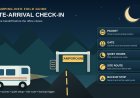
BC Ferries warns that check-in and ticket cutoffs vary by terminal.[5] Do not turn one terminal's rule into a systemwide rule. At Vancouver (Tsawwassen), for example, booked vehicles for Victoria and Nanaimo are accepted from 60 to 30 minutes before departure, while booked vehicles for the Southern Gulf Islands have a 90-to-40-minute window. Arriving before that booking window opens, as well as after it closes, means the booking will not be honored and travel reverts to arrival order.[7]
WSF publishes route-specific arrival guidance too. The recommended lead is 30 to 45 minutes at Port Townsend/Coupeville and 45 to 60 minutes for Anacortes/San Juan Islands. On the island routes, the driver must reach a tollbooth or attendant no later than 30 minutes before sailing or the reserved spot is lost.[1] "At the terminal" is not necessarily "checked in." Leave time for the tollbooth line.
Prepare propane before joining the lane
Ferry propane rules use different measurements, exclusions and procedures. Read the rule for the operator actually carrying the rig. Do not combine a U.S. weight limit with a Canadian cylinder-capacity limit.
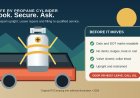
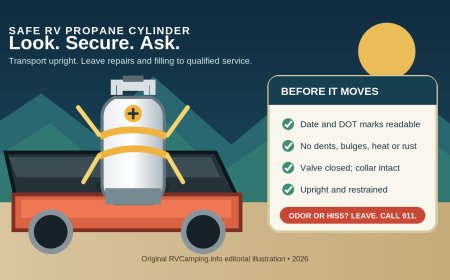
WSF limits the total weight of portable propane tanks and their contents to 100 pounds. Permanently installed tanks on a vehicle frame or chassis are excluded from that portable-tank allowance. If a vehicle carries both portable propane and gasoline containers, WSF limits their combined quantity to 12 gallons of water capacity.[3]
BC Ferries states its RV allowance in cylinder water capacity: up to two cylinders with no more than 65 L combined, and no cylinder over 46 L. It requires propane tanks to be closed and tagged before boarding, with cylinders upright and securely attached to the vehicle.[6] A separate personal-use allowance applies to a vehicle or trailer carrying propane for camping or a barbecue, so read the full current rule if the load does not match a built-in RV setup.[6]
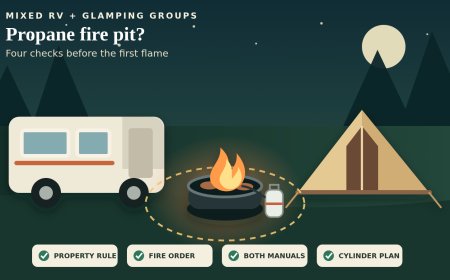
Use the markings on each cylinder rather than guessing from how full it feels. Before leaving the campground:
- close the cylinder or tank valves as the carrier requires;
- shut down propane-burning appliances and confirm every flame is out;
- secure portable cylinders upright in their approved exterior position;
- remove loose spare cylinders that would exceed the operator's allowance;
- keep cylinders accessible for declaration, inspection or tagging;
- tell the ticket agent exactly what is aboard.
The appliance shutdown items are conservative boarding preparation, not a substitute for the carrier's current dangerous-goods instructions. If a refrigerator must be off propane before reaching the terminal, cool it in advance and keep the doors closed. Do not restart an appliance until the operator permits it and the RV is in a safe location.
Make the rig ready to load, not just ready to camp
Stow the interior before entering the terminal approach. A sudden ramp change or deck direction is a poor time for a cabinet to open. Retract slides and awnings, lower antennas, lock exterior doors, secure bikes and roof cargo, and verify that the trailer coupler, safety chains, breakaway cable and electrical connector are set for travel.
Keep the driver's side clear enough to open the window and hear deck crew. Turn off the vehicle alarm once aboard, set the parking brake and follow crew directions; WSF includes those steps in its first-rider boarding guidance.[4] The crew may place an over-height RV where the vessel has usable clearance. A preferred deck is not guaranteed on BC Ferries because placement depends on reservations and over-height traffic at loading time.[5]
Approach ramps slowly and squarely. Long wheelbases, low ground clearance and rear overhang deserve special attention. WSF notes that extreme low tides can create steep ramp angles on several routes and that Port Townsend/Coupeville sailings can be affected by tidal-current cancellations.[2] BC Ferries says low-clearance or long-overhang vehicles may have to wait during extreme tides at some smaller terminals, with Langdale, Horseshoe Bay and Campbell River particularly affected.[5]
If clearance looks doubtful, stop where staff direct and ask. Do not improvise a diagonal approach around people or other vehicles.
Build a route backup before departure day
A backup is more useful when it has a decision time. Write four levels:
- 1. Preferred sailing: booking number, check-in window and latest time to leave the campground.
- 2. Same-terminal fallback: later sailings, standby procedure and the last sailing that still works with campground check-in.
- 3. Alternate crossing or road route: total driving time, fuel range, bridge or border considerations, and any reservation needed there.
- 4. Overnight stop: a legal place that can accept the complete rig if the crossing slips to the next day.
Do not assume standby space will fit a tall RV. WSF warns that unreserved travelers may face very limited standby space and later sailings.[1] BC Ferries places a missed booking on the next available sailing according to arrival order, which can also mean a wait.[5] A realistic backup includes meals, pet needs, medication, battery state and enough fresh water for several extra hours without blocking access to safety gear.
Check the operator's live service notices, assigned vessel, terminal conditions and weather on travel day. If a disruption changes the vessel, recheck clearance. If the alternate road adds hours, choose a cutoff before fatigue makes that route the worse option.
The 15-minute departure check
- The connected rig was measured in its loaded travel configuration.
- Length includes the tow system, rear carrier, bikes and towed vehicle.
- Height includes roof equipment and cargo.
- The booking matches the route, direction, date, sailing and true vehicle class.
- Outbound and return movements are both covered where reservations are one-way.
- The scheduled vessel and known height or tide restrictions were checked.
- The terminal-specific check-in opening, cutoff and arrival target are saved.
- Confirmation number and barcode are available offline.
- Propane quantities fit this operator's rule; valves, cylinders and appliances are prepared.
- Slides, awnings, antennas, compartments and cargo are secured.
- Standby, alternate-route and overnight backups have decision times.
- Live service notices were checked before pulling out.
The final review should compare the physical RV in the driveway with the booking on the phone. That catches the errors that matter: the bike rack added after measuring, the return sailing never reserved, the propane bottle left loose, or the check-in cutoff mistaken for a suggested arrival time.
Sources
- Washington State Ferries Vehicle Reservations, retrieved September 20, 2026.
- Commercial and oversized vehicles on ferries, Washington State Department of Transportation, retrieved September 20, 2026.
- What you can bring aboard, Washington State Department of Transportation, retrieved September 20, 2026.
- First-time riders, Washington State Department of Transportation, retrieved September 20, 2026.
- Travelling with a vehicle, BC Ferries, retrieved September 20, 2026.
- Dangerous Goods, BC Ferries, retrieved September 20, 2026.
- Vancouver (Tsawwassen) Terminal, BC Ferries, retrieved September 20, 2026.
What's Your Reaction?