













"Accessible" Is Not Enough: a Booking Checklist for RV-and-Glamping Groups
A copy-ready question script for mixed RV and glamping groups to verify routes, entrances, bathrooms, beds, transfers, service animals and power before booking.

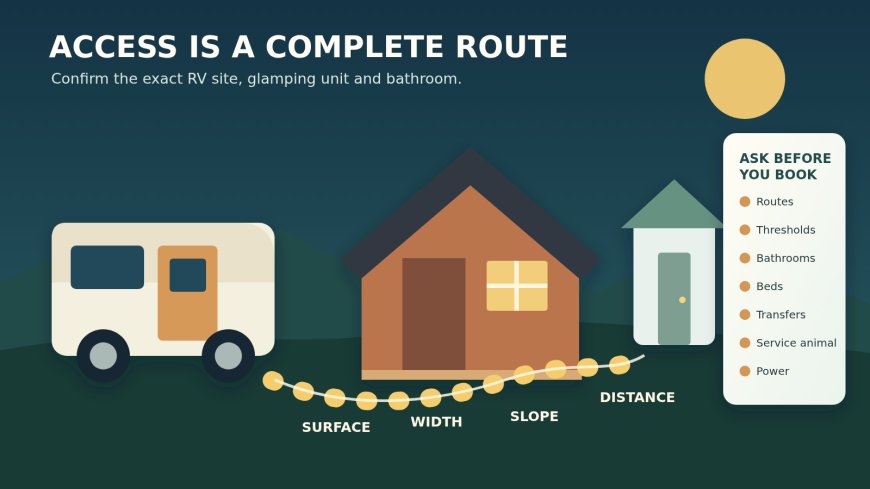

Confirm the entire route, room layout and operating policies before a vague accessibility label becomes a nonrefundable reservation.
"Accessible" is not enough: a booking checklist for RV-and-glamping groups
An RV pad marked accessible and a glamping tent described as wheelchair friendly can still fail the same group. The missing link may be six inches of gravel, one step at the bathhouse, a bed that is too high for a safe transfer, or two units separated by a steep loop road.
Do not book from the accessibility icon alone. Ask the property to describe the exact RV site, tent or cabin, bathroom and routes that will be assigned. Compare those answers with the access needs of the people traveling. A useful answer names surfaces, distances, steps, thresholds, fixtures and policies. "ADA compliant" without those details is not a trip plan.
This guide is practical booking help, not legal advice or a determination that any property complies with disability law.
Separate the legal question from the trip question
Federal rules are not one universal campground blueprint. The operator, land ownership, type of accommodation, age of a facility and scope of later alterations can affect which requirements apply. A furnished cabin may be analyzed as transient lodging in one setting while an outdoor tent platform raises a different set of questions. State and local requirements may add another layer.
For covered places of lodging, the Justice Department's Title III reservation rule requires the reservation service to describe accessible features in enough detail for a traveler with a disability to judge whether a room or property will work.[1] That rule is stronger than a vague icon, but it does not make every cabin, safari tent or individually owned rental legally identical.
The Access Board's outdoor guide needs the same care. Its camping provisions explain federal Architectural Barriers Act standards. The guide expressly warns that its newer outdoor provisions are not part of the Justice Department's 2010 ADA Standards and do not themselves govern state, local or private entities covered by DOJ rules.[3] Use the dimensions in that guide to understand why measurable details matter, not to declare that every private glamping property must match a federal outdoor standard.
There are two questions to keep apart:
- What does the law require of this particular operator and facility?
- Will the assigned units work for each person in this group?
The first may require the operator, its accessibility coordinator or a qualified adviser. The second requires concrete answers before the cancellation deadline.
Map the whole stay, not just the sleeping unit
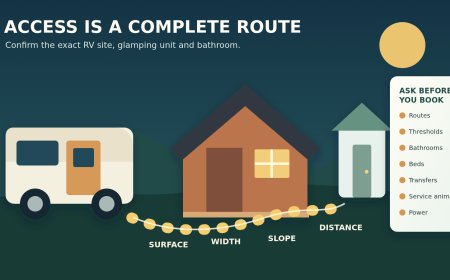
A mixed group uses a chain of spaces: arrival area, RV site, glamping unit, bathroom, meal table and shared gathering spot. One broken segment can separate the group even when each reservation carries an accessible label.
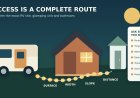
The Access Board describes an outdoor recreation access route as a continuous path linking accessible elements in qualifying federal camping settings. Its baseline route discussion includes firmness and stability, clear width, obstacles, grade, cross slope, resting intervals and passing space.[3] Those categories make a good conversation checklist anywhere, provided they are treated as questions rather than legal conclusions.
Lassen Volcanic National Park shows why readers need unit-level detail. Its accessibility page identifies specific campsites and specific Manzanita cabins. The cabin description mentions a ramp and other furnishings, while the campsite description separately addresses proximity to accessible restrooms.[5] "The campground has accessible cabins" would lose all of that useful information.
Sketch the property as five boxes and draw every route the group expects to use:
- designated parking or the RV parking position;
- the RV door and outdoor living area;
- each reserved tent, yurt or cabin entrance;
- the exact toilet and bathing facility available overnight;
- the fire ring, picnic table, kitchen or gathering area.
Ask about each connecting line. Do not assume that two accessible units are close, that the shortest route is usable, or that a bathroom described on the property page serves the assigned loop after dark.
Send this exact pre-booking question script
Copy the script into an email so the answers create a dated record. Replace every bracketed field. If staff prefer a phone call, send the completed notes back afterward and ask them to confirm or correct the details.
Subject: Accessibility details for [dates] before we reserve
We are a mixed group planning to reserve RV site [site or type] plus [cabin/yurt/furnished tent type]. We need factual details about the exact units before payment. An accessibility label by itself will not tell us whether the setup works. Please answer for the units you would assign, not for the property in general.
1. Routes and location
What are the exact unit or site numbers? How far is the travel route from (a) accessible parking or the RV parking position to the glamping entrance, (b) the glamping entrance to the usable toilet and shower, and (c) the RV site to the shared gathering area? For each route, what is the surface: concrete, pavement, boards, compacted soil, loose gravel, grass or something else? What is the narrowest clear width? Are there slopes, cross slopes, roots, drainage channels, curbs, gates, cattle guards or steps? Where are passing and resting places? Is the route lit after dark, and does rain or snow change the surface or close the route? Please send current photos or a continuous phone video of each route if possible.
2. Entrances, doors and thresholds
At every entrance we will use, are there any steps? If there is a ramp or lift, where is it and will it be available at all check-in hours? What is the narrowest clear door opening when the door is open? What is the threshold height and shape on both sides? Is there a raised track, loose mat, screen door, heavy closer or lip where a ramp meets the deck? Is there level space to stop, open the door and turn? Please include a photo with a tape measure at the threshold and door opening.
3. Toilet and bathing setup
Is the usable bathroom private, shared or in a separate bathhouse? Is it open and unlocked all night? Describe the route to it and every entrance threshold. What are the toilet-seat height, clear space beside the toilet, grab-bar locations and transfer side? Does the door swing into the clear space? For bathing, is the fixture a roll-in shower, a transfer shower, a tub, or a shower with a curb? Give the curb height, interior size, seat type and seat height. Is there a handheld shower head, and can the controls be reached from the seat? Is the sink usable from a seated position? Please send dated photos of the entire room, including the floor beside the toilet and the shower entry.
4. Beds and sleeping transfers
What bed types and mattress sizes are in the exact unit? Measure from the finished floor to the top of the mattress with the bed made. How much clear floor space is available along each side and at the foot? Which side permits a wheelchair or other mobility device to approach parallel to the mattress? Is furniture movable on request, and will staff confirm the layout before arrival? If a portable lift is used, what unobstructed clearance exists beneath the bed frame, including height and depth? Are there rugs, bed frames or guy lines in the transfer area? For a furnished tent, is the bed and transfer floor firm and level in ordinary and wet conditions?
5. Personal transfers and assistance
The traveler will use [independent transfer / transfer board / portable lift / assistance from their own companion / other method]. We are not asking staff to perform personal care. Can the confirmed clear spaces remain free of tables, luggage racks and other furniture? Where can the mobility device be positioned beside the bed, toilet and shower seat? If property equipment such as a shower chair is offered, what exact model, dimensions, arm configuration and weight rating will be reserved, and who verifies that it is present? May we bring our own transfer equipment, and is there a secure place to store it?
6. Service animal
A member of our party will travel with a service animal. Please confirm that the reservation will not be treated as a pet booking or charged a pet fee. Where is the nearest safe relief area, what is the route and surface, and is that route usable after dark? Are there wildlife, livestock, campground or shuttle conditions we should plan for? Please identify any area you believe is restricted and the reason, so we can resolve the question before booking. We will keep the animal under control and handle its care and cleanup.
7. Electricity and powered equipment
The traveler uses [device] with a nameplate input of [volts/amps/watts]. It must operate for [hours/overnight/continuously]. Without asking about the person's diagnosis, please confirm which outlet in the exact sleeping unit may be used, whether it stays energized overnight, and whether that circuit is shared or controlled by a timer, key card or wall switch. How far is the outlet from the bed, and may the approved cord remain where needed without crossing a walking route? What is the property's outage-notification procedure? Are generators, battery stations, extension cords or charging in the unit restricted? Please describe any backup power the property promises, including what it serves and for how long. We will bring the backup specified by the equipment provider rather than assume campground power is uninterrupted.
Please attach these answers to reservation [number] and identify the employee or department confirming them. Tell us which details could change before arrival and whom we should contact for a final recheck [number] days before check-in.
The script is intentionally specific. A staff member may not have every measurement ready. That is useful information too: it tells you to wait for an on-site measurement rather than convert "should be fine" into a nonrefundable booking.
Why the bathroom and bed labels still need measurements
The ADA Standards for transient lodging illustrate the gap between a category and a person's transfer method. Section 806 calls for approach space at both sides of a bed in an accessible sleeping area, with an exception for certain two-bed layouts. It also connects accessible guest-room bathrooms to detailed requirements for toilets, sinks, tubs and showers.[4]
Those standards do not tell a traveler the actual height of this mattress, whether a decorative bed frame blocks a portable lift, which side of this toilet is open, or whether the only shower seat suits a particular transfer. The traveler needs the real layout even when a room was correctly designed under an applicable standard.
Ask for measurements in inches, not adjectives. "Low threshold" and "wide doorway" mean different things to different people. A photo with a tape measure is better. A slow video from parking through the door is better still because it can reveal turns, latches, soft patches and furniture that a close-up misses.
Do not ask staff to promise that a transfer is safe. The person making the transfer, with input from their clinician or equipment provider when appropriate, decides whether the dimensions and equipment fit their needs.
Handle service animals as service animals, not pets
DOJ guidance says covered state, local and private entities generally allow a trained service dog in public areas open to other guests. When the task is not apparent, staff may ask only whether the dog is needed because of disability and what trained work or task it performs. The guidance also says pet fees must be waived, although ordinary damage charges may still apply, and identifies limited reasons an animal may be removed, including lack of control or housebreaking.[2]
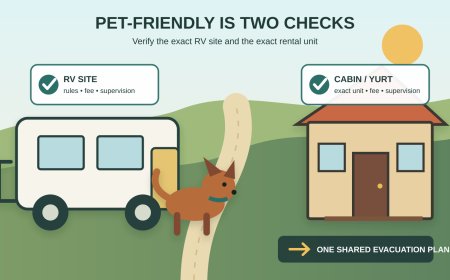
That is the legal guidance. The practical call still matters. A remote glamping property may have wildlife, livestock fencing, shuttle procedures or a distant relief area. Ask about those conditions without accepting a pet-only cabin, pet surcharge or isolation as the automatic answer. If the operator gives a restriction that does not make sense, ask for its accessibility contact and use the ADA Information Line listed on ADA.gov for general information. Get legal advice for a dispute; do not rely on a travel article to resolve one.
Build a power plan that does not depend on optimism
"Electricity available" can mean a lamp and one switched outlet. For powered medical or disability-related equipment, record the exact device input, required run time and approved outlet. Ask whether power is continuous, whether the circuit is shared, how outages are communicated and what backup the property actually maintains.
Keep health details private unless the traveler chooses to share them. The reservation staff need functional facts: the device must run overnight, its electrical rating, where it must sit, and whether a cord may cross a route. They do not need a diagnosis to measure an outlet distance.
Property power is not a complete emergency plan. Follow the equipment manufacturer's or clinician's backup instructions. Confirm whether a battery can be charged in the unit and whether generators are permitted, but do not present a consumer power station as a universal substitute. Capacity, charging time, temperature and device compatibility all matter.
Use a stoplight decision before paying
Green: Staff identify exact units, answer with measurements, provide current images, explain what is guaranteed, and attach the details to the reservation.
Yellow: Staff know the property but need maintenance or an accessibility coordinator to measure. Hold a refundable option if available and wait for written answers before the penalty date.
Red: The answer depends on "usually," an unknown unit assignment, a promised piece of equipment that cannot be reserved, or an inaccessible bathroom that staff expect companions to work around. Choose another unit or property.
For a mixed group, also confirm adjacency. A workable cabin and a workable RV site on opposite sides of a steep campground do not create a workable group trip. Put the site numbers, route distances and bathroom assignment in the same written record.
Recheck before travel and again at arrival
Contact the property shortly before the cancellation deadline and again a few days before arrival. Ask whether construction, weather, a broken lift, a unit swap or a closed bathhouse has changed any confirmed route or feature. If the operator cannot preserve the assignment, compare the replacement with the same script rather than accepting "equivalent" without details.
At check-in, one group member should walk or roll the complete route before unloading. Confirm the bed layout, bathroom equipment, outlet and service-animal relief route. Photograph any mismatch and speak with staff while alternatives are still available.
The goal is not to force every traveler into one definition of accessible. It is to replace a vague claim with enough facts for the person using the space to make the call.
Sources
What's Your Reaction?