
















Before your RV enters a tunnel, verify these four restrictions
A tunnel-specific route check for RV propane, travel height and width, permits, escorts, operating windows and a verified bypass.

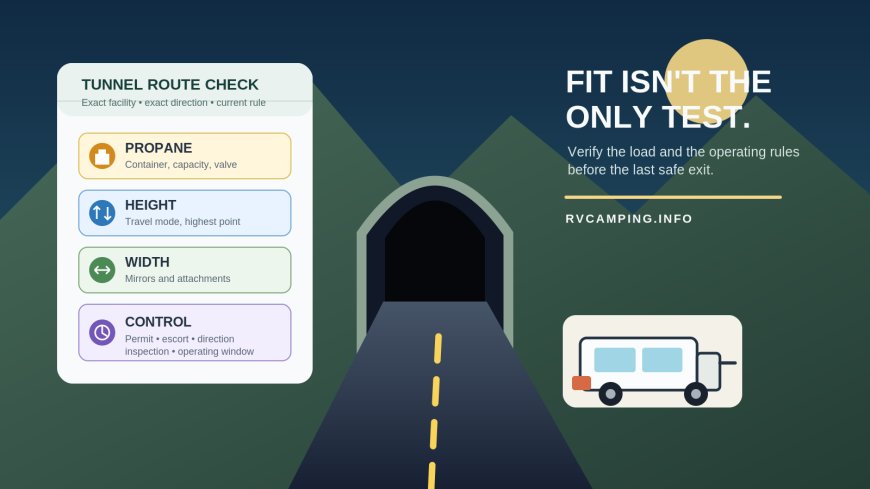
Before your RV enters a tunnel, verify these four restrictions
Planning note (September 14, 2026): Tunnel rules change, and the examples below cover only a handful of facilities. They are not a national tunnel list. Check the official operator for every tunnel on your route, then recheck alerts and posted signs before arrival.
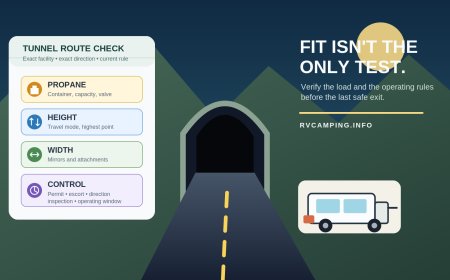
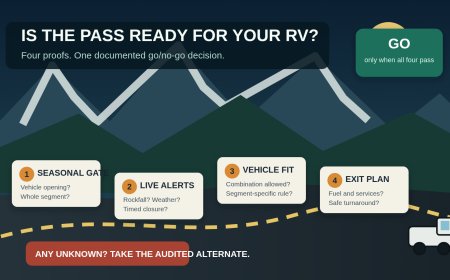
An RV route is not tunnel-ready until you have verified four separate items for the exact facility and direction: propane or other hazardous-material rules, height, width, and any permit, escort or timed-operation requirement. A navigation app can put you on the right highway while missing every one of those checks.
The fastest reliable method is to make a one-page tunnel card before you commit to the approach. Record what the RV carries, its travel dimensions, the rule for the named tunnel, the operating window and a checked bypass. If one field remains unknown, take the bypass before the last useful exit.
Why a generic clearance check is not enough
A low-clearance audit asks whether the rig fits beneath and between fixed objects. A tunnel check has another layer: what the vehicle carries and how the facility operates.
Maryland's two Baltimore harbor tunnels show the difference. The Maryland Transportation Authority says the Fort McHenry Tunnel on I-95 and Baltimore Harbor Tunnel on I-895 prohibit bottled propane in containers larger than 10 pounds, even when the containers are empty. The same notice gives different size limits for each tunnel: 13 feet 6 inches high and 8 feet wide for I-895, versus 14 feet 6 inches high and 11 feet wide for I-95.[1]
A rig can therefore fit the concrete opening and still be prohibited because of its propane cylinder. It can also pass one Baltimore tunnel's dimensional screen but fail the other's. "The tunnel on I-95" is not a complete record; the card needs the facility name, route and direction.
Build the tunnel card before routing
Use one card per tunnel, bridge-tunnel or named bore. Put these fields at the top:
- facility name, route number and direction;
- operator and official restriction page;
- planned arrival date and time;
- RV height and width in travel mode;
- motorhome length or connected tow-combination length;
- every propane container or tank, including empty spares;
- other carried fuels or hazardous materials;
- permit, inspection, escort and schedule result;
- last safe exit or turnaround;
- verified alternate route;
- date and time of the latest check.
Do not combine several tunnels under one shorthand entry such as "Norfolk tunnels." Virginia DOT lists different height and width conditions for the Hampton Roads, Midtown, Downtown and Monitor-Merrimac facilities.[5] Treating a regional tunnel system as one obstacle invites the wrong limit to be applied at the wrong portal.
Check propane by container, capacity and installation
Start with an inventory, not a yes-or-no answer to "Do we have propane?" Record each cylinder or tank separately:
| Item | What to copy from the label or data plate |
|---|---|
| Removable DOT cylinder | quantity, rated propane capacity, water capacity if shown, and whether full or empty |
| Permanently mounted ASME tank | rated capacity, installation type and fuel use |
| Portable grill bottle or spare | capacity, secure storage location and valve condition |
| Propane-powered vehicle system | manufacturer installation or conversion details and rated fuel capacity |
| Gasoline or other fuel can | fuel type, container capacity and quantity |
Keep the units exactly as the operator publishes them. "Pounds of LP-Gas," "pounds water capacity" and gallons are not interchangeable labels. If the facility's wording and the tank plate do not give you a clean comparison, call the operator. Do not improvise a conversion to get under a limit.
Rules can differ sharply. At the Chesapeake Bay Bridge-Tunnel, the published noncommercial rule allows no more than two non-permanently mounted containers of up to 45 pounds LP-Gas each, or one up to 60 pounds LP-Gas. It separately addresses permanently mounted tanks used as motor fuel. The tanks must meet approved standards, may be inspected at the toll plaza, must be secured and must have their valves closed during the crossing.[2]
That allowance does not carry over to Boston. MassDOT's tunnel emergency guidance says hazardous materials, including propane, are always prohibited in its tunnels.[3] Nor does closing a valve erase Maryland's container-size rule; MDTA explicitly says its Baltimore restriction applies to empty as well as full bottles.[1]
The practical rule is simple: never transfer a propane answer from one tunnel to another. Save the exact operator language on the card and note whether it applies to personal vehicles, commercial vehicles, alternative-fuel systems or carried cargo.
Measure height and width in travel mode
Use actual travel dimensions, not the RV brochure's body measurements. Height includes the highest fixed or deployed-for-travel item: air conditioner, vent cover, antenna base, satellite hardware and any rack-mounted load. Width includes mirrors and anything that remains extended while moving.
Measure on level ground with normal tire pressure and the suspension at its travel setting. For a towable, couple it to the tow vehicle first. Record both the measured number and a margin; do not treat the posted maximum as a target.
Facility-specific figures matter. MassDOT lists 12 feet 6 inches for the Callahan and Sumner tunnels, while its Ted Williams, O'Neill and CANA tunnel entries show 13 feet 6 inches.[4] VDOT lists 13 feet 6 inches westbound at the Hampton Roads Bridge-Tunnel without a permit, but 14 feet 6 inches eastbound with a permit. Its page also says widths above 10 feet 6 inches there require a VDOT escort.[5]
These are examples, not default U.S. limits. They also show why direction belongs on the card. A height result for one bore cannot be pasted onto the return trip without checking.
Separate three outcomes: allowed, allowed with controls, prohibited
For each rule, write one of three decisions:
- Allowed: the official page plainly permits the exact configuration without a special process.
- Controlled: passage requires an inspection, permit, escort, staging lane or scheduled window that you have confirmed.
- Prohibited or unresolved: the published rule excludes the RV, or the available evidence does not answer the question.
An escort is not a waiver you can assume will be available at the portal. VDOT says vehicles wider than 10 feet 6 inches at the Hampton Roads and Monitor-Merrimac facilities must be escorted by VDOT.[5] That statement tells an affected traveler to contact the agency in advance; it does not promise on-demand passage or authorize a driver to proceed until someone stops them.
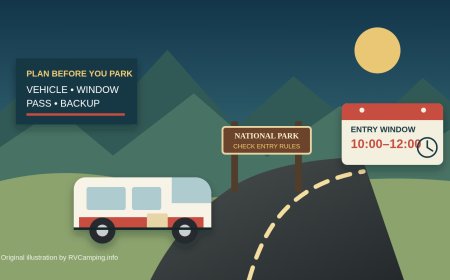
The Anton Anderson Memorial Tunnel near Whittier, Alaska, is a useful time-control example. Alaska DOT classifies vehicles above 10 feet wide or 14 feet high, up to 11 feet wide and 15 feet high, as Class E. It says special operating hours are scheduled for those vehicles, with staff direction and assistance as needed.[6] The normal schedule is directional: vehicles stage at each end for alternating 15-minute departure windows, and unscheduled trains can add 15 to 30 minutes.[7]
For a September trip, the posted summer schedule applies through September 30 and lists daily operation from 5:30 a.m. to 11:15 p.m. Winter hours begin October 1.[7] A campground ETA that ignores the direction window can be wrong before traffic or weather adds any delay.
Look for rules that changed, not just pages that still rank
Old advice is especially risky when it describes an escort program. Beginning June 7, 2026, Zion National Park no longer permits vehicles exceeding its published large-vehicle limits on the Zion-Mt. Carmel road linking Canyon Junction with the park's East Entrance.[9] The current limits include 7 feet 10 inches wide and 11 feet 4 inches high; single vehicles are limited to 35 feet 9 inches, while connected combinations have a 50-foot overall cap and a 26-foot cap on the trailer's hitch-to-rear-axle span.[8]
That means a pre-change article about arranging one-way tunnel traffic is not proof of access in September 2026. NPS says the restrictions cover the entire highway segment, not merely the tunnel.[8] The correct action for an over-limit RV is to use an alternate route, not to arrive expecting the former tunnel-control process.
When you research a tunnel, check the update date and compare any general page with current alerts or dated policy notices. Search snippets and saved forum posts can help identify a concern. They do not decide the route.
Call with a question the operator can answer
"Can my RV go through?" leaves too much unstated. Use a short script:
I am planning to travel through [facility and direction] on [date] at about [time]. My RV is [height] high and [width] wide in travel mode. The complete combination is [length]. I carry [number and type of propane containers], each labeled [capacity and units], plus [other fuel containers]. Is this exact configuration permitted? Do I need an inspection, permit, escort or reserved time? Where must I exit if it is not permitted?
Write down the office, phone number, time and answer. Ask the operator to point you to the controlling webpage or regulation. If the answer conflicts with a posted restriction, do not choose the more convenient version. Ask for clarification or reroute.
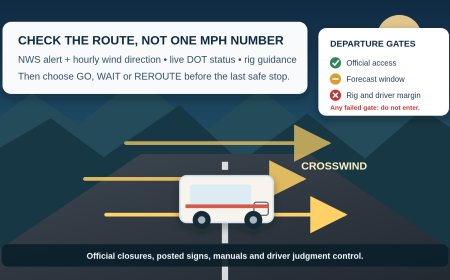
A phone call also cannot overrule an on-scene closure, traffic officer or posted sign. The final authority at arrival may be a temporary control that did not exist when the card was made.
Verify the bypass as carefully as the tunnel
"Avoid highways" is not a bypass plan. The alternate needs its own screening for clearances, weight limits, propane rules, construction, tolls and turn restrictions. It must split from the original route before the last legal exit for the tunnel approach.
Record the bypass as a sequence of route numbers and junctions. Save enough detail for weak-cell-service areas. If the operator publishes an alternate, start there, but still check current conditions. MDTA's Baltimore notice directs affected traffic to the western side of I-695 around the tunnels.[1] That is more useful than asking a map app to improvise after the RV has entered the final approach.
Add a decision sentence to the card:
Use [tunnel] only if propane, travel height, travel width and required controls remain confirmed at [recheck time]. Otherwise leave at [decision exit] and follow [verified bypass].
Use a four-check timeline
- One to two weeks before departure: identify every tunnel and directional bore, inventory propane and fuel, measure the loaded rig, and build the bypass.
- The day before: reopen each official restriction page, check alerts and confirm permits, inspections, escorts or operating windows.
- Before moving: check the live road system and weather. Make sure the propane valves are in the condition the operator requires, without assuming valve closure makes a prohibited load legal.
- At the last safe stop: look for new signs or controls. If the card and the road disagree, follow the sign and leave the approach.
The tunnel card is complete only when every field has a source, a measurement or a named fallback. "Probably fine" is an unresolved field.
Sources
- Reminder: I-95 & I-895 Tunnel Restrictions (Maryland Transportation Authority, accessed 2026-09-14)
- Hazmat and Compressed Gas Regulations (Chesapeake Bay Bridge-Tunnel District, accessed 2026-09-14)
- Tunnel emergency awareness (Massachusetts Department of Transportation, accessed 2026-09-14)
- Commercial truck permits - height and weight limitations (Massachusetts Department of Transportation, accessed 2026-09-14)
- Truck restrictions (Virginia Department of Transportation, accessed 2026-09-14)
- Whittier Tunnel FAQs (Alaska Department of Transportation and Public Facilities, accessed 2026-09-14)
- Whittier Tunnel Schedule and Hours of Operation (Alaska Department of Transportation and Public Facilities, accessed 2026-09-14)
- Large Vehicles (National Park Service, Zion National Park, accessed 2026-09-14)
- Zion National Park Prepares to Implement Large Vehicle Restrictions on the Zion-Mt. Carmel Highway (National Park Service, Zion National Park, accessed 2026-09-14)
What's Your Reaction?