



The Two-Map Test for Booking an RV-and-Glamping Group Stay
A practical campground comparison method for groups splitting a stay between RV sites and glamping rentals, with a five-part booking checklist.

One couple is bringing a fifth wheel. Another wants a cabin with a real bed. Someone else is fine in a furnished tent, as long as the bathroom trip at 2 a.m. is not an expedition.
A campground can list all three accommodation types and still be a poor fit for that group. The problem usually appears after booking: the RV loop is across the property from the cabins, the glamping deck has no cooking, quiet hours end the evening early, or each reservation has a different cancellation deadline.
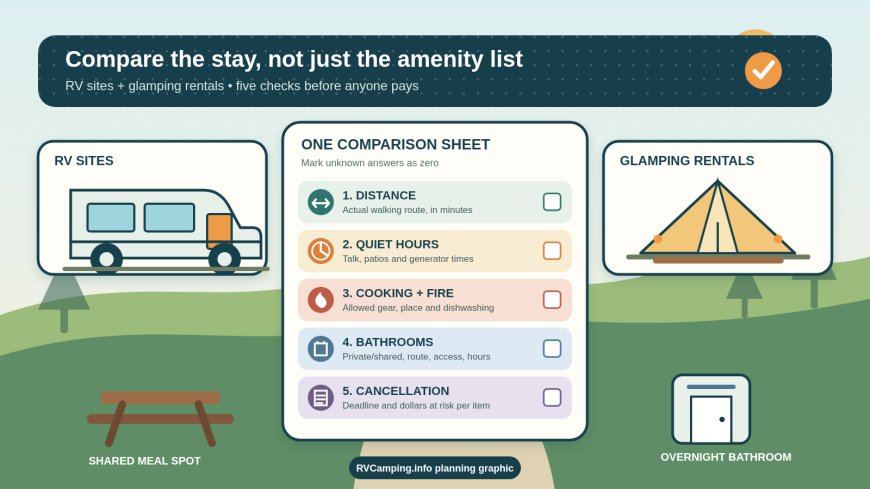
The fix is to compare how the stay will work, not how many amenities appear on the listing. Use two maps, five questions and one written reply from the campground before anyone pays.
Source note: This guide was prompted by Camp New York's article on campgrounds as group venues. That piece points out that group-friendly parks may have pavilions, lodges, grills, electricity and nearby restrooms.[1] The framework below is original RVCamping.info analysis for groups splitting their stay between RV sites and glamping-style rentals.
Start with two maps
Ask for the campground map and make a second, simple map of your own.
The campground map should show the actual RV sites and rental units under consideration, not just the pool, office and entrance. If online booking reveals site numbers, mark those. If the system assigns accommodations later, ask which loops or clusters are normally used.
Your map only needs five points:
- every RV site and rental your group may book;
- the bathroom each party can use overnight;
- the place where everyone expects to eat;
- parking for extra vehicles; and
- the route between all of them.
Do not accept "close" as a distance. Ask for walking time in minutes or an estimated distance along the route people actually use. A cabin and RV pad may look adjacent on a stylized map but sit on opposite sides of a creek, fence or one-way road.
Then test the map against the least mobile person, the youngest child and the person most likely to make a late bathroom trip. If the setup works for those three, it will probably feel easy for the rest of the group.
Set the distance limit before you search
Groups get into trouble when "nearby" changes meaning after a favorite campground appears. Pick the limit first.
For example, your group might decide that the shared meal site must be within a five-minute walk of every sleeping space, and that anyone using a shared bathroom must have a shorter, lit route. Those are not universal standards. They are booking rules for your trip.
Also ask whether guests may walk through occupied sites. The shortest line on a map may not be an acceptable path.
Read quiet hours as an itinerary rule
Quiet hours are more than a noise policy. They determine whether the group can linger over dinner, run an RV generator, sit on a cabin porch or arrive late without waking a loop.
Get exact answers to these questions:
- When do quiet hours begin and end?
- Must conversation move indoors, or is low-volume talk outside allowed?
- Are generator hours different from quiet hours?
- Do the same rules apply at cabins, glamping tents and RV sites?
- What happens during campground events or holiday weekends?
Theodore Roosevelt National Park, for instance, sets quiet hours from 10 p.m. to 6 a.m. and permits generators from 8 a.m. to 8 p.m. in the campgrounds covered by its posted regulations.[3] That is one park's rule, not a default you should assume elsewhere. It shows why a group needs both times in writing.
Compare those hours with the trip you are actually planning. If dinner starts at 8:30 and the only gathering spot is an RV patio in a quiet loop, the group has a mismatch even if every accommodation is available.
Separate cooking from having a fire
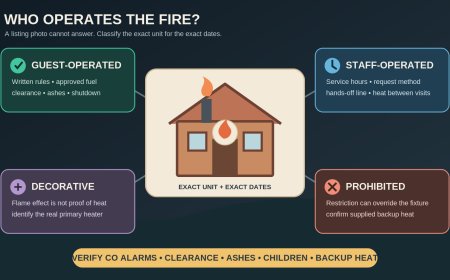
A fire ring does not automatically mean guests may cook over it. A grill does not mean the glamping unit permits food preparation. A kitchenette may have a microwave and mini-fridge but no sink, cookware or dishes.
Build a small cooking inventory for each accommodation:
| Question | RV site | Glamping rental |
|---|---|---|
| Private fire ring? | Confirm | Confirm |
| Charcoal allowed? | Confirm | Confirm |
| Propane grill or stove allowed? | Confirm | Confirm |
| Cooking allowed on the deck or inside? | Not applicable or confirm | Confirm |
| Food storage rules? | Confirm | Confirm |
| Dishwashing location? | Confirm | Confirm |
| Fire restrictions can change before arrival? | Ask how guests are notified | Ask how guests are notified |
Posted rules can separate these activities sharply. Theodore Roosevelt National Park allows open fires only in designated grills or rings, or in portable fire pans that contain ash and residue. Its sanitation rule tells campers to wash dishes at their site rather than in comfort stations or at water faucets.[3] A mixed group therefore needs a meal plan that is legal for both the RV side and the rental side.
Choose one of three workable arrangements before booking:
- Everybody cooks and eats at one designated site.
- Each accommodation handles breakfast and lunch, then the group shares dinner at an approved gathering area.
- The group uses a pavilion or communal cooking area that the campground confirms is included or reserved.
Ask who supplies the table, grill, fuel, utensils and water. "Outdoor kitchen" is not a useful answer until you know what is physically there.
Audit bathrooms by route, not by checkbox
A listing that says "bathrooms available" leaves most of the useful questions unanswered.
For every rental, confirm whether the toilet and shower are private, shared or absent. For every RV, note whether the group expects to use the rig's bathroom, a bathhouse or both. Then record:
- walking distance and surface;
- steps, grades, curbs and thresholds;
- lighting after dark;
- whether a code or key is required;
- toilet and shower operating hours;
- family or companion-care rooms;
- whether the facility closes for cleaning; and
- the seasonal status of water and showers.
Do not use the word "accessible" as the whole question. Ask about the feature a traveler needs: a step-free route, door width, grab bars, shower seat, turning space, firm ground or room beside an RV lift.
The U.S. Access Board's federal outdoor standards illustrate why specifics matter. In covered camping facilities, camping units with mobility features must offer choices comparable to and integrated with other units. The standards also address features inside those units, including RV parking, vehicle parking, tent pads, platforms and shelters.[2] Those federal Architectural Barriers Act provisions do not certify every public or private campground. They are a useful reminder to verify the route and the individual features instead of relying on a single icon.
A practical request sounds like this: "Can a guest using a walker travel from rental G4 to the nearest toilet on a firm, step-free, lit route, and about how far is it?" That gives the campground something concrete to answer.
Compare cancellation terms as one group bill
Mixed groups often make several reservations, sometimes under different product categories. Put every component in one table before checkout.
| Booking | Deposit due | Free-change deadline | Cancellation deadline | Amount lost after deadline | No-show rule |
|---|---|---|---|---|---|
| RV site 1 | |||||
| RV site 2 | |||||
| Cabin or tent 1 | |||||
| Cabin or tent 2 | |||||
| Pavilion or group area |
Look for five details: whether the deposit is refundable, the cutoff time and time zone, a separate cancellation fee, the treatment of shortened stays, and whether one cancelled accommodation affects the others.
Do not assume sites and rentals share a deadline. Recreation.gov's general policy treats late cancellation of an individual campsite differently from a cabin, lookout or yurt. Under the posted policy, the cabin category enters its late-cancellation window less than 14 days before arrival, while an individual campsite becomes late after midnight local time on the day before the reservation starts. Both can involve a $10 fee and loss of the first night's fees.[4] Recreation.gov also says a facility's own page overrides the site-wide policy when the two differ.[4]
That example is not a price forecast for another campground. It is a reason to copy the terms attached to each item in your cart and save them with the confirmation.
Pick one person to calculate the group's total money at risk on three dates: a month before arrival, a week before arrival and the day before arrival. If the result would cause an argument, agree in advance whether each household absorbs its own loss or the group shares it.
Use hard stops before scores
A score can make a bad fit look acceptable. Check hard stops first.
A hard stop is any condition that makes the trip unworkable, such as:
- an RV that cannot fit the available pad;
- no step-free bathroom route for a traveler who needs one;
- no permitted way to prepare the group's planned meals;
- rentals too far from the RV sites for child supervision; or
- cancellation exposure the group cannot accept.
Any hard stop removes the campground from the list. Do not average it away.
For the campgrounds left, score each of the five categories from 0 to 2:
- 0: unknown or poor fit;
- 1: workable with a compromise;
- 2: confirmed fit.
The five categories are distance, quiet hours, cooking and fires, bathrooms, and cancellation terms. Keep the notes beside the number. "Distance: 2" is weak; "all units within a four-minute walk on the marked road: 2" is useful.
A campground with a lower total may still win because it has fewer fragile assumptions. Treat every unanswered question as zero until the campground replies.
Send one message and keep the answer
A short, specific note is easier for staff to answer than a general request for adjoining accommodations.
We are considering [dates] for [number] people in [RV types/sizes] plus [number and type of rentals]. Before booking, could you confirm:
- Which RV sites and rentals could be assigned, and the walking distance between them along permitted paths?
- The nearest overnight bathroom for each rental, including whether the route is lit and step-free?
- Quiet hours and generator hours for both areas?
- Where our group may use a propane stove, grill or fire ring, and where dishes may be washed?
- The cancellation, change, early-departure and no-show terms for each reservation and any group space?
If exact assignments are not possible, which loops or rental clusters should we compare on your map?
Save the reply, the map and screenshots of the terms. Then have one person read the plan back to the group: where everyone sleeps, where everyone eats, which bathroom each person will use and how much money is at risk.
The best mixed-accommodation booking is not the one with the longest amenity list. It is the one the whole group can picture clearly before anyone enters a card number.
Sources
[1] Rethink the Venue: Why Campgrounds Make Unforgettable Event Spaces
[2] Chapter 10: Outdoor Developed Areas
What's Your Reaction?