





Can Cabin Guests Gather at the RV Site? A Mixed-Stay Rules Worksheet
Use this mixed RV-and-cabin worksheet to verify guest counts, visitor hours, vehicles, pet handoffs and written approvals before booking.

Can Cabin Guests Gather at the RV Site? A Mixed-Stay Rules Worksheet
By Romana | Category: Glamping
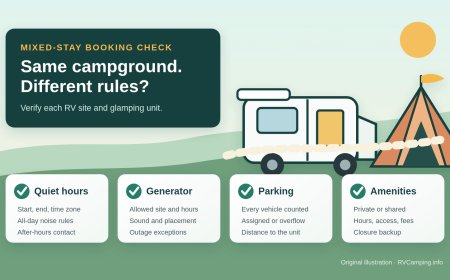
A cabin and an RV site can be two reservations inside one campground—and two different rule sets. Before the group chooses the RV patio as headquarters, verify who may enter, who may stay after dark, whose occupancy total they count toward, and whether a pet may move with them.
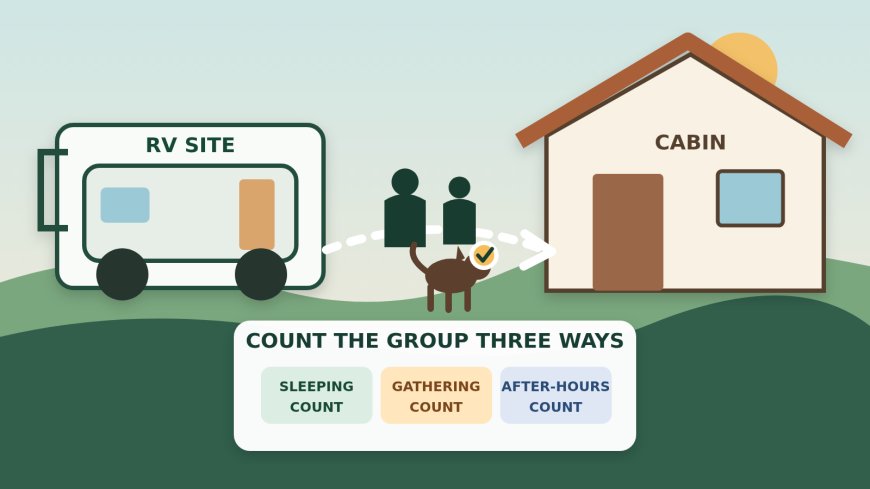
The safest answer is not “we booked enough beds.” It is a written plan showing where every person, vehicle and pet is registered at three moments: overnight, during a daytime gathering and after visitor hours end.
This worksheet is intentionally about cross-use: cabin guests visiting the RV site, RV guests using the cabin porch, and friends joining for a meal. It is not a destination ranking. The official examples below show why a group cannot infer gathering permission from sleeping capacity alone.
Four labels that are easy to confuse
A booking page may use occupant, registered camper, co-camper and visitor as if everyone knows the difference. Do not build the itinerary around those labels until the operator defines them.
- Overnight occupant: a person assigned to sleep in a particular RV site or rental unit.
- Registered guest or co-camper: a person recorded on a reservation or at check-in. The operator may apply this label property-wide or to one unit only.
- Day visitor: someone admitted for limited hours, sometimes with a fee or vehicle pass, but not approved to sleep there.
- Gathering attendee: an editorial planning label, not necessarily a campground category. It means anyone physically present at the meal, fire ring, porch or RV patio at that moment.
Those groups can overlap, but they are not automatically interchangeable. At Jetty Park, the Canaveral Port Authority’s rules set a maximum of six people for an RV/tent site and four for a cabin site. They separately define co-campers as registered campers’ overnight guests, require notice before the registered camper arrives, and limit ordinary camper guests to Day Park hours.[1] A four-person cabin reservation plus a six-person RV reservation therefore does not prove that all ten may gather at the RV site.
Washington State Parks uses different wording. Its statewide camping page allows one camping party and no more than eight people per site. It says day visitors need a day-use or annual pass; overnight visitor parking can carry a nightly fee and remains subject to the site’s eight-person capacity.[2] That is useful evidence, but a mixed group should still ask whether people already registered to a cabin count as visitors when they walk over to an RV site.
Oregon State Parks says a regular site usually allows eight campers, while some allow six; cabin and yurt capacities vary from five to eight by location, and the park manager has the final say. The registered camper is responsible for everyone’s activity at the site.[3] Again, the published sleeping limit does not answer how many people may attend dinner at one unit.
California State Parks makes the verification problem explicit: its statewide reservation policy directs travelers to each park’s own page for local headcount restrictions, animal policies and other important details. It also says adjacent assignments for two reservations at a non-site-specific park are subject to availability.[4] “Same campground” may not mean “next door,” and a systemwide rule may not be the last word.
The three-count worksheet
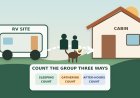
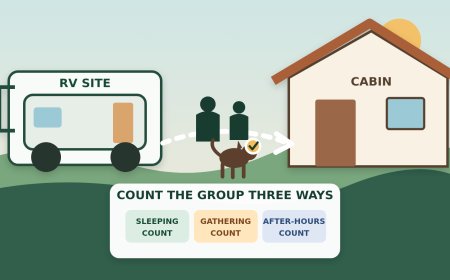
Create one row for every person, including children. Then count the group three ways rather than relying on one headcount.
| Person or pet | Sleeps at | Registered under | At RV meal? | At cabin after dark? | Leaves property by | Written proof |
|---|---|---|---|---|---|---|
| Person 1 | RV site ___ | RV reservation | Yes / No | Yes / No | Overnight guest | Confirmation / email |
| Person 2 | Cabin ___ | Cabin reservation | Yes / No | Yes / No | Overnight guest | Confirmation / email |
| Day visitor | Off property | Visitor pass / none | Yes / No | Yes / No | ___ p.m. | Visitor policy |
| Pet A | RV / cabin ___ | Reservation ___ | With handler? | With handler? | N/A | Pet approval |
Now calculate:
- 1. Sleeping count: the people assigned overnight to each unit. Compare each subtotal with that exact unit’s limit.
- 2. Gathering count: everyone who will be physically present at the host site during the largest meal or activity. Ask whether the host site’s occupancy rule applies to this number.
- 3. After-hours count: everyone remaining in that campground area after day-visitor hours. Confirm which people must return to their assigned unit and which may remain as registered property guests.
Do not “solve” an over-capacity gathering by moving names between reservations unless the operator approves the change. Some systems require the named reservation holder to be present. Jetty Park says its reservation holder must remain for the stay and that co-campers cannot enter the campground before the registered camper checks in.[1] The person whose credit card made the booking is therefore not always a disposable administrative detail.
Ask where the boundary is
Occupancy rules can describe a reservation, a sleeping unit, a physical site or the whole campground. Those boundaries produce different answers.
For the proposed host location—perhaps the RV’s picnic table—mark the physical edge on the site map. Ask whether the limit applies only to people sleeping there or to everyone present. Then ask whether a cabin occupant walking over is treated as:
- an already registered overnight guest of the property;
- a visitor to the RV site;
- an occupant counted against the RV site limit; or
- someone allowed to gather there only during specified hours.
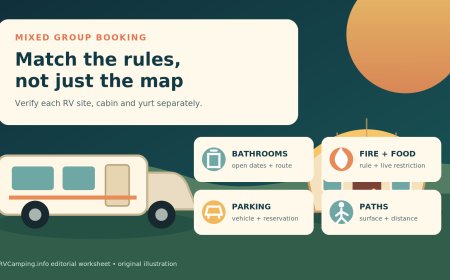
Do the same in reverse for the cabin porch or fire ring. A cabin’s bed capacity may be four while its outdoor area has a different practical or legal limit. Never treat a larger deck, extra chairs or an open patch of ground as permission for more people.
If the answer is “small gatherings are fine,” ask for a number and an end time. If the group intends a birthday dinner, reunion, catered meal or amplified music, describe it plainly. The activity may cross from ordinary socializing into a group-use or special-event rule even if nobody sells tickets.
Register vehicles separately from people
A person may be permitted while their car is not. Washington advises checking the exact site description for room or nearby parking before bringing an extra car and posts a nightly extra-vehicle charge.[2] Oregon says overflow arrangements vary by campground and a nightly extra-vehicle charge may apply.[3] California’s statewide policy bundles the arriving vehicle plus a lawfully towed car or trailer into the base fee, then assesses a nightly charge for additional vehicles; the specific park still controls details.[4]
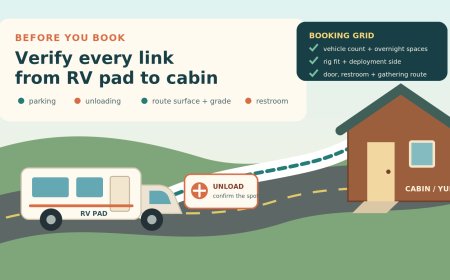
Make an inventory of the RV, its towing or towed automobile, and the cars driven by cabin occupants. For each, record:
- the reservation or visitor pass attached to it;
- the legal overnight parking location;
- whether it must leave when day-use hours end;
- the fee and whether payment guarantees a space;
- whether a hangtag, plate number or check-in is required.
“Cabin guests will park at the RV” is not a parking plan until the operator confirms both the space and the permit. Keep the lane, neighboring site and deployed slide or awning clear regardless of what the occupancy rule allows.
Add a pet handoff row
This article pivots away from the already-covered question of whether a pet may sleep in an RV or cabin. Here, the narrower issue is whether the pet may accompany a registered cabin guest to the RV gathering, and who supervises it there.
Rules can be strict about that distinction. Jetty Park prohibits pets in cabins, allows only dogs and cats in its campground, charges for dogs at RV sites, caps animals at an RV site, bars campers’ guests from bringing animals and forbids leaving a pet alone.[1] Washington allows pets in campsites but only in designated pet-friendly roofed accommodations.[2] Those two policies use different categories; neither supports a universal assumption that an animal approved somewhere on the property may visit every reserved unit.
Write down:
- which reservation lists the pet;
- whether it may enter the other party’s site;
- whether the animal counts against a per-site pet maximum;
- whether the handler must be the registered owner;
- where the animal may wait during a meal or activity;
- what “unattended” means inside an RV, cabin, vehicle or crate;
- the route to an approved relief area; and
- the backup if the pet cannot join and cannot remain alone.
Avoid a handoff that leaves the dog tied outside the RV while everyone goes to the cabin. A supervision plan needs a named adult, a permitted location and an answer for heat, power loss, barking or an early departure.
Send one scenario, not ten vague questions
A short message with exact numbers is easier to answer than “Are groups allowed?” Copy and complete this template:
Our group intends to book RV site [number/type] for [number] overnight occupants and cabin [number/type] for [number] overnight occupants on [dates]. We will have [vehicle count] vehicles and [pet count/species] pets. We would like all [total] registered overnight guests to share dinner at the RV site from [time] to [time], with no additional public visitors. Please confirm in writing: (1) whether cabin occupants may enter and gather at the RV site; (2) the maximum number of people allowed there at one time; (3) whether they count as RV-site visitors or remain cabin guests; (4) any visitor, wristband, vehicle or extra-person fees; (5) when anyone must return to their assigned unit; (6) whether the listed pet may accompany its handler to the RV site and where it may be left, if anywhere; and (7) whether the reservation holders must be present at check-in and throughout the stay.
If outside friends may join, send a second scenario with their number, arrival method and departure time. Do not hide them inside the first question; visitor policies may differ from cross-visits between registered overnight guests.
What to save before paying
Keep the operator’s reply with both reservation confirmations, not in one traveler’s text thread. Save:
- the exact RV site and cabin type or number;
- each unit’s sleeping and at-one-time occupancy limits;
- names or counts registered to each reservation;
- visitor hours, passes and fees;
- vehicle assignments and overflow location;
- pet registration, cross-site permission and unattended-pet answer;
- reservation-holder presence requirements;
- the contact’s name, date and communication channel; and
- screenshots or PDFs of the rules in effect when booked.
Recheck before the cancellation deadline and shortly before departure. If the staff answer conflicts with the published rule, ask which document controls and request a corrected written confirmation. Do not rely on “the host probably won’t mind.”
The booking works when the sleeping count, gathering count and after-hours count all fit—and when every vehicle and pet has a permitted place during the same schedule. Two valid reservations do not automatically create one valid group site.
Sources
- Jetty Park Rules and Regulations — Canaveral Port Authority — Reservation holder must be present; co-campers cannot enter before registered camper checks in.; Maximum six people per RV/tent site and four per cabin site.; Camper guests are limited to Day Park hours; overnight co-campers must be disclosed before arrival.; Pets are prohibited in cabins; RV-site dog fee, pet maximum, guest-pet prohibition, and no-unattended-pet rule are stated. Accessed September 21, 2026.
- Camping — Washington State Parks — One camping party and no more than eight people per site.; Day visitors require a day-use or annual pass; overnight visitor parking has a nightly fee and cannot exceed site capacity.; Extra-car feasibility depends on the exact site or nearby parking.; Pets are allowed at campsites but only designated roofed accommodations. Accessed September 21, 2026.
- Statewide FAQ — Oregon State Parks — Usual campsite maximum is eight, with some six-person limits; cabin and yurt limits vary from five to eight.; Park manager has final say.; Extra-vehicle arrangements vary and a nightly fee may apply.; Registered camper is responsible for everyone at the site. Accessed September 21, 2026.
- Camping Information & Reservation Policies — California State Parks — Exact park pages control occupancy, pet rules and other critical details.; Base fee covers one vehicle and one legally towed vehicle or trailer; additional vehicles are charged nightly.; Adjacent assignments for two reservations in non-site-specific parks are subject to availability. Accessed September 21, 2026.
What's Your Reaction?