






Black Rock vs. Cottonwood vs. Indian Cove: the RV-fit comparison
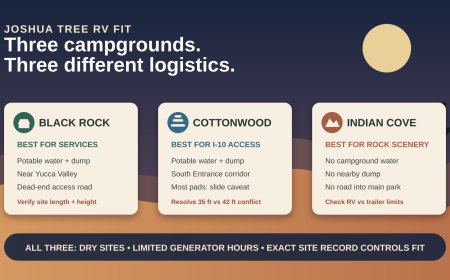
Black Rock leads for Yucca Valley services, Cottonwood for I-10 access, and Indian Cove for rock scenery—but exact Recreation.gov site fields decide RV fit.

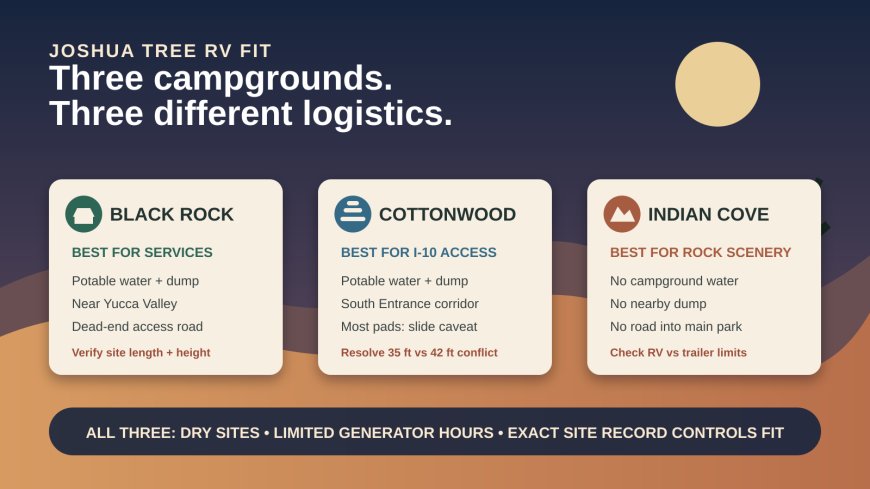

Quick answer: Black Rock is the best utility-and-resupply base: fresh water, flush toilets and waste disposal are available near Yucca Valley. Cottonwood offers the same tank-servicing advantage from the I-10 side, but most pads are too narrow for slide-outs. Indian Cove is the rock-scenery choice near Twentynine Palms; fill before camp and plan to dump elsewhere. Its road also does not join the park's main drive. Every individual site in this comparison lacks electric, water and sewer connections.[7][8][9]
This comparison is deliberately narrower than a general Joshua Tree campground roundup. It puts three perimeter campgrounds through the same RV-fit test: access route, tank logistics, generator dependence and the exact Recreation.gov fields that decide whether a rig actually fits.
At a glance
| Decision point | Black Rock | Cottonwood | Indian Cove |
|---|---|---|---|
| Best fit | Yucca Valley supplies, water and dump access | I-10 arrival, southern park, water and dump access | Climbers and campers prioritizing rock scenery |
| Road relationship | Dead-end spur; not a drive-through entrance | Inside the South Entrance corridor from I-10 exit 168 | Dead-end area outside the main driving circuit |
| Campsite hookups | None | None | None |
| Shared water | Potable water in campground; fill near site 6 | Potable water; fill between visitor center and campground | No water in campground; potable water about 2 miles away at ranger station |
| Dump | Near campground; $5 | Between visitor center and campground; $5 | No nearby dump |
| RV headline limit | 35 feet, but not every site | NPS says some family sites up to 35 feet combined; one listing shows 42 feet | Some sites up to 35 feet combined |
| Generator hours | Three daily two-hour windows | Same | Same |
NPS lists Black Rock, Cottonwood and Indian Cove as reservation campgrounds. Reservations can be made on Recreation.gov the same day or up to six months ahead, subject to availability.[1] That booking window does not make the inventory interchangeable: each site has its own equipment, vehicle and parking limits.
The utility distinction is simple: shared service is not a hookup
Black Rock and Cottonwood are Joshua Tree's two official RV water-fill and dump locations. NPS places the Black Rock facilities near campsite 6 and the Cottonwood facilities between the visitor center and campground; either dump costs $5.[1] Their Recreation.gov pages still describe every campsite as having no electric, water or sewer hookup.[7][8]
Indian Cove is the more demanding tank plan. Recreation.gov says the campground itself offers neither hookups nor drinking water, and a dump is not close by. The ranger station has a potable supply roughly two miles from the campsites.[9] Treat that as a fill stop, not permission to remain connected. An Indian Cove stay works best when fresh-water capacity and waste-tank space already cover the reservation.
None of the official campground pages promises reliable cell service at a particular site. NPS instead warns that cell service is very limited across Joshua Tree and advises booking before entering the park.[1] Download the confirmation, campground map and exact site page before arrival. A signal found at one overlook or ranger station should not be treated as a campground amenity.
Black Rock: easiest logistics, but outside the through-road network
Black Rock sits five miles south of Highway 62 via Joshua Lane, close enough to Yucca Valley for groceries, fuel, showers and laundry. Black Rock Canyon Road terminates at camp.[3][7] An RV cannot continue from the campground into the park's main paved sightseeing circuit; reaching Hidden Valley, Keys View or the North Entrance means returning to Highway 62 and entering elsewhere.
For tank management, Black Rock is the easiest of these three. Campers get a drinking-water supply, flushing restrooms and on-site waste disposal, while the pad remains nonelectric.[7] It suits a rig that can dry-camp electrically but benefits from filling and dumping without relocating to a commercial facility.
The 35-foot figure needs a second pass. NPS calls 35 feet the campground maximum and immediately warns that not every site handles long RVs.[5] Current Recreation.gov listings show why:
- Site 013 has a 35-foot RV ceiling and a pull-through of the same stated length. Its notes add a roughly 10-foot entrance, challenging campground turns, overhanging vegetation, 12 feet of vertical clearance and no promise of a level pad.[10]
- Site 093 permits a 24-foot RV, only one vehicle and a gravel back-in with moderate grade; its notes say the site is not very level.[11]
A 35-foot motorhome therefore belongs in a verified 35-foot listing, not any site labeled “standard nonelectric.” Black Rock is the best choice when services and town access lead the decision, provided the site record also clears length, height, turn radius and leveling tolerance.
Cottonwood: best I-10 approach, hardest slide-out caveat
Cottonwood is reached from I-10 exit 168, the Mecca/Twentynine Palms exit. Recreation.gov specifically warns that the park headquarters address is not the campground's physical address.[8] For an east-west I-10 trip, that makes Cottonwood the cleanest arrival. It also places the RV inside the park's southern road corridor rather than on a dead-end external spur.
The services resemble Black Rock: potable water, flush toilets and a nearby $5 dump, but no campsite utility connections.[1][8] The major RV caveat is width. Recreation.gov says most Cottonwood campsites cannot accommodate slide-outs because their parking areas are narrow.[8] A length filter alone cannot answer whether a living-room or bedroom slide can deploy without crossing the pavement edge or vegetation.
Cottonwood also contains an official-record conflict that matters to long rigs. NPS caps the full RV-and-towed-vehicle combination at 35 feet for some family sites.[6] Recreation.gov currently lists site A25 for an RV and vehicle length up to 42 feet on a paved parallel space.[12] Meanwhile, site B14 is an RV-only nonelectric site capped at 20 feet and described as best for camper vans or pickup campers; tents are not allowed.[13]
Do not use A25's 42-foot field to infer a campground-wide 42-foot allowance. For any setup above the NPS 35-foot combined guidance, call the park or Recreation.gov before paying, identify the exact site, and record the answer. Cottonwood is the best fit for an I-10 itinerary or southern-park focus, but only after confirming both parked length and slide width.
Indian Cove: strongest rock setting, weakest water-and-waste support
Indian Cove lies off Highway 62 between Joshua Tree and Twentynine Palms. Recreation.gov says there is no vehicle access from the campground into the main portion of the park; the road serves the Indian Cove area and stops there.[9] This is a destination base for climbing, nearby trails and the surrounding boulders, not a shortcut into the park drive.
The family campground has individual RV-capable sites, but its separate group campground follows a different rule. At certain individual spaces, NPS allows the entire RV-and-tow combination to reach 35 feet. Indian Cove group sites instead cap small RV or trailer combinations at 25 feet.[1][4] Confirm that the reservation is an individual site before applying the family-campground guidance.
Two current listings show why equipment type matters as much as the largest number:
- Site 052 lists a 33-foot maximum for an RV or camper van, but only 17 feet for a trailer or fifth wheel. Its notes describe either an RV no larger than 33 feet or a 17-foot truck with a 17-foot trailer.[14]
- Site 022 lists an RV and maximum vehicle length of 35 feet, yet the notes warn that its Y-shaped driveway is shared with site 21 and large RVs can block one another.[15]
Indian Cove is the best fit when scenery and on-site climbing access outweigh campground plumbing. It is a poor fit for a long stay with small tanks, for travelers who expect to dump on departure, or for anyone planning daily drives into the central park without first accounting for the Highway 62 detour.
Generator and reservation rules that affect all three
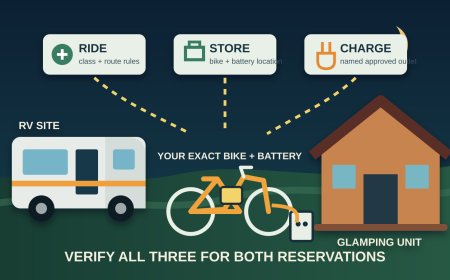
Generators may run during 07:00–09:00, 12:00–14:00 and 17:00–19:00 only. Quiet hours run from 10 p.m. until 6 a.m.[1][2] That schedule supports battery charging; it does not support continuous air-conditioning. If medical equipment, pets or hot-weather cooling require uninterrupted power, these dry campgrounds are the wrong electrical plan.
All three facility pages require reservations year-round, allow same-day booking and open inventory up to six months ahead.[7][8][9] Recreation.gov's current no-show language holds a site until noon on the day after scheduled arrival, assesses a $20 service fee plus the first night's use fee, and cancels the remaining reservation.[7][8][9] Black Rock specifically asks late arrivals who will miss the first night to call the campground.[7]
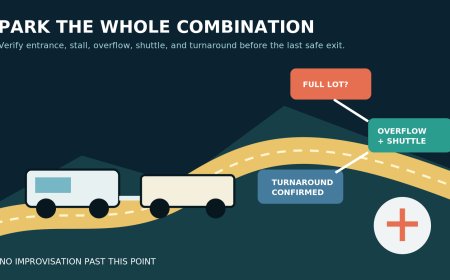
There is no overflow lot in the park. A trailer uses one vehicle allowance, and NPS counts a motorhome plus its towed car as two vehicles.[1][2] A pad may fit the RV while the reservation still fails because the site permits only one vehicle or has nowhere legal to place the tow car.
A five-step best-fit decision
- Choose the access side first. Pick Black Rock for Yucca Valley logistics, Cottonwood for I-10 and the South Entrance corridor, or Indian Cove for the boulder-and-climbing destination.
- Choose the tank plan. Black Rock and Cottonwood provide shared water and dumps. Indian Cove requires a separate water stop and an off-site dump plan.[1][9]
- Check the power budget against the generator windows. All three are nonelectric. Solar, battery and generator charging must carry the stay without running outside the three allowed periods.[1][2]
- Open the exact site record. Match equipment type, maximum RV or trailer length, combined-length language, vehicle count, driveway entry, grade, width, height notes and slide clearance. Do not substitute campground maximum for site fit.[1][2]
- Resolve contradictions before checkout. Cottonwood A25's 42-foot listing conflicts with the NPS 35-foot combined guidance. A written or recorded confirmation for the exact rig and site is better than discovering the mismatch at the pad.[6][12]
For most RV travelers, Black Rock wins on easy servicing, Cottonwood wins on I-10 routing, and Indian Cove wins on immediate desert-rock atmosphere. The safest reservation is not the campground with the biggest headline number; it is the exact site whose equipment limits, driveway notes and utility plan all agree with the rig.
Sources
- Campgrounds — Joshua Tree National Park (accessed October 6, 2026)
- Camping Regulations — Joshua Tree National Park (accessed October 6, 2026)
- Black Rock Canyon — Joshua Tree National Park (accessed October 6, 2026)
- Indian Cove Campground — Joshua Tree National Park (accessed October 6, 2026)
- Black Rock Campground — Joshua Tree National Park (accessed October 6, 2026)
- Cottonwood Campground — Joshua Tree National Park (accessed October 6, 2026)
- Black Rock Campground — Recreation.gov (accessed October 6, 2026)
- Cottonwood Campground — Recreation.gov (accessed October 6, 2026)
- Indian Cove Campground — Recreation.gov (accessed October 6, 2026)
- Black Rock Site 013 — Recreation.gov (accessed October 6, 2026)
- Black Rock Site 093 — Recreation.gov (accessed October 6, 2026)
- Cottonwood Site A25 — Recreation.gov (accessed October 6, 2026)
- Cottonwood Site B14 — Recreation.gov (accessed October 6, 2026)
- Indian Cove Site 052 — Recreation.gov (accessed October 6, 2026)
- Indian Cove Site 022 — Recreation.gov (accessed October 6, 2026)
What's Your Reaction?