















Shenandoah's Four RV Campgrounds: Site-by-Site Fit (2026)
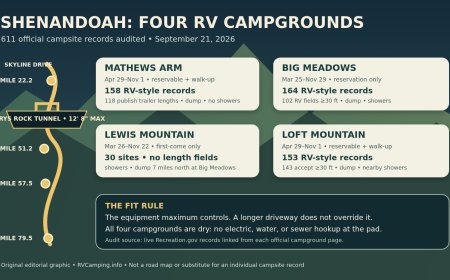
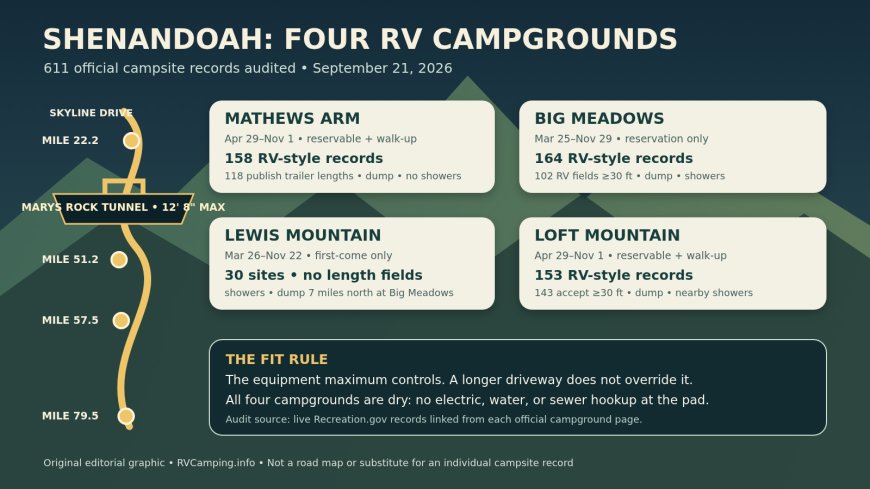
A 611-record audit finds Big Meadows has the broadest RV mix, Loft Mountain the clearest large-rig inventory, Mathews Arm better trailer data than motorhome data, and Lewis Mountain no published site-level length fields.

Shenandoah's four RV campgrounds: a site-by-site rig-fit audit for 2026

By Romana | September 21, 2026 | Campgrounds
Quick answer: Big Meadows has the broadest useful mix for RVs and the longest 2026 season.[2][3] Loft Mountain has the cleanest large-rig inventory in the reservation data.[4] Mathews Arm works well for northern-park trips, but many of its records name an equipment type without supplying a positive motorhome length, so trailer owners have better booking data than motorhome owners.[5] Lewis Mountain is the small, first-come-only alternative with showers, but Recreation.gov exposes no site-specific RV length allowances there.[1][6] All four are dry campgrounds without campsite hookups.[3][4][5]
This is not a comparison based on a handful of sample sites. On September 21, we downloaded all 611 active campsite records exposed by the four official Recreation.gov campground pages: 215 at Big Meadows, 202 at Loft Mountain, 164 at Mathews Arm, and 30 at Lewis Mountain.[3][4][5] We then counted records that permit an RV-style equipment category and kept the equipment limits separate from driveway dimensions. The result is a useful filter, not a substitute for the exact record you reserve.
The four-campground decision table
| Campground | Best practical fit | Official 2026 season | Booking pattern | RV services |
|---|---|---|---|---|
| Big Meadows, mile 51.2 | First trips, central park access, widest range of reservable RV records | March 25-November 29 | Reservation only | No hookups; potable water, dump station, flush toilets, showers.[2][3] |
| Lewis Mountain, mile 57.5 | Small rigs willing to accept a walk-up gamble | March 26-November 22 | First-come only | No hookups; water, flush toilets, pay showers; dump at Big Meadows, about 7 miles north.[2][6][8] |
| Loft Mountain, mile 79.5 | South district and the clearest 30- to 50-foot inventory | April 29-November 1 | Reservable plus first-come | No hookups; potable water, dump station, flush toilets, pay showers near the campstore.[2][4] |
| Mathews Arm, mile 22.2 | North district and arrivals through Thornton Gap | April 29-November 1 | Reservable plus first-come | No hookups; potable water, dump station, flush toilets; no showers.[2][5] |
The dates above come from the NPS 2026 operating table, which now lists firm closing dates rather than the “TBD” dates shown earlier in the season.[2] That is the material planning change for fall travel: Big Meadows remains scheduled almost four weeks later than Loft Mountain and Mathews Arm, while Lewis Mountain runs three weeks beyond them.[2]
What the 611 campsite records actually say
The audit uses an intentionally broad definition of “RV-style”: RV, RV/motorhome, trailer, fifth wheel, pop-up, pickup camper, or camper van. A zero-length allowance is not treated as proof that any size fits. It means the record names the equipment category but does not publish a positive maximum in that field.
Big Meadows: the widest spread, with several data quirks
Of 215 active records, 164 permit at least one RV-style equipment category.[3] The current file contains 163 positive RV-length fields, ranging from 15 to 70 feet.[3] Of those, 102 are at least 30 feet, 56 are at least 35 feet, and 29 are at least 40 feet.[3] The same records include 139 back-in and 25 pull-through entries.[3] Every RV-capable record is nonelectric and lists no water hookup.[3]
Those numbers make Big Meadows flexible, but they also show why the site detail matters. Motorhome and trailer limits frequently differ on the same record.[3] A long driveway does not override the permitted-equipment field, and an unusually high number should prompt a screenshot and a call rather than an assumption. NPS requires the entire setup to remain on the established paved or graveled campsite area.[9]
Big Meadows also has the strongest service cluster. Recreation.gov lists more than 200 campsites, flush toilets, showers, and a dump station.[3] There are no RV hookups, so the showers and dump/fill point reduce chores without turning the stay into full-hookup camping.[3]
Loft Mountain: the easiest large-rig data to filter
Loft Mountain exposes 202 active records, 153 of which permit RV-style equipment.[4] Unlike the mixed fields at the other large campgrounds, all 153 publish a positive RV and trailer maximum.[4] Five list 20 feet, five list 25 feet, 64 list 30 feet, 41 list 35 feet, 26 list 40 feet, and the remaining 12 range from 32 to 50 feet.[4] In total, 143 records accept at least a 30-foot RV or trailer, 77 accept at least 35 feet, and 35 accept at least 40 feet.[4]
That is the clearest large-rig pool in the park's booking data. It does not guarantee an easy arrival. Check whether the site is back-in or pull-through, read its grade field, and compare the listed maximum with the actual camping unit. Recreation.gov lists water and dump stations, flush toilets, and pay showers near the campstore, but no RV hookups.[4]
Loft Mountain also gives southern arrivals a simpler route. It is about 15 miles south of Swift Run Gap and about 25 miles north of Rockfish Gap, so a traveler can reach it without passing through Marys Rock Tunnel.[4][7]
Mathews Arm: good trailer data, incomplete motorhome lengths
Mathews Arm has 164 active records, and 158 permit at least one RV-style equipment category.[5] That headline count needs context: 118 records publish a positive trailer maximum, from 20 to 52 feet.[5] Among those trailer fields, 94 are at least 30 feet, 76 are at least 35 feet, and 66 are at least 40 feet.[5] By contrast, the RV/motorhome fields in this dataset are usually zero rather than a usable positive limit.[5]
Do not translate a 45-foot trailer field into permission for a 45-foot motorhome. Filter by the equipment you will bring, then open the exact record. If the field remains ambiguous, contact the park before booking. Mathews Arm's location is its main advantage: it sits at mile 22.2, about nine Skyline Drive miles north of Thornton Gap, and is the only campground in this comparison north of Marys Rock Tunnel.[2][5][7]
The campground is dry, with drinking water, flush toilets, and one dump station.[5] It has no showers.[5]
Lewis Mountain: useful, small, and deliberately uncertain
Lewis Mountain has 30 sites and is first-come, first-served only.[1][6] The current Recreation.gov campsite records do not expose permitted-equipment length fields for any of those 30 sites.[6] That means an honest comparison cannot publish a site-count-by-length table for Lewis Mountain.
The NPS campground map says RV sites are limited to one motorhome, pop-up, or fifth wheel, that electric and water hookups are unavailable, and that all equipment must fit within the established campsite.[8] It does not give a campground-wide RV length maximum.[8] For a camper van or short motorhome, Lewis can be a quiet alternative seven miles south of Big Meadows. For a longer rig, the missing dimensions and walk-up-only system create two separate risks: fit and availability.
Lewis does have flush toilets, showers, and a campstore.[6][8] Its dump option is at Big Meadows, about seven miles north on Skyline Drive.[6][8] Arrive with enough tank capacity to make that service plan work, and download the Recreation.gov app before entering the park because reception is limited.[6]
Tunnel clearance can decide the campground
Marys Rock Tunnel is at mile 32.2.[7] NPS publishes a maximum clearance of 12 feet 8 inches, measured for both lanes, and says RVs can avoid it by visiting only the northern or southern section of Skyline Drive.[7]
That splits the campground map cleanly. Mathews Arm is north of the tunnel. Big Meadows, Lewis Mountain, and Loft Mountain are south. A rig close to the published clearance should not build a trip around “probably.” Measure travel height to the highest fixed point, choose an entrance on the correct side, and leave room for measurement error and loaded suspension changes.
Services and power: no hookup winner
None of the four offers electric, water, or sewer hookups at the campsite.[3][4][5] Big Meadows and Loft Mountain have dump stations and showers in or near their campground service areas. Mathews Arm has a dump station but no showers. Lewis Mountain has showers but sends RV wastewater to Big Meadows.[3][4][6]
The Recreation.gov pages set two standard generator periods, 8-10 a.m. and 4-7 p.m.; the published sound ceiling is 60 decibels.[3][4][5] Lewis Mountain posts the same two periods and ceiling.[6] Generator-free sites and seasonal cold-weather extensions can alter that baseline, so verify the campground map attached to the current booking record. If shore power is nonnegotiable, the correct answer is not another Shenandoah campground; it is a commercial or public campground outside these four.
A booking sequence that avoids bad fits
- Pick the park district and entrance first. Mathews Arm serves the north; Big Meadows and Lewis Mountain serve the center; Loft Mountain serves the south.[2]
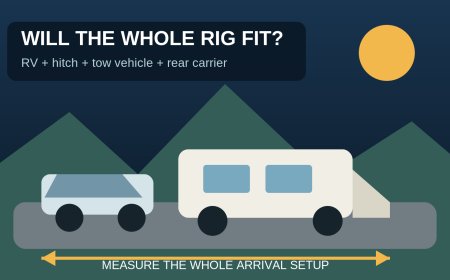
- Measure the RV in travel mode. Record total height, motorhome length, trailer body length, and the connected tow combination separately.
- Filter by the exact equipment type. Do not substitute a trailer allowance for an RV/motorhome allowance.[3][4][5]
- Read the site's equipment maximum before its driveway length. They answer different questions.
- Check entry type and grade. A nominally long back-in can still be a poor match for a low-clearance rear overhang.
- Reject sites that cannot hold the tow vehicle or toad on the designated surface. Park rules require vehicles and equipment to stay on the established pad.[9]
- Save the record offline, then recheck alerts and the 2026 operating table before departure.[2]
- Treat Lewis Mountain as a deliberate walk-up plan with an outside-park backup, not overflow you can count on.[1][6]
Bottom line
For most RV travelers, Big Meadows remains the best all-around choice because it combines central geography, showers, a dump station, 164 RV-capable records, and the latest closing date.[2][3] Loft Mountain is the better data-driven pick for a 30- to 40-foot rig: its records provide consistent positive limits, and 143 accept at least 30 feet.[4]
Choose Mathews Arm for a north-district itinerary or to stay north of Marys Rock Tunnel, but verify motorhome fit directly when the official record supplies only a zero-length RV field.[5][7] Choose Lewis Mountain for a small rig and a flexible schedule. Its 30-site scale, first-come system, and missing site-level length data make it the least predictable choice, even though the shower and campstore setup is appealing.[1][6][8]
Sources
- Campgrounds - Shenandoah National Park — NPS booking patterns for all four campgrounds; accessed September 21, 2026.
- Operating Dates & Hours - Shenandoah National Park — official 2026 opening and closing dates; accessed September 21, 2026.
- Big Meadows Campground - Recreation.gov — facility services and linked campsite records used in the audit; accessed September 21, 2026.
- Loft Mountain Campground - Recreation.gov — facility services, directions, and linked campsite records used in the audit; accessed September 21, 2026.
- Mathews Arm Campground - Recreation.gov — facility services, directions, and linked campsite records used in the audit; accessed September 21, 2026.
- Lewis Mountain Campground - Recreation.gov — first-come procedure, 30-site count, services, and linked campsite records; accessed September 21, 2026.
- Driving Skyline Drive - Shenandoah National Park — Marys Rock Tunnel location and clearance; accessed September 21, 2026.
- Lewis Mountain campground map and rules (PDF) — NPS equipment-fit, hookup, generator, sanitation, and service rules.
- Campground Regulations - Shenandoah National Park — parking-surface, vehicle, and wastewater rules; accessed September 21, 2026.
What's Your Reaction?