






RV breakdown on the highway: a safer emergency stop plan
A no-repair roadside plan for moving an RV out of traffic when safe, reporting an exact highway location, and calling the right emergency or towing help.


RV breakdown on the highway: a safer emergency stop plan
By Romana
Category: RV Camping
An RV loses power in the worst possible place: a live lane, a narrow shoulder, or the blind side of a curve. The first job is not diagnosing the fault. It is reducing exposure to moving traffic, telling responders exactly where the rig is, and getting the right kind of help moving.
The Federal Highway Administration warns that occupants face substantial risk when a vehicle fails on a high-speed road.[4] This plan keeps the sequence short: control the rig, improve the stopping position if it can still be driven safely, make the occupants safer, report the location, and call help. It does not include roadside repair instructions.
Make one plan before the warning light
Keep a one-page breakdown card in the cab and a copy on each driver's phone. Fill in details that are hard to recall under pressure:
- motorhome or tow-vehicle license plate;
- RV type, overall length, height, and approximate loaded weight;
- for a trailer, the tow vehicle and trailer plate numbers plus the hitch type;
- whether the motorhome is front-, rear-, or all-wheel drive;
- roadside-assistance policy and callback number;
- insurer and policy number;
- the RV maker's emergency and towing instructions;
- a contact who knows the trip plan; and
- the official highway-help or 511 resource for each state on the route.
Do not assume that dialing 511 summons a truck everywhere. Highway service patrol coverage, request method, route, and hours vary. Colorado, for example, describes its Safety Patrol as non-emergency help on defined patrol areas and schedules, and says the patrol has no hotline for requesting support.[5] Check the current state DOT page before departure and save the actual procedure, not just the number "511."
Give every traveler one rule: nobody begins a repair, opens an exterior compartment, walks along the shoulder, or steps out to inspect damage until the stopping position has been assessed. Missouri DOT says a flat should not be changed beside or within a traffic lane.[1]
The first 30 seconds: drive the rig, not the diagnosis
If the RV still responds normally enough to move, signal, turn on the hazard flashers, reduce speed smoothly, and look for the nearest place completely outside the travel lane. Missouri DOT advises using the right shoulder where possible and maximizing separation from active lanes.[1]
A wide paved pullout, exit, rest area, parking lot, or other location separated from moving traffic is better than stopping at the first thin strip of shoulder. Do not force a failing rig farther if steering, braking, fire, smoke, a separated trailer, a damaged wheel, leaking fluid, or another condition makes continued movement unsafe. Call 911 and follow the call-taker's instructions.
Do not make a sudden multi-lane move to reach the right shoulder. If the RV stops in a live lane, partly blocks one, sits on a narrow left shoulder, or is hidden by a curve or crest, treat the traffic exposure itself as an emergency. FHWA's service-patrol guide identifies curves, narrow left shoulders, and shoulders restricted by barriers or guardrails as hazardous locations.[4]
Once stopped, set the parking brake and leave the hazard flashers on. Keep seat belts fastened while you decide whether the cab or another location is safer. As a default on a high-speed road, remain inside the belted vehicle rather than standing beside it; Missouri DOT gives the same stay-inside guidance.[1] That default changes if there is fire, smoke, rising water, an unstable vehicle, or a responder directs evacuation. In that case, tell 911 what is happening and follow its instructions rather than improvising a path through traffic.
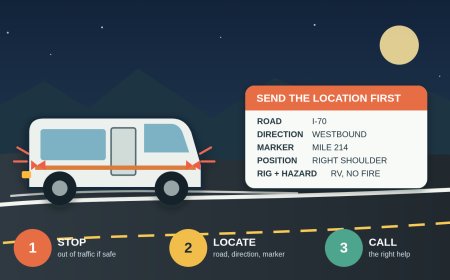
Send the location before the story
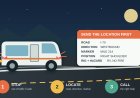
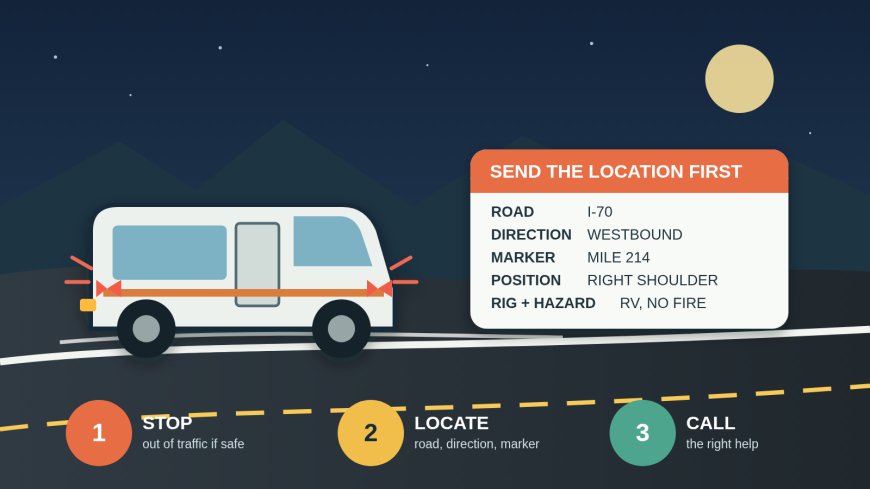
"We're somewhere on I-40" is not a dispatchable location. Build a location string in this order:
- Road: Interstate, U.S., state, or local route number and any named roadway.
- Direction: Eastbound, westbound, northbound, or southbound. Do not substitute the direction the phone map happens to face.
- Marker: Milepost, exit number, bridge name, tunnel, rest area, crossroad, or a sign you can read without leaving safety.
- Position: Right shoulder, left shoulder, gore, ramp, median, or blocking a numbered lane.
- Rig: Color and type, plus trailer or towed vehicle.
- Hazard: Smoke, fire, leaking fluid, debris, injury, poor visibility, traffic-lane blockage, or no safe shoulder.
FHWA tells service-patrol operators to report an exact location that includes direction and a milepost or cross street.[4] The National 911 Program also notes that rural response is hindered when callers cannot provide crossroads, mile markers, or another identifiable location marker.[3]
A phone location pin is useful supporting information, but read the road, direction, and marker aloud first. The National 911 Program says callers should be ready to provide the emergency location and the callback number.[2] If a passenger is available, have that person copy the coordinates or pin while the driver watches traffic and vehicle conditions.
Use a compact opening sentence:
Disabled 34-foot motorhome, westbound I-70 at mile 214, right shoulder but close to the lane. Four people inside, no injuries, no smoke or fire. My callback number is [number].
Then answer the call-taker's questions. Do not bury a lane blockage, injury, fire, fuel or propane concern, unstable trailer, or unsafe occupant location at the end of the call.
Choose the call by the risk, not the repair
Call 911 now
Use 911 for a crash, injury or medical problem, fire or smoke, a suspected hazardous leak, a rig blocking or intruding into a travel lane, occupants exposed to moving traffic, an unsafe shoulder, or any immediate danger. The National 911 Program's public guidance says to dial 911 immediately in an emergency.[2] Colorado DOT draws the same line: its patrol handles non-emergency breakdown help, while immediate emergencies go to 911.[5]
Say what kind of vehicle is involved. "RV" could mean a camper van or a 40-foot diesel motorhome towing a car. Dispatch needs the actual road obstruction and hazard, not a diagnosis of why the engine stopped.
Use the official highway-help channel when it applies
Some corridors have DOT safety patrols, motorist-assistance programs, call boxes, or a regional 511 option. These programs can protect the scene, relocate a disabled vehicle, or connect a motorist with towing, but coverage is not universal. Use the state-specific method saved before the trip. If conditions become dangerous while waiting, call 911 and report the change.
Do not wait for a patrol simply because a website says trucks operate on that corridor. Colorado notes that its crews may encounter stranded motorists in a patrol area during operating hours, but they are not emergency responders.[5]
Call RV-capable roadside assistance for a safe, non-emergency stop
If the rig is fully out of traffic, stable, and there is no immediate danger, call the roadside plan or an RV-capable towing provider. Start with the location string, then give the equipment facts from the breakdown card:
- motorhome, travel trailer, fifth wheel, truck camper, or van;
- overall length, height, and approximate loaded weight;
- number of axles;
- drive configuration for a motorhome;
- tow vehicle, trailer, hitch, and whether they remain connected;
- attached car, cargo rack, bikes, slide, jack, awning, or body damage that changes clearance;
- number of people and pets needing safe transport; and
- the warning shown by the vehicle, without claiming a diagnosis.
Ask the dispatcher to repeat back the route, direction, mile marker, rig type, and equipment being sent. Also ask where the rig will be taken and whether the tow destination can accept its dimensions. A light-duty truck arriving for a heavy motorhome is not help; it is another vehicle exposed on the shoulder.
Control the waiting period
Make one adult the caller and one the scene monitor. Everyone else stays belted and keeps pets contained. Do not let people drift between the RV and traffic, stand behind the rig, or gather around a damaged wheel.
Reassess only when something changes: smoke appears, traffic begins striking debris, the shoulder floods, the RV shifts, a person becomes ill, or visibility deteriorates. Report the change to 911 or the assistance dispatcher. Do not step outside to improve a photo, inspect the traffic side, place a warning device, or try a repair unless an on-scene responder has established a safe way to do it.
When a patrol, police vehicle, fire apparatus, or tow truck arrives, stay put until the responder tells you how to communicate or exit. A shoulder is still a live roadside work area after warning lights appear.
Know what to say if the call drops
The first words should allow a second call-taker to restart the response:
We were disconnected. Disabled RV, [road and direction], [milepost or exit], [exact road position]. [Immediate hazard]. Callback [number].
Keep the phone connected to power if that can be done from inside the vehicle. If voice service is weak but a call connects, give location and danger before insurance details. Do not leave the RV to hunt for reception along a high-speed road; FHWA warns that occupants of disabled vehicles may be tempted to walk beside the roadway to seek assistance, which adds exposure.[4]
The cab-card checklist
Print this in large type:
- Hazards on; smooth move toward a place fully outside traffic only if the rig can be driven safely.
- Parking brake set; occupants belted; pets contained.
- No inspection or repair beside traffic.
- Read road, direction, marker, road position, rig, and hazard.
- 911 for immediate danger; official highway help or RV-capable roadside assistance for a safe non-emergency stop.
- Give dimensions, weight, axles, drive type, hitch, attached vehicle, occupants, and pets.
- Ask for a read-back of location and equipment.
- Report any worsening condition immediately.
- Wait for responder instructions before anyone exits.
A breakdown plan earns its keep before a wrench ever comes out. Get the RV out of the traffic stream if that can be done safely, make the location unmistakable, and send a service that fits the rig. Repairs can wait for a protected location.
Editorial note: This is a roadside stopping and communication plan, not repair or towing instruction. Conditions and state programs vary. Follow 911, law-enforcement, fire, DOT patrol, and towing-professional directions at the scene. Official sources were checked September 22, 2026. No firsthand roadside response or equipment testing is claimed.
Sources
- [1] Missouri DOT: Tips for Breakdown (accessed September 22, 2026).
- [2] National 911 Program: Calling 911 (accessed September 22, 2026). Direct retrieval was blocked; cited claims are limited to the official search excerpt saved in the source corpus.
- [3] National 911 Program: 911's Role in Highway Safety (accessed September 22, 2026). Direct retrieval was blocked; cited claims are limited to the official search excerpt saved in the source corpus.
- [4] FHWA: Field Operations Guide for Safety/Service Patrols, Incident Actions (accessed September 22, 2026).
- [5] Colorado DOT: My car broke down on the highway (accessed September 22, 2026).
What's Your Reaction?