



















RV surge protector vs. EMS: choose by what it does
Compare surge-only RV protectors with monitoring and automatic-disconnect systems, then check 30/50-amp fit, generator limits and hookup order.

By Romana Category: Tips and Trends

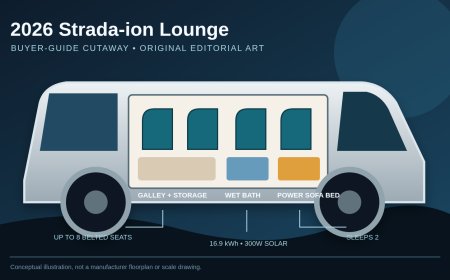
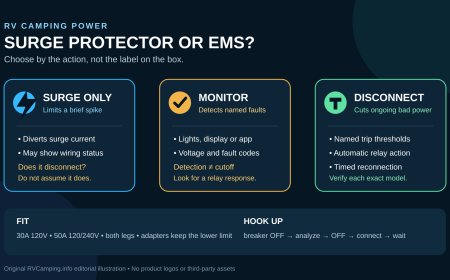
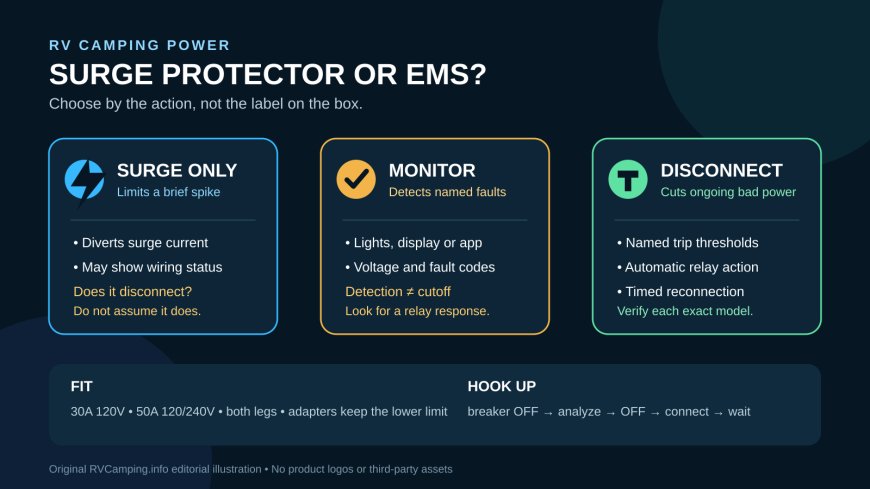
The useful dividing line is whether the device only suppresses a transient or can also disconnect the RV from an ongoing fault. Original RVCamping.info illustration.*
A portable surge protector and an RV electrical management system are not interchangeable, even though stores and manufacturers may put both under the same "surge protector" label. A surge-only device limits brief overvoltage events. A fuller protection device also checks selected power conditions and uses a relay or contactor to withhold or disconnect power when its programmed limits are crossed.[1][2][3]
For frequent campground hookups, automatic disconnect for sustained low voltage, sustained high voltage and specified wiring faults is the more useful baseline. Surge suppression should be included too. Buy by the exact model's manual and listing, not by the letters EMS, a product-family name or the size of a joule number.
The difference is in the verbs
UL defines a surge protective device as equipment that limits surge voltage by diverting or limiting surge current.[3] That is a specific job. The definition does not, by itself, promise continuous voltage monitoring, a power-disconnect relay, a restart delay or fault history.
The contrast is visible inside one manufacturer's product range. Progressive Industries' SSP-30XL/50XL manual describes surge ratings and indicator lights for correct wiring, reverse polarity, open neutral and open ground. It also says the unit continues to work during those wiring conditions and directs users to have any fault corrected before use.[1] The same company's EMS-PT30X/50X manual says those EMS models automatically shut down for sustained low or high voltage, withhold power for several wiring faults, monitor frequency, display present and previous errors, and delay reconnection.[2]
Brand names can blur this boundary from the other direction. Southwire calls models 34930 and 34950 "Surge Guard," yet their manual specifies over/under-voltage disconnection, an industrial contactor, an air-conditioner restart delay, current and voltage display, plus other checks.[4] A product called a surge protector can therefore have management features, while another product with diagnostic lights may only report a condition.
Use this three-layer test:
| Layer | What it must do | What not to assume |
|---|---|---|
| Surge suppression | Divert or limit short surge energy; show whether protection is still available if the design has an indicator | It may not stop sustained low or high voltage |
| Monitoring or analysis | Identify the listed conditions through lights, a display or an app | Detection does not prove the RV will be disconnected |
| Automatic protection | Use an internal switching device to block or cut power for the faults and thresholds named in the manual, then reconnect only as specified | Trip points, delay times and covered faults vary by model |
The buying question is not "Does it detect low voltage?" It is "Will this exact model disconnect the RV for low voltage, at what threshold and after what delay?" Repeat that question for high voltage, open neutral, open ground, reverse polarity, frequency and 50-amp leg faults.
Who can reasonably choose surge-only protection
A surge-only unit is a limited tool, not a fake one. It can suit an owner who understands that limit, separately checks the pedestal, actively watches voltage under load and is prepared to shut down loads or disconnect when conditions change.[1] A model with wiring indicators adds useful screening, but an indicator is not an automatic switch.[1]
That trade is easy to underestimate. Campground voltage can change after the air conditioner starts or as the park fills up. If nobody is watching the display, monitoring without cutoff cannot act.[1] The SSP manual makes the distinction unusually clear: it reports several wiring states but continues operating.[1]
Choose a device with verified automatic disconnection when you want protection to remain active after setup, while you are away from the display or overnight.[2][4] Confirm whether it interrupts power for every condition you care about.[2][4] The Progressive EMS cited here cuts power below its model-specific low-voltage threshold after a stated delay, applies stepped high-voltage timing, and refuses power for reverse polarity, open neutral and open ground.[2] Southwire's cited models use different voltage points and timing.[4] Neither set of numbers should be copied onto another product.[2][4]
Compatibility boundaries to settle before buying
Match the RV service first
A 30-amp RV connection is nominally 120 volts. A 50-amp RV connection is nominally 120/240 volts with two hot legs. The cited SSP and EMS manuals assign different models and surge modes to those services.[1][2] Match the protector to the RV's shore-power cord unless the manufacturer explicitly approves an adapter arrangement.
An adapter changes plug compatibility, not the available capacity. The Progressive EMS manual permits proper adapters across listed service sizes but says power must remain limited to the lower rating of the source and RV.[2] Southwire warns that cord adapters are not recommended for full-load use because exceeding their current rating can overheat them.[4] If an adapter is necessary, follow all three manuals: the RV, protector and adapter. Do not build a chain merely to make the plugs fit.
On a 50-amp RV, verify that the device monitors both legs and handles the neutral conditions stated in its documentation.[2][4] A 30-amp product cannot evaluate two 50-amp legs simply because an adapter allows a physical connection.[1][2]
Portable and hardwired solve different setup problems
A portable unit can test a pedestal before the RV cord is attached, moves with the owner and needs no coach-side installation. It is also exposed at the pedestal, adds another plug-and-receptacle junction and may need physical support or theft deterrence.
A hardwired unit stays with the RV and removes the chance of leaving the protector at home. Installation must match its instructions, conductor sizes, enclosure requirements and display arrangement. This is work for a qualified RV electrical technician when the owner is not trained for it. A hardwired unit checks power only after the shore cord and any adapter are in the circuit, so the arrival sequence differs from a portable model.
Generator and inverter behavior is model-specific
Do not assume a campground-compatible device will accept every generator or inverter.[2] Ground and neutral sensing may report a fault on a source configured differently from campground utility power.[2] The Progressive EMS-PT30X/50X manual says a bonded-neutral generator is recommended, allows use with inverter-generators, and says never to plug those EMS models into an inverter.[2] Those are limits for those models, not a universal rule for all protectors or all RV power systems.[2]
Do not improvise a neutral-ground bonding plug because a forum post says it clears an error. Check the RV, generator and protection-device manuals together. Ask the equipment manufacturers or a qualified RV electrician when their instructions do not line up.
A voltage booster is another category
Automatic disconnection does not mean voltage regulation or boosting. The devices documented here monitor and disconnect; they do not promise to raise campground voltage.[2][4] A booster, transformer or inverter/charger may change voltage, but it introduces another compatibility and installation review. Confirm the order of components, grounding design, transfer equipment and protection settings with every manufacturer involved.
Read the specification sheet like a fault matrix
Before paying, make one row for each condition and record the exact response:
- surge protection modes, rating and end-of-life indication;
- sustained low-voltage threshold and time before disconnect;
- sustained high-voltage threshold and time before disconnect;
- open neutral, open ground and reverse-polarity response;
- both-leg and neutral monitoring for 50-amp service;
- frequency limits, if provided;
- restart delay and whether reconnection is automatic;
- display, previous-fault memory or app functions;
- weather rating, required orientation and operating temperature;
- portable or hardwired installation, service rating and adapter rules;
- generator, inverter, transfer-switch and voltage-booster compatibility;
- safety listing for the exact model, not a similar model in the same family.
Two details deserve a second look. First, a depleted surge module may not force a shutdown. The cited Progressive EMS shows an E10 warning when surge protection is depleted but says that condition does not cut incoming power.[2] Southwire likewise says its other functions continue after its surge element has been sacrificed and recommends replacement.[4] Check the status indicator after a reported event and at every setup.
Second, a big joule number does not describe the whole system.[1][2] It says nothing about whether the product disconnects for an open neutral or low voltage.[1][2] Compare surge specifications only after the electrical service and fault responses match your needs.
A safe portable hookup workflow
This is the protection-device sequence, not a repeat of a full pedestal inspection. Use it after the enclosure, receptacle, breaker, shore cord and plug have passed our five-minute RV pedestal check.
- Turn off the RV's large 120-volt loads. Follow the RV manual for its main breaker.
- With dry hands and dry connections, put the pedestal breaker fully OFF.
- Inspect the protector, cord and every mating plug. Stop for heat damage, corrosion, cracks, loose parts or a missing surge-protection status light.[1][2][4]
- Plug the portable device into the matching pedestal outlet without the RV attached. Support it in the orientation its manual requires.[1][2]
- Turn the pedestal breaker ON. Let the device complete its analysis. Read the exact light pattern, voltage or fault code.[1][2][4]
- If any fault appears, turn the breaker OFF, keep the RV disconnected and contact campground staff.[1][2] Do not use a bypass control merely to make the power flow.
- If the source passes, turn the pedestal breaker OFF again. Connect the RV cord fully, securing a detachable RV end as its manual directs.
- Turn the pedestal breaker ON. Wait through the device's startup delay and confirm that power is actually being passed. The cited EMS uses a 136-second delay; the cited Southwire models use 128 seconds, which shows why the exact manual matters.[2][4]
- Bring large loads on one at a time. Recheck voltage, current and status after the air conditioner or electric water heater starts.
- If the protector disconnects, leave it active. Record the code and voltage, switch large loads off, and ask campground staff to investigate.[2] Repeated cycling is a fault report, not an invitation to bypass protection.[2][4]
For a hardwired system, the pedestal breaker remains off while the shore cord is connected. Turn it on only after all plugs are seated, then wait for the coach-mounted system to approve and pass power.
At departure, switch off major loads, turn the pedestal breaker OFF, and disconnect by the molded plug body rather than pulling the cable. Inspect for new heat discoloration before packing the device dry.
The practical decision
Buy surge-only protection only when you are deliberately accepting manual monitoring and intervention. For most campers who want one device left in line throughout a stay, look for surge suppression plus explicitly documented automatic disconnection for sustained voltage problems and relevant wiring faults.
The label on the housing is a starting point. The fault table, relay behavior, service rating and compatibility section make the decision.
Source credit: This original RVCamping.info decision guide compares UL's surge-device definition with manuals from Progressive Industries and Southwire. Product examples illustrate feature boundaries; they are not endorsements, and no affiliate links are used.
Sources
- Progressive Industries SSP-30XL & SSP-50XL Smart Surge Protector instruction manual — Manufacturer manual archived by an RV retailer; accessed September 16, 2026.
- Progressive Industries EMS-PT30X & EMS-PT50X instruction manual — Manufacturer manual archived by Amazon media; accessed September 16, 2026.
- UL Guidelines for Surge Protective Devices Used in Industrial Control Panels — UL definition and UL 1449 context; 2017 document accessed September 16, 2026.
- Southwire Surge Guard 34930/34950 installation and operating instructions — Official manufacturer manual; accessed September 16, 2026.
Safety note: This guide does not replace the RV, pedestal, generator, inverter, adapter or protection-device manuals, campground rules, electrical codes or a qualified electrician. Do not open, probe, rewire or repair energized equipment.
What's Your Reaction?