












Before you plug in: a five-minute RV pedestal check
A safe arrival routine for inspecting, testing and connecting to a campground RV pedestal, with voltage limits, EMS guidance and clear stop points.

Before you plug in: a five-minute RV pedestal check
Use the breaker, your eyes and the right tester to reject bad campground power before it reaches the coach.
A campsite power pedestal should never be a plug-and-hope proposition. The safe routine is short: leave the pedestal breaker off, inspect the box and your cord, test the supply without the RV connected, then make the final connection with the breaker off. If the pedestal is damaged, the plug will not seat firmly, or the tester reports a wiring fault, stop and call campground staff.
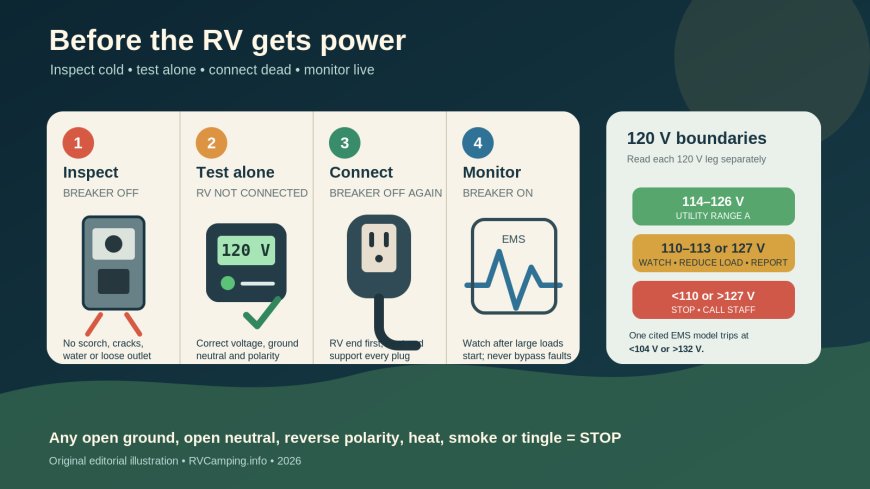
The short answer: With dry hands and dry connections, switch the pedestal breaker off. Look for heat damage, broken parts, water intrusion and a loose receptacle. Test the matching outlet with a listed RV pedestal tester or a portable electrical management system (EMS). Do not connect the RV if it reports open ground, open neutral, reversed hot and neutral, voltage on ground, wrong voltage or any other fault. Turn the breaker off again before making the final connection, seat every plug fully, then switch the pedestal breaker on.
First, match the outlet to the RV
A 30-amp TT-30 connection is a 120-volt, three-conductor service: one hot, one neutral and one equipment ground. A 50-amp NEMA 14-50 connection is a four-conductor 120/240-volt service with two 120-volt hot legs, a neutral and an equipment ground. NFPA's NEC panel material identifies campground receptacles as 30-amp, 125-volt and 50-amp, 125/250-volt configurations.[4][5]
That distinction matters. A 30-amp RV is not supposed to receive 240 volts.[3][4]
A proper 50-amp supply has about 120 volts from either hot leg to neutral and about 240 volts from hot to hot.[2][4] Do not poke meter probes into a live pedestal unless you are qualified to do that work. A listed tester made for the outlet gives campers a safer pass/fail check without exposed-probe measurements.
Use the outlet that matches the RV cord whenever it is available. If an adapter is necessary, it must be listed or certified for the application, undamaged and rated for the lower-capacity connection. An adapter changes fit and available amperage; it does not turn a 30-amp supply into 50-amp service. The coach must stay within the smaller limit.
Inspect before energizing anything
Keep the pedestal breaker off while you look. Do not open the pedestal enclosure, remove a cover plate, tighten terminals or attempt a campsite repair. Those jobs belong to campground maintenance or a qualified electrician.
Reject the connection and notify staff if you see any of the following:
- a cracked box, missing cover, exposed conductor or broken receptacle face;
- blackening, brown discoloration, melted plastic, blistering or a burned smell;
- corrosion, standing water, active dripping or mud inside the receptacle area;
- a receptacle that moves in the enclosure;
- a breaker that is broken, will not stay in position or feels unusually hot;
- a plug slot that is distorted, or a plug that sags, wobbles or will not seat fully;
- bent, loose, pitted, burned or missing blades on your cord, adapter or portable protector;
- cuts, crushed spots, soft melted areas or exposed material on the shore cord.
CPSC warns that frayed or cracked cords can create shock or fire hazards.[1] It also says an unusually hot outlet should be taken out of use until a qualified electrician checks it.[1] A loose fit also matters because a poor contact can heat up under load even when the breaker never trips.
Rain by itself does not make every outdoor pedestal unusable; outdoor equipment is designed for its rated environment. But do not handle energized plugs with wet hands, connect a wet cord end, or use equipment that shows water intrusion. Move the cord connection out of puddles without hanging its weight from the receptacle. If the pedestal's weather cover cannot close as designed around the connection, ask staff to inspect it.
Use the breaker in the right order
The pedestal breaker is the switch for making and breaking the campground connection. Using it prevents the plug blades from becoming the switch and reduces arcing at the contacts. The portable EMS manual used for this guide calls for disconnecting power at the source before inserting the EMS, then switching power off again before attaching the RV cord.[3]
For a portable EMS, use this arrival sequence:
- Turn off air conditioning, the electric water heater and other large 120-volt loads in the RV. Follow the coach manual if it also directs you to switch off the RV main breaker.
- With dry hands, put the campsite breaker firmly in the OFF position. If it appears tripped, move it fully off; do not keep resetting a breaker that trips again.
- Inspect the pedestal, RV cord, adapters and EMS.
- Plug the EMS into the matching pedestal receptacle by itself. Do not connect the RV yet.
- Switch the pedestal breaker on and wait for the EMS to finish its check. Read the actual code or message, not just the fact that its display lights.
- If it passes, switch the pedestal breaker off again.
- For a detachable cord, connect and lock the RV end first. Then connect the pedestal end to the EMS and seat every connection fully. Support the device and cord as its instructions require.
- Switch the pedestal breaker on. Wait through the EMS delay, confirm a normal reading, and bring large loads on one at a time.
A hardwired EMS runs its check inside the RV, so there is no portable box to connect first. Keep the pedestal breaker off while plugging in, then turn it on and wait for the hardwired display to approve the supply before starting major loads.
When leaving, switch off large loads, turn the pedestal breaker off, unplug at the pedestal, then disconnect a detachable cord from the RV. Pull on the molded plug body, never the cable. The Progressive Industries manual likewise says to connect at the RV first and disconnect at the AC source first.[3]

Know what the voltage numbers mean
For a nominal 120-volt supply, the ordinary target is not "anything the RV will tolerate." PacifiCorp's ANSI C84.1-based table places Range A service voltage at 114 to 126 volts. Its wider Range B is 110 to 127 volts and is intended to be limited in extent, frequency and duration.[2]
That gives campers useful boundaries:
| Reading or indication | What it means at the campsite | What to do |
|---|---|---|
| 114-126 V on each 120 V leg | Normal Range A service band | Continue if wiring checks pass and voltage remains stable |
| 110-113 V or 127 V | Wider Range B, outside the preferred band | Reduce large loads, watch the reading and report a sustained condition |
| Below 110 V or above 127 V | Outside the utility table's service Range B | Do not treat this as normal; disconnect and call staff |
| EMS shutdown below 104 V or above 132 V | Product protection boundary, not a "good power" target | Leave protection active and report the fault |
The last line needs care. The Progressive Industries EMS-PT30X/50X manual says its unit disconnects after voltage remains below 104 volts for more than six seconds and also disconnects for high voltage above 132 volts, with faster action at more extreme levels.[3] Those are that EMS model's trip points. They do not redefine healthy campground voltage, and another model may use different timing or thresholds. Follow the label and manual for the exact device you own.
A voltage reading taken before connection is only a snapshot. Campground voltage may sag after large loads start, and the cited EMS manual notes that a short low-voltage event may follow a water heater or air-conditioner load.[3] Check the EMS display again after the coach is connected and after adding a large load. If voltage dives, the plug becomes hot, the display begins cycling, or power repeatedly drops out, turn the pedestal breaker off and report it.
Ground, neutral and polarity are pass-or-stop checks
Voltage alone cannot approve a pedestal. The wiring pattern must also pass.
- Open ground: The safety path is missing. The cited EMS withholds power for this condition.[3]
- Open neutral: The normal return conductor is interrupted. The cited EMS manual treats it as a shock hazard and does not energize the RV.[3]
- Reverse polarity: Hot and neutral are interchanged. The EMS manual classifies this as a fault and withholds power.[3]
- Voltage on ground or a ground/neutral fault: Treat any such code as unsafe, even if lights or appliances appear to work.
- Wrong 30-amp voltage: A TT-30 is nominally 120 volts. A 240-volt indication is an immediate stop.
- Bad 50-amp leg: Both hot-to-neutral legs should be near 120 volts and the supply is nominally 240 volts hot-to-hot. A missing leg, large imbalance or wiring error needs staff attention.
Do not use a three-to-two-prong workaround, remove a ground pin, make a bonding plug for campground use, or join neutral and ground inside the RV. In an RV, neutral and ground remain separated; the EMS manufacturer warns that bonding them in the coach can create shock, fire or ground-fault problems.[3]
If anyone feels even a faint tingle from the steps, frame, hitch or metal skin, do not touch the RV again to "see if it still does it." Shut the pedestal breaker off only if you can reach it without touching the RV or standing in water, keep people away, and call campground staff or emergency services as conditions warrant. Heartland's electrical guide says a tingle at the body or frame calls for immediate disconnection until the cause is found.[4] NFPA's 2023 NEC development record also added a grounding monitor interrupter requirement for RVs, effective January 1, 2026, aimed at disconnecting circuits after loss of equipment grounding; local adoption and the equipment on a particular RV can vary.[5]
A simple tester is a screening tool; an EMS stays on watch
A basic RV pedestal analyzer can be worth carrying. The right model for a TT-30 or 14-50 receptacle can identify some static wiring errors before the coach is connected, and a voltage display is more informative than lights alone. OSHA's electrical-safety material recognizes receptacle testers as one way to check proper grounding-terminal connections, although its workplace rules are not an RV operating manual.[6] It is small, quick and useful for explaining a problem to staff.
Its job ends when you remove it unless it remains installed and is designed to carry the RV load. A basic light-pattern tester may not disconnect power, watch both 50-amp legs, record a fault, delay air-conditioner restart or protect the coach when voltage changes later. A household three-light tester used through a stack of adapters is especially incomplete for a 50-amp pedestal.
A full EMS does more. Check the specifications rather than relying on the words "surge protector" on the box. The unit should match 30- or 50-amp service and should explicitly monitor low and high voltage, open neutral, open ground and reverse polarity. Useful additions include protection for both legs of 50-amp service, frequency monitoring, a previous-fault code and a restart delay. The cited EMS manual monitors continuously, refuses power for several wiring faults, and delays reconnection after a fault.[3] Our research-based guide to one 30-amp EMS shows how to compare automatic shutoff with monitor-only products.
Surge suppression and electrical management are not synonyms. A surge-only device may absorb a short spike but still pass sustained low voltage or bad wiring. An EMS with automatic cutoff is the better layer for changing campground conditions. Neither device makes a damaged receptacle acceptable, and neither replaces the RV's breakers, GFCIs or required maintenance.
When to stop and call campground staff
Ask for inspection, repair or a different site when:
- the enclosure, breaker or receptacle is damaged, wet inside, scorched, loose or hot;
- your plug cannot seat firmly and completely;
- a tester or EMS reports open ground, open neutral, reverse polarity, voltage on ground, wrong voltage, frequency error or a missing 50-amp leg;
- voltage is outside the stated acceptable band, remains in a marginal band, or falls sharply under ordinary RV load;
- the pedestal breaker trips a second time after large RV loads have been turned off;
- there is buzzing, crackling, smoke, sparking, a hot-plastic smell or growing heat at any connection;
- the RV frame or steps produce a tingle or shock;
- the EMS repeatedly disconnects and restores power.
Give staff the site number, receptacle type, time, voltage reading and exact tester code. A photo of the display can help. Keep the breaker off while they investigate. Do not accept "just bypass the protector" as a diagnosis; the EMS operating instructions say to disconnect and report a fault code to park management or a qualified technician.[3]
Once staff says the problem is corrected, begin from the top: breaker off, visual check, unloaded test, breaker off, final connection, then monitored load. Moving to another pedestal is a new test, not proof by assumption.
Five careful minutes at arrival beats tracing a melted plug after dinner. The rule is simple enough to remember: inspect cold, test alone, connect dead, then monitor live.
Source note: RVCamping.info built this campground routine from CPSC electrical-safety guidance, a public utility's ANSI C84.1 voltage ranges, an RV EMS operating manual, RV electrical reference material and NFPA's NEC development record. It gives no instructions for opening or repairing energized equipment.
Sources
[1] CPSC and NESF Urge Consumers to Plug Into Electrical Safety
[3] Progressive Industries EMS-PT30X and EMS-PT50X Instruction Manual
What's Your Reaction?