










When one RV site will not cover your whole stay: plan a split-site booking
A practical worksheet for combining campground sites safely, checking rig fit and rules, calculating the move-day gap, and protecting every reservation.

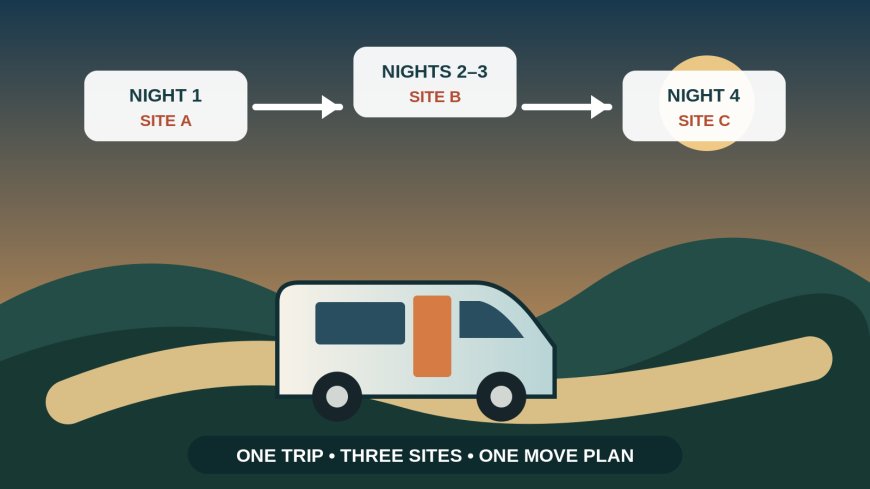
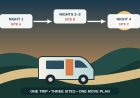
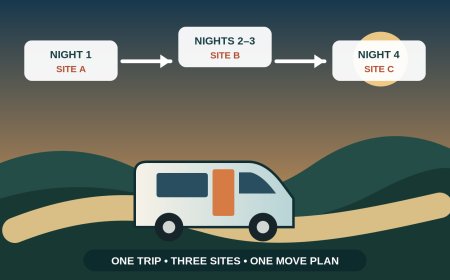
A sold-out campground can still show one night on Site 18, two nights on Site 42, and another night back on Site 18. Recreation.gov itself suggests stringing together multiple campsites when one site is not available for an entire stay.[2] That can rescue a trip, but it creates a moving day inside the campground. Treat it as a small relocation, not as one continuous reservation.
First, make sure every site fits the same rig
Availability is only the first filter. Open each site's detail page and compare the allowed equipment, parking-pad length, driveway type, slope notes, vehicle limit, generator rules, accessibility features, shade, and hookup type. A four-night calendar assembled from three sites is useless if the middle site is tent-only or too short for the motorhome.
Do not assume the same campground means the same fit. Yosemite says the listed RV and trailer limits can differ because backing geometry and turning radius matter, and it warns that staff may not have another site if your rig does not fit the one you reserved.[4]
Build a quick fit sheet before paying:
| Night | Site | RV/trailer limit | Hookups | Driveway | Check-in/out | Problem to resolve |
|---|---|---|---|---|---|---|
| 1 | A | Record the listing | Record exact service | Back-in/pull-through | Record facility times | None yet |
| 2-3 | B | Record the listing | Record exact service | Back-in/pull-through | Record facility times | Can the rig move safely? |
| 4 | C | Record the listing | Record exact service | Back-in/pull-through | Record facility times | Is a dump/fill stop needed? |
Measure the entire camping setup the way the facility asks. Do not quietly subtract the tow vehicle, bike rack, rear cargo box, or tongue if the listing's limit covers the complete occupied pad.
Read the facility rules before combining reservations
Recreation.gov's general policies are a baseline. The specific facility can publish exceptions that take priority.[1] Open the Rules and Regulations, Need to Know, Alerts, Seasons and Fees, and individual site details for every segment.
Check five points in writing:
- Are consecutive reservations allowed, and do stay limits apply across sites or nearby facilities?
- Must the named reservation holder be present with identification?
- Does each reservation require a separate check-in?
- What are checkout and check-in times on the move day?
- May campers change sites without staff approval?
The answer can vary even inside the federal system. Sleeping Bear Dunes tells campers to register on arrival, occupy the site for which they are registered, and change sites only with ranger approval.[3] That is why a vacant-looking pad is not an invitation to move early.
Save a PDF or screenshot of each confirmation and the rules that applied when you booked. Put the reservation numbers, site numbers, dates, campground phone, and emergency contact in one offline note.
Calculate the move-day gap
Suppose checkout from Site A is noon and check-in at Site B is 2 p.m. Your plan needs a legal two-hour holding place for the complete rig. A campground lane, empty campsite, dump-station approach, or visitor parking row is not automatically available for that job.
Use this worksheet:
Move-day gap = next check-in time minus current checkout time
Then ask the campground:
- Can the next site be occupied early if it is already serviced?
- Is there designated oversized-vehicle parking?
- May the RV remain hitched there?
- Is the dump station suitable for waiting, or strictly for active use?
- What is the fallback if the holding area is full?
If the campground offers no legal place to wait, choose an off-site stop that can accept the full rig and lies on a route you have checked for height, weight, grade, turn radius, and parking restrictions. Do not plan to circle narrow campground loops until the clock runs out.
Pack for a move, not for a full departure
The fastest safe move starts the night before. Bring in the awning and outdoor rug, stow chairs and cooking equipment, secure loose items, and clear anything beneath slides. In the morning, disconnect utilities, perform the same walk-around used for a road departure, and verify that people and pets are accounted for.
Keep a small move-day tote accessible: reservation confirmations, keys, gloves, drinking water, medications, pet supplies, wheel chocks, leveling tools, and any adapters needed at the next site. If Site B has different hookups, the change should already be on the fit sheet.
Do not leave property on the next site to claim it before the authorized occupancy time. Do not ask a child or another traveler to stand in a roadway while the driver waits. The site belongs to the current occupant until checkout and to the reservation system after that.
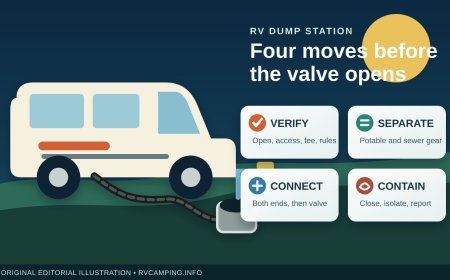
Handle water, waste, and power once
Moving sites can become three separate chores if the RV needs a dump, fresh water, and fuel. Sequence them before the trip:
- Decide whether the holding tanks can cover the full stay.
- Locate the approved dump and potable-water points.
- Check operating hours and whether access requires a code or fee.
- Decide whether to service on move day or on final departure.
- Keep food cold while shore power is disconnected.
A short internal move is not a reason to travel with open valves, a connected hose, loose electrical cable, an extended antenna, or unsecured interior cargo. Complete the normal departure check even if the next pad is 200 yards away.
Keep every reservation alive
A split stay creates more ways to trigger a no-show. Recreation.gov defines a no-show and applies service fees and forfeitures under its general policy, while the exact facility page may set additional details.[1] If arrival for any segment will be late, contact the campground using the number in that reservation. Do not assume checking in for the first site automatically protects the second booking.
Recreation.gov says that switching sites at the same price, on the same dates, in the same facility does not carry its standard change fee, but facility-specific rules still control and availability can change.[1] Ask staff before trying to consolidate reservations or move outside the booked sequence.
Decide whether the split stay is worth it
A one-time move can be reasonable when both sites clearly fit, the campground confirms the process, and the gap has a legal holding plan. Two or three moves during a short visit often consume the time the trip was supposed to create.
Skip the split booking when:
- any site has uncertain dimensions or equipment rules;
- a mobility need makes repeated setup difficult;
- the campground cannot explain where the rig may wait;
- a pet would be left in unsafe temperatures during the move;
- weather makes repeated leveling, hitching, or backing hazardous; or
- the cancellation exposure is greater than the value of keeping the itinerary.
Before buying scattered nights, compare a nearby campground with one continuous site. Add the fuel, booking fees, setup time, lost daytime, and stress of the internal moves. The cheaper nightly rate can be the more expensive plan.
A 10-minute booking audit
Before checkout, answer each line with a saved source or a campground contact name:
- Every site accepts the exact RV or trailer and support vehicles.
- Every site's pad and approach work for the rig.
- Hookups and generator rules are known for each night.
- Consecutive reservations comply with the stay limit.
- The named holder and check-in requirements are understood.
- Move-day checkout, check-in, and waiting location are confirmed.
- Dump, water, fuel, and food-cooling needs have one sequence.
- Late-arrival and no-show rules are saved for every segment.
- Weather and road conditions have a fallback.
- A continuous-site alternative was compared honestly.
A split-site booking works when the reservations form one operational plan. The calendar is only the start.
Source credit: This original RVCamping.info guide was prompted by Recreation.gov's suggestion that campers may need to string together sites at popular facilities. The booking worksheet, move-day gap calculation, fit audit, and relocation plan are original RVCamping.info analysis.
Sources
- Rules and Reservation Policies - Recreation.gov (retrieved September 17, 2026)
- Tips for Making Campsite Reservations at Popular Locations - Recreation.gov (retrieved September 17, 2026)
- Campground Rules - Sleeping Bear Dunes National Lakeshore (retrieved September 17, 2026)
- Campground Reservations FAQ - Yosemite National Park (retrieved September 17, 2026)
What's Your Reaction?