






Late arrival, short generator window: plan the first RV night before booking
A generator-permitted campground can still leave a late-arriving RVer with no legal charging time. Compare official NPS rules by campground and loop, then calculate the first night from site-ready time to cutoff.

Late arrival, short generator window: plan the first RV night before booking
A reservation page can say generators are permitted and still leave a late-arriving RV with zero generator time on the first night. The missing number is site-ready time: when the rig is parked, checked in, leveled as needed, and ready to run legally.
Official National Park Service rules show why the park name is not enough.
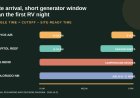
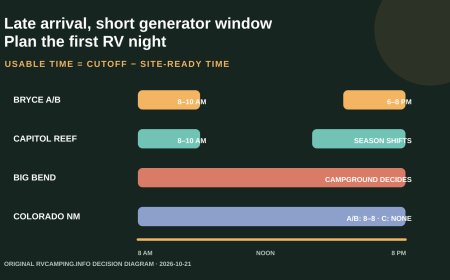
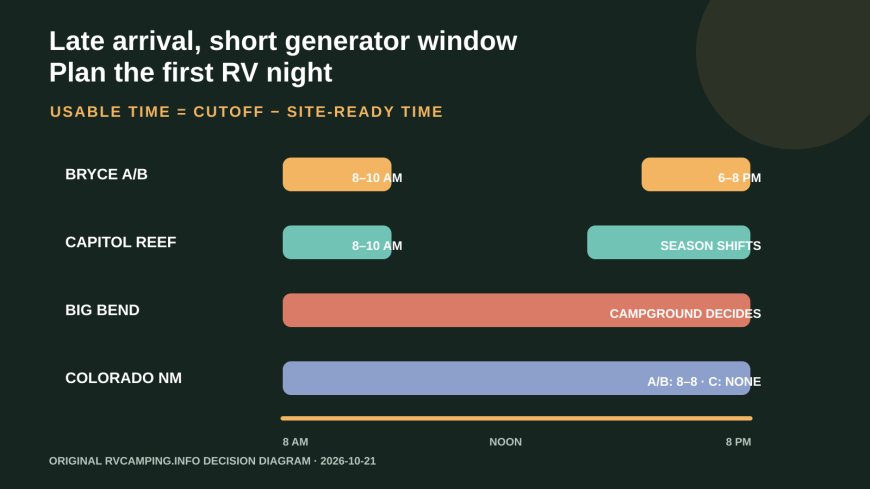
Bryce Canyon limits generators to Loops A and B and two short daily windows.[1]
Capitol Reef changes both loop eligibility and the evening window by season.[2]
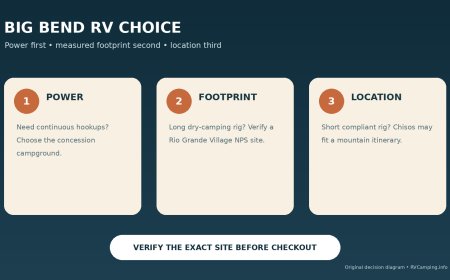
Big Bend gives three different answers across three campgrounds.[3]
At Colorado National Monument, Loops A and B permit daytime use while Loop C prohibits generators and idling engines.[4]
This guide answers a narrower planning question than a general rule lookup: after accounting for arrival and setup, how much first-night runtime is actually left?
Calculate the window that remains
Use the exact reservation and this formula:
usable arrival-night runtime = applicable window close − later of site-ready time or window open
If the result is zero or negative, the first night has no legal generator runtime. Do not borrow time from the morning window or treat quiet hours as a grace period.
Record six fields:
| Field | What belongs there |
|---|---|
| Campground | Exact NPS campground, not only the park |
| Loop or site type | The booked loop and any generator-free designation |
| Stay date | The actual arrival date, including seasonal boundaries |
| Evening window | Every applicable start and stop time |
| Site-ready time | ETA plus check-in, internal roads, parking and setup buffer |
| Required runtime | A realistic equipment-specific charging or operating need |
The number is a planning screen, not permission to create unsafe exhaust, violate a noise limit or ignore a host's direction. Generator location and carbon-monoxide safety remain separate checks.
Bryce Canyon: arrival after 8 means wait for morning
Bryce Canyon's campground regulations permit generators only in Loops A and B. The posted windows are 8–10 a.m. and 6–8 p.m.[1]
Suppose the route estimate reaches the campground at 7:05 p.m. Add time for the entrance queue, finding the site and positioning the RV. If the rig will not be site-ready until 7:35, only the remainder before 8 is potentially available. An 8:05 site-ready time produces no evening runtime at all.
That is the booking consequence: a late arrival should not depend on generator charging that night. Choose one of these plans before paying:
- arrive early enough to preserve a useful margin before 8;
- begin the night with adequate stored energy and wait for the 8 a.m. window;
- reserve a different power arrangement; or
- change the travel day.
Loops matter too. "North Campground" or "Sunset Campground" does not by itself establish generator permission; the official rule names Loops A and B.[1] Match the booked loop, not a campground search snippet.
Capitol Reef: date and loop can both change
At Capitol Reef's Fruita Campground, the NPS page lists 8–10 a.m. and 6–8 p.m. under its Mountain Daylight Time schedule. Under the Mountain Standard Time schedule, the evening period is 5–7 p.m. The page says generators may not run outside approved hours for any reason.[2]
The permitted location also shifts. From March 1 to December 1, generators are allowed only in Loop C; for the remainder of the year, the page allows them in Loops A and B.[2]
That makes a saved summer answer unsafe for a winter reservation. An RVer arriving at 6:30 p.m. may see a nominal 7 p.m. cutoff under the winter schedule, but the loop must also be eligible. If parking and setup cross the cutoff, the legal runtime is zero.
The page presents overlapping month labels for time standards and exact dates for loop eligibility. Do not invent how an ambiguous boundary date works. Ask the park about the exact stay date and loop, save the answer, and plan to the more restrictive reading until it is resolved.
Big Bend: move campgrounds, change the answer
Big Bend's rules show that two reservations inside one park can have completely different arrival-night plans. Chisos Basin permits generators in designated areas from 8–11 a.m. and 5–8 p.m. Rio Grande Village permits them in designated areas from 8 a.m.–8 p.m. Cottonwood allows none.[3]
Big Bend also treats an idling vehicle engine as a generator for this rule.[3] A motorhome cannot recover a missed window by running the chassis engine at the campsite, and a tow vehicle cannot be used as an unstated charging workaround.
For a 7:15 p.m. site-ready time, the posted campground-level difference is plain:
- a designated Chisos Basin area has only the remaining period before 8;
- a designated Rio Grande Village area also closes at 8, despite its longer daytime span;
- Cottonwood has no generator window to calculate.
The decision should happen before booking. If the first night's electrical need cannot wait until morning, Cottonwood is not a generator-dependent option. A longer daytime rule at Rio Grande Village does not help an RV that becomes site-ready after the cutoff.
Colorado National Monument: one loop allows, one loop forbids
Colorado National Monument permits generator use and idling engines from 8 a.m.–8 p.m. in Loops A and B. Loop C prohibits both at all times.[4]
The same page also describes material RV-fit differences: Loops A and B have a 40-foot limit for RVs and a 40-foot combined limit for a trailer and tow vehicle, while Loop C is limited to 19 feet and no trailers.[4] The generator answer and rig-fit answer therefore come from the same loop choice.
A small camper van may physically fit Loop C but cannot plan on generator or engine-idling time there. A towable might need Loops A or B for size reasons before generator planning even starts. Do the fit check first, then calculate the arrival window for the eligible loop.
Build an honest site-ready time
An optimistic ETA is not a site-ready time. Add a buffer for tasks that occur after reaching the park:
- entrance traffic and any campground check-in procedure;
- slower travel on internal roads;
- locating the loop and site;
- backing or positioning the rig without rushing;
- resolving an occupied, unsuitable or confusing site;
- leveling or stabilizing only as needed before operation;
- reading the posted campground and loop notices.
Do not start a portable generator while backing, fueling or moving it into a safe operating location. Do not run it just because the clock is closing. If a calm setup leaves too little time, the schedule fails.
Use a conservative buffer rather than a minute-perfect promise from a navigation app. Weather, road work, wildlife traffic and a longer fuel stop can consume the margin. The correct response is an energy plan that survives the missed window, not a faster final hour on the road.
Separate permission from required runtime
The campground rule supplies the maximum legal window. It does not say how long a specific RV needs to charge its battery bank or run equipment.
Estimate required runtime from the installed equipment and manuals. Account for the battery's starting state, charger output, loads that continue during charging, temperature and any generator operating limits. If those inputs are unknown, do not write "one hour should be enough" on the trip plan.
Then compare required runtime with usable runtime:
- If usable time comfortably exceeds the supported requirement, keep a shutdown margin.
- If the numbers are close, treat the plan as fragile and reduce the travel-day demand or arrive earlier.
- If required time exceeds the window, choose hookups, another eligible campground or an energy plan that does not depend on that session.
- If the loop prohibits generators, usable runtime is zero regardless of battery state.
Medical equipment needs a documented power and backup plan. Do not assume a campground will create an exception that the official rule does not state.
Recheck at three moments
Rules and operating conditions can change. Recheck the official source:
- Before booking: confirm campground, loop or site type, dates and every window.
- Before departure: look for current alerts or changed rules and recalculate site-ready time from the new route estimate.
- At check-in: read posted notices and follow staff directions. A saved page records the basis of the plan; it does not override a current closure or restriction.
When two official pages conflict, confirm that they describe the same campground, loop and season. Use the narrower applicable restriction while asking the park a closed question: "For Loop B on October 28, may I operate a generator after I am site-ready at 6:45 p.m., and what is the cutoff?"
The first-night reservation test
Do not complete a generator-dependent booking until every line has an answer:
- Exact campground: ___
- Exact loop/site type: ___
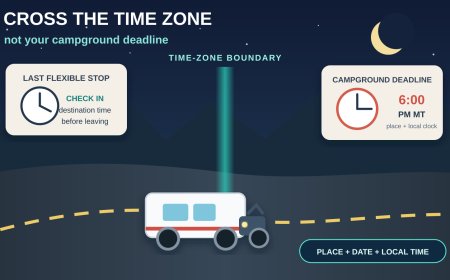
- Arrival date and local time zone: ___
- Posted evening window: ___
- Generator or idling prohibition: ___
- Conservative site-ready time: ___
- Usable runtime before cutoff: ___
- Supported required runtime: ___
- Plan if the window is missed: ___
A rule that says "generators permitted" is only the start.
At Bryce Canyon, the loop and an 8 p.m. cutoff control the evening.[1]
At Capitol Reef, loop and season both matter.[2]
At Big Bend, the campground can change the answer from split hours to no use.[3]
At Colorado National Monument, crossing from Loops A or B into Loop C changes the answer to a full prohibition.[4]
Make the first night work with no rushed setup and no borrowed minutes. If the plan fails when arrival slips by an hour, it was never a reliable generator plan.
Editorial note: Official NPS pages were archived October 21, 2026. Campground, loop, season, posted notices and staff directions can change the applicable rule. This article does not claim firsthand campground experience.
Sources
What's Your Reaction?