







Backing an RV into a campsite: a spotter plan that stops confusion before it starts
Use a clear driver-and-spotter plan for backing an RV into camp: walk the site, rehearse five hand signals, stop on lost contact, and use a conservative solo fallback.

Backing an RV into a campsite: a spotter plan that stops confusion before it starts
The worst time to invent hand signals is when a trailer is angled across a campground loop, the driver is staring into two mirrors, and the spotter is waving at a picnic table.
A safer campsite arrival starts before reverse is selected. The driver and spotter need one plan: who makes each decision, what every signal means, where the spotter will stand, and what makes the vehicle stop. The plan should work for a motorhome, travel trailer, or fifth-wheel, but the driver still has to follow the manuals for the exact RV, tow vehicle, hitch, and camera system.
This is a low-speed communication workflow, not a substitute for practice or professional instruction. If the site requires backing into traffic, crossing a busy pedestrian route, working near an electrical hazard, or maneuvering on ground that will not support the rig, ask campground staff for another site or qualified help.
Rule zero: either person can stop the maneuver
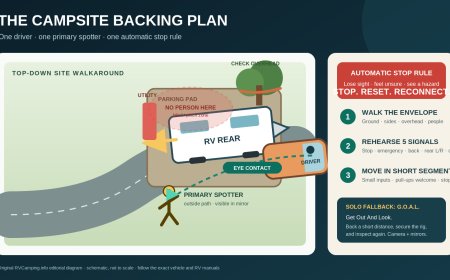
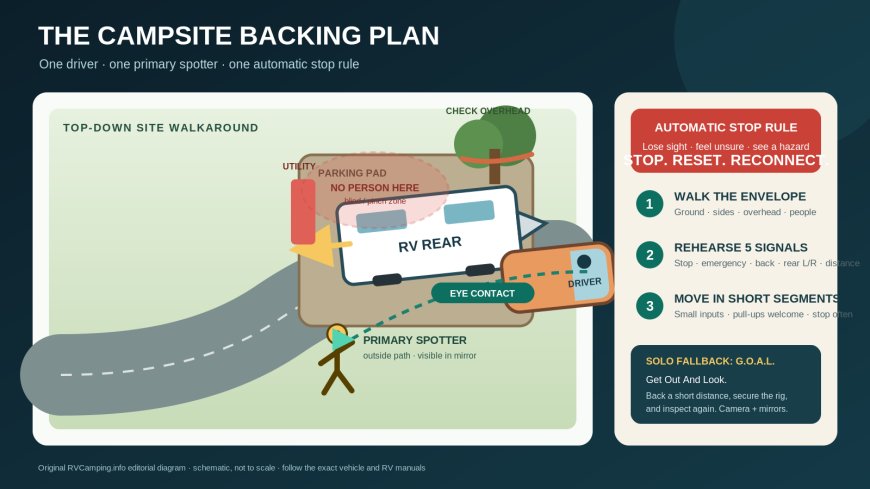
Agree on the stop rule while the rig is still parked:
If the driver cannot see the spotter, the driver stops. If the spotter is uncertain, the spotter signals stop. Nothing moves again until both people reconnect and agree on the next move.
This is not merely a couple's truce. The City of San Antonio's vehicle-backing guideline tells drivers to stop immediately when visual contact is lost and tells spotters to stop the driver when they see a hazard or are unsure of the maneuver.[1] It also says verbal commands alone are not enough; the spotter should use hand signals.[1]
The driver keeps authority over the controls and remains responsible for the vehicle. The spotter owns the clearance report, not the steering wheel. “It looks fine” is not a command. “Stop,” “straight back,” “rear left,” “rear right,” and a visible distance-to-stop signal are.
Assign two roles, not two competing drivers
The driver's job
The driver chooses whether the maneuver can be attempted, moves only on an understood signal, checks both mirrors, and backs at walking pace or slower. The driver should lower a window, silence distractions, keep a foot ready for the brake, and stop before asking a question. Cameras and proximity sensors are additional views, not permission to ignore mirrors or the spotter.
The South Carolina RV manual makes that camera boundary explicit: use a rear-looking television system together with the mirrors.[2] It also notes that RVs bring restricted vision and need more room than passenger vehicles.[2]
The spotter's job
The spotter walks the intended path before movement, reports hazards, takes an agreed visible position, and gives one signal at a time. The spotter never stands directly behind the RV, between the rig and a fixed object, or where a sudden swing could pin them. San Antonio's guideline likewise puts the spotter out of vehicle blind spots, calls for a safe distance, says never to stand directly behind the vehicle, and warns against walking backward while spotting.[1]
The spotter should pause, relocate, and reacquire eye contact rather than trying to stay visible by stepping into danger. If a second person wants to help, make that person a hazard watcher who reports to the primary spotter. Only the primary spotter signals the driver. Two sets of arms create two plans.
Walk the site before you back
Park clear of traffic, set the brake, and get both people out. Do not rely on the site photo or what was visible through the windshield.
Walk the full envelope the RV will occupy, including the front swing of the tow vehicle or motorhome. Look low, high, and to both sides:
- Ground: soft shoulders, holes, rocks, roots, curbs, fire rings, wheel stops, steep cross-slope, leveling blocks, and drainage edges.
- Sides: utility pedestals, water posts, picnic tables, parked vehicles, tent lines, shrubs, and neighboring slide-outs.
- Overhead: branches, wires, roof edges, signs, and anything that could meet an air conditioner, antenna, ladder, or awning housing.
- People: children, pets, bicycles, and anyone likely to enter the path after the walkaround.
- Final setup: room for slides and awnings, a safe step-down area, utility-hose reach, tailgate or rear-ramp clearance, and space to unhitch.
San Antonio's solo-backing guidance specifically calls for checking the rear, sides, and overhead before backing.[1] The South Carolina RV manual also emphasizes the extra height, width, length, turning radius, and restricted vision of an RV.[2] At camp, that means the clearance check must cover the whole three-dimensional path, not just the tires.
Now choose a stopping point. A small cone or bright marker placed beside the intended final corner can help, provided it does not become an obstacle. Do not place a person at the stopping point behind the rig.
Agree on five signals
Stand face-to-face and rehearse the signals before returning to the cab. Keep the set small:
- Stop: cross both forearms above the head. The driver brakes immediately and holds position.
- Emergency stop: hands clasped above the head, then driven downward repeatedly. The driver brakes immediately, sets the parking brake, and waits.
- Straight back: face both palms toward the spotter and repeatedly draw the forearms toward the chest. Move slowly.
- Move the rear left or right: point clearly toward the side where the rear of the RV should travel. The driver decides the steering input needed for that rig.
- Distance remaining: hold palms facing each other and close the gap as the RV nears the agreed stopping point. When the hands meet, change to the stop signal.
These are adapted into a campsite-sized set from the San Antonio guideline's illustrated signals for backward movement, turns, distance remaining, stop, and emergency stop.[1] The important part is not claiming there is one universal campground language. It is agreeing on a language before movement.
Avoid vague circular arm motions. With a trailer, “turn left” can mean turn the steering wheel left, move the truck's nose left, or move the trailer's rear left. Define the desired movement of the RV's rear and let the driver translate it into steering. The South Carolina RV manual warns that sharp steering corrections can jackknife a trailer and damage the tow vehicle or trailer.[2]
Put the spotter where the driver can actually see them
The default position is outside the vehicle's path, usually near the driver's-side rear quarter with enough lateral clearance to see the campsite boundary and the driver's eyes in the mirror. The right position changes as the rig turns, so the team should plan relocation points.
Before moving, the driver points to the mirror being used. The spotter confirms eye contact. Seeing the side of the RV is not enough; the spotter must be able to see the driver's eyes or receive a clear acknowledgment.
Blind spots change during a turn. A travel trailer can hide the inside of the arc. The tow vehicle's front corner may swing toward a tree while everyone watches the trailer bumper. A motorhome's rear overhang can swing sideways as the front turns. The spotter must scan those moving zones, not fixate on the final marker.
If the spotter needs to cross to the other side, the sequence is: signal stop, wait for the vehicle to become fully stationary, move through a safe route that does not pass behind the rig, reestablish eye contact, then signal again. Never disappear and expect the driver to infer that the path remains clear.
Back in short, boring segments
A good backing run is deliberately uneventful:
- Complete the walkaround and agree on the first segment.
- Driver and spotter take positions and establish eye contact.
- Driver selects reverse only after receiving a clear signal.
- Move a few feet at idle speed while the driver alternates mirrors.
- Stop before a large correction, before the spotter relocates, or whenever either person is unsure.
- Pull forward to reset the angle when needed. A pull-up is part of the plan, not a failure.
- As the final point approaches, the spotter gives the shrinking-distance signal, then a definite stop.
- Driver sets the parking brake and keeps the service brake applied as the transmission and RV manuals require. Only then does anyone approach for the final position check.
For a trailer, small inputs and early resets matter. The South Carolina manual advises slow, smooth backing and keeping the trailer's left rear corner visible during straight-line backing; it also describes having another person help as useful.[2] A campsite is not a skills-test lane, but the same principles discourage last-second steering.
After stopping, both people verify wheel position, overhead clearance, slide clearance, utilities, and room to open doors. Chock and level in the sequence specified by the RV and leveling-equipment manuals. Do not unhitch or deploy slides merely because the bumper is on the marker.
When the driver is alone: use a stop-and-look fallback
Solo backing should become slower and more conservative, not more improvised. If the site is too tight to check safely alone, request staff assistance or a different site. Do not recruit a child or an unbriefed stranger as an instant spotter.
For a manageable site:
- Park, secure the rig, and walk the route.
- Identify the tire path, front-swing area, rear-swing area, overhead clearance, and hard stop.
- Place one or two visible reference markers beside hazards, never where tires must pass.
- Adjust mirrors and use the rear camera as a supplement.
- Back only a short distance.
- Stop completely, set the brake, shift to the secure position specified by the vehicle manual, and get out to inspect.
- Repeat as often as needed. If a marker disappears, the angle changes unexpectedly, or a person enters the area, stop and walk again.
San Antonio calls this G.O.A.L.—Get Out and Look—and directs a solo driver to verify rear, side, and overhead clearance.[1] That method is more reliable than trying to remember a campsite that has changed since the first walk. Wind can move branches, neighbors can arrive, and children can cross a path that was empty thirty seconds earlier.
The 20-second briefing card
Before every campsite backing maneuver, say this aloud:
- Driver: “I stop if I lose you or do not understand.”
- Spotter: “I stay visible, never stand behind the rig, and stop you if I am unsure.”
- Both: “Rear left and rear right mean the direction the RV's rear should move.”
- Both: rehearse stop and emergency stop.
- Both: name the first stopping point and the first planned pull-up.
The aim is not a one-pass arrival. It is a controlled arrival in which silence, lost sight, uncertainty, or a new hazard always produces the same response: stop.
Sources
- City of San Antonio: Vehicle Backing & Spotter Guidelines (municipal vehicle-safety guideline effective August 28, 2018; accessed October 10, 2026)
- South Carolina Department of Motor Vehicles: Recreational Vehicles and Large Non-Commercial Vehicles Manual (state driver manual for RV and large non-commercial vehicle operation; accessed October 10, 2026)
What's Your Reaction?