


Check the fire rules, not the fire ring: an RV trip-planning routine
A three-check routine for confirming current campfire, charcoal, portable-stove, propane-fire-pit and generator restrictions for an exact RV campsite.
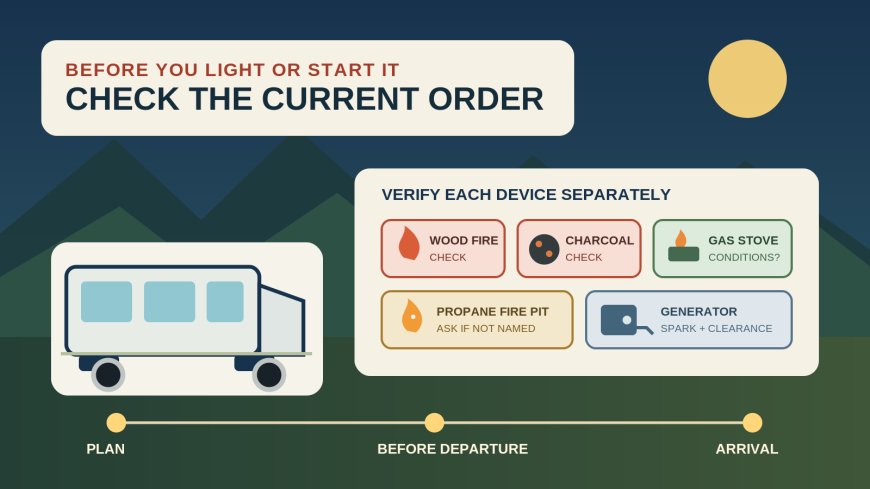
Summary: Fire restrictions can split your campsite setup into separate yes-or-no decisions for a wood fire, charcoal grill, portable stove, propane fire pit and generator. Use this three-check routine to verify the current order for the exact land and dates before you leave.
By Romana RVCamping.info trip-planning guide, prepared September 10, 2026.
A steel fire ring beside your RV is not proof that you may light it. Neither is last week's campground review, a photo on the booking page or a neighbor saying, "Stage 1 still allows fires." The current rule comes from the agency or owner responsible for that exact campsite, and one order can treat wood, charcoal, propane appliances and generators differently.
The Bureau of Land Management sends visitors to regional pages because restrictions are issued for particular places rather than as one nationwide rule.[1] Build fire checking into the trip itself: once while planning, again before departure, and once more when you arrive.
The short answer
Find the current restrictions or closure page for the land manager, then read the actual order or campground notice. Confirm all of these separately:
- the campsite is inside the order's mapped area;
- the order is still in effect on your stay dates;
- your specific device and fuel are allowed;
- an allowed-device exemption has conditions, such as a shutoff valve, clear ground, a spark arrestor or a permit;
- the campground has not imposed a stricter site rule.
If you cannot settle one of those questions online, call the ranger district, park, field office or campground named on the official page. Ask about the device, not just "fires." A useful question is: "May I use a portable propane stove with an on/off valve at Site 28 tonight, and are there clearance or permit conditions?"
Why the word "fire" is too vague
Campfire restrictions often separate appliances by how quickly the flame can be stopped and whether the device can throw embers.
Wood campfire
Treat a wood fire as the first thing likely to disappear from the plan. Read whether it is allowed only in agency-provided rings, only in named developed campgrounds, only above or below an elevation, or nowhere in the restricted area.
Yosemite's current page, for example, says restrictions apply below 8,000 feet but still allows wood and charcoal fires in certain open frontcountry campgrounds and picnic areas. Its parkwide restriction tier removes those exceptions.[2] Do not memorize Yosemite's elevations as a general rule. Notice instead how much geography and facility status can matter inside one park.
Charcoal grill
Do not assume charcoal is the same as a controllable gas grill. Official orders commonly group charcoal with wood because hot briquettes remain an ignition source after cooking. Joshua Tree's 2026 restrictions prohibit both wood-burning and charcoal fires throughout the park, including campgrounds and picnic areas.[3]
If charcoal is prohibited, do not bring it "just in case." Plan an indoor RV meal that your ventilation and appliance manuals allow, a cold meal, or an outdoor cooking device specifically permitted by the current order.
Portable stove or gas grill
A portable stove may remain legal when campfires and charcoal are banned, but the details are not portable from one park to another. Yosemite says its listed pressurized-gas, liquid-fuel, propane, alcohol and tablet/cube stoves remain allowed.[2] Joshua Tree's order permits liquid-gas devices only in an area free of flammable material within three feet.[3] Crater Lake's June 2026 notice allows propane and liquid-fuel cooking appliances across its listed use areas, including campgrounds and the backcountry.[4]
Read the noun and the conditions. "Propane fire pit" may not be treated the same as a metal cooking stove, even though both connect to a propane cylinder. If the order exempts a stove, lantern or cooking appliance but says nothing about decorative fire pits, ask before using the fire pit.
Generator
A generator can be covered by restrictions on internal-combustion engines even though it has no cooking flame. Joshua Tree's current notice allows generators only with approved spark arrestors and at least three feet from dry grass and other flammable material.[3] Another order may require more clearance, restrict operating hours, limit use to a developed campground or prohibit it.
Check two rule sets: the fire order and the campground's generator policy. Satisfying the fire order does not cancel quiet hours, and a generator-friendly campground does not override a fire restriction. If shore power is unavailable, decide before the trip what loads you can shed if generator use is restricted.
Run the three checks
Check 1: while you are building the itinerary
Identify who manages the campsite. A postal address or nearby national park does not answer that question; adjacent National Park Service, Forest Service, BLM, state, tribal, county and private lands may have different rules.
Save four things with the reservation:
- the land manager's restrictions or alerts page;
- the campground's own rules page;
- the ranger station or campground phone number;
- a no-flame meal and power backup.
The BLM's national restrictions page links to its state and regional fire pages, making it a useful starting point for BLM sites.[1] For other public lands, start at the exact park, forest, refuge or state-park website rather than a generic fire map. A map can help you find the responsible agency; the signed order or official notice tells you what is prohibited.
Check 2: 24 to 48 hours before departure
Open the official page again. Do not rely on the screenshot you saved at booking. Look for an effective date, an end date or the words "until further notice" or "until rescinded." Joshua Tree's notice says its restrictions run through October 1, 2026 unless park leadership changes them.[3] Crater Lake's June notice uses "until further notice."[4] Both phrases require a fresh check.
Read the map or area description, exemptions and definitions. Then write a one-line status for each device you intend to use:
- wood campfire: yes / no / only in a provided ring;
- charcoal: yes / no;
- propane stove: yes / no, plus valve, permit and clearance conditions;
- propane fire pit: confirmed yes / no / not answered;
- generator: yes / no, plus spark-arrestor, surface, clearance and hour limits.
Take a dated screenshot or save the order for offline reference, but regard it as a record of what you checked, not a promise that the rule cannot change.
Check 3: at arrival and every day conditions shift
Read entrance signs, bulletin boards and check-in material. Ask the host or ranger whether the posted order changed that day. Wind, active fire, staffing limits or a new closure can alter the answer after you leave home.
Repeat the check if smoke arrives, a red-flag warning is issued, you move to a different jurisdiction or campground staff announce a change. Follow the stricter applicable instruction until you can confirm the current rule.
Pack so a restriction does not wreck dinner or power
A good backup is boring and ready. Carry at least one meal that needs no outdoor flame. If an official order permits a controllable stove, keep the correct fuel and a stable cooking surface available, but do not count on that exemption until you verify it for the site.
For electricity, arrive with charged battery banks and a realistic list of essential loads. Know which RV functions depend on 120-volt power and which can run from the house battery or propane according to your manuals. Never move a running generator into an RV, compartment, tent, truck bed with a cap or other enclosed space to solve a fire-clearance problem.
Put the restriction check beside weather, route clearance and arrival time on your departure list. The useful question is not "Are campfires banned?" It is "What can I legally and safely operate at this exact campsite today?"
Sources
What's Your Reaction?