












NOCO GB70 review for RVs: capable backup, strict battery limits
Research-based NOCO GB70 review for RV travelers covering engine limits, lead-acid compatibility, short cables, charging and safe jump-start use.

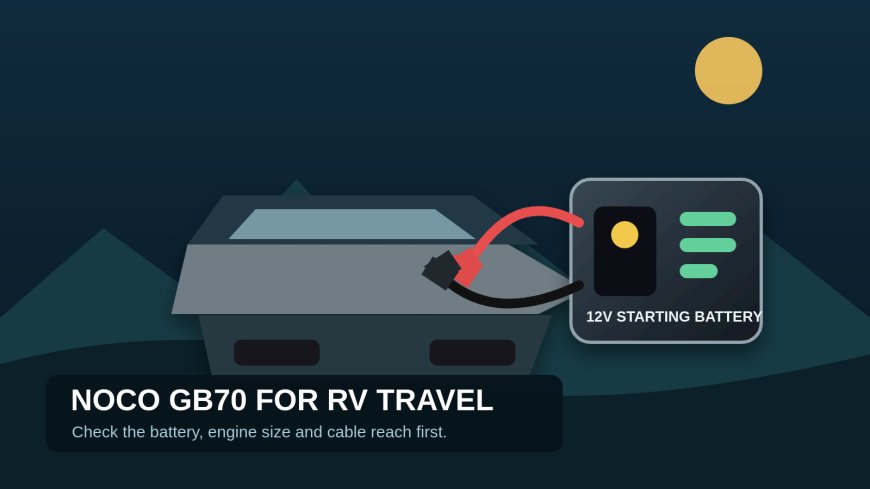
The NOCO Boost HD GB70 makes sense for RV travelers who want one portable jump pack for a gas tow vehicle, smaller diesel, or compatible motorhome chassis.[1][2] Buy it only after confirming a 12-volt lead-acid starting battery, an engine no larger than 8.0 liters gas or 6.0 liters diesel, and a safe place for the short attached leads to reach.[1][2][4] Skip it for a 6.7-liter diesel pickup, a 24-volt system, or a lithium house bank.[1][2] The central tradeoff is useful big-engine starting power in a five-pound pack versus narrow chemistry limits, slow USB charging, and cramped cable reach.[1][3][4]
This is a research-based review. RVCamping.info did not purchase, use, or physically test this jump starter.
The exact model and Amazon listing
This review covers the NOCO Boost HD GB70, manufacturer model GB70. NOCO rates it at 2,000 peak amps for gas engines through 8.0 liters and diesel engines through 6.0 liters. The official data sheet lists a 56-watt-hour internal lithium-ion battery, 12-volt operation, IP65 housing protection with the ports closed, and five pounds with the clamps and accessories.[1]
The matched Amazon listing is ASIN B016UG6PWE. Its item details identify the manufacturer part number and model as GB70.[5]
As an Amazon Associate, RVCamping.info earns from qualifying purchases. If you buy through an Amazon link in this article, we may earn a commission at no additional cost to you.
Check the NOCO Boost HD GB70 on Amazon
Do not shop from the 2,000-amp headline alone. NOCO sells several similar Boost models, and marketplace pages can mix family photos or accessories. Confirm GB70 and B016UG6PWE before ordering.[5]
Verdict: good for some RV starting batteries, not every RV battery
The GB70 is a defensible emergency tool for an RVer whose tow vehicle or motorhome fits the published engine and battery limits. It carries enough official documentation to plan around, has automatic reverse-polarity and spark protection in normal mode, and can also supply modest USB or 12-volt accessory power.[1][2]
Its RV usefulness is easy to overstate. An RV may have a chassis starting battery, a generator starting battery, and a separate house bank. Those batteries can use different voltages and chemistries. The GB70 manual authorizes 12-volt lead-acid batteries only.[2] That excludes a lithium iron phosphate house bank even though the jump pack itself contains lithium-ion cells.[2] It also means the GB70 is not a general battery charger, converter substitute, or cure for a failing battery.[2]
The displacement ceiling catches many RV travelers. A gasoline engine under 8.0 liters may fit, but a common 6.7-liter diesel exceeds the GB70's published 6.0-liter diesel limit.[1] Do not round down or assume the 2,000-amp label erases that boundary.[1] Select a larger manufacturer-rated starter or follow the chassis maker's roadside procedure instead.
The RV compatibility check takes five minutes
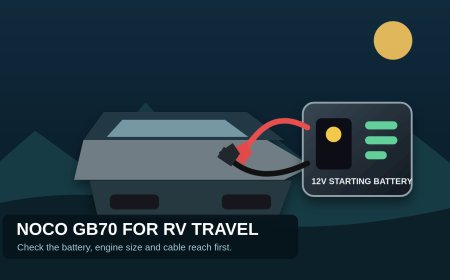
Start with the vehicle manual, not the jump pack. Find the approved jump points, system voltage, negative-ground instructions, and any warnings for battery monitoring electronics. Some motorhomes and pickups hide the battery or provide remote terminals. Short leads that work on an exposed battery may not reach both approved points.
Then check these four items:
- The target is a starting battery, not simply whichever RV battery is easiest to reach.
- The battery is 12-volt lead-acid: flooded, AGM, gel, maintenance-free, or enhanced flooded chemistry within the vehicle maker's instructions.[2][3]
- The engine is within the 8.0-liter gas or 6.0-liter diesel ceiling.[1]
- Both clamps can reach approved connection points while the GB70 rests securely, clear of belts, fans, hot surfaces, fuel lines, and the hood latch path.[2]
Dual-battery starting systems deserve extra caution. The product literature's displacement rating does not explain every parallel-bank, battery-isolator, or coach-builder arrangement. Follow the chassis and coach manuals. If they do not clearly permit a portable jump pack at the identified terminals, call roadside service or a qualified technician.
Short cables are the practical catch
Two independent reviewers arrived at the same drawback. Automoblog used a GB70 supplied by NOCO and found the attached cables and clamps rugged, but called the jumper leads relatively short.[3] A 4X4 Australia contributor who bought and used the unit for about a year was blunter: the short leads sometimes forced the pack to sit on the battery, which made operation fiddly.[4]
That matters more on an RV than on a sedan with an exposed under-hood battery. A motorhome battery tray, diesel pickup battery pair, or remote positive post may leave no stable surface within reach.[3][4] Measure the path between the approved points before relying on the GB70. The unit should not hang by its leads or sit where vibration can pull a clamp loose.
The independent reports also put the "up to 40" starting claim in perspective. NOCO states that figure as a maximum.[1] The 4X4 Australia reviewer reported that a deeply discharged 4.0-liter diesel required time connected and manual boost, then doubted that the pack could repeat that demanding start anywhere near 40 times.[4] One hard start is more useful than an ideal-condition count when judging emergency gear.
Manual override is not a routine boost button
In normal operation, the GB70 detects a connected battery and keeps its spark-proof and reverse-polarity protections active. A battery below two volts may not be detected. Manual Override forces output, but the manual says it disables both protections.[2]
That changes the risk. Do not use Manual Override simply because the first crank failed or because an auxiliary bank will not wake up.[2] Confirm chemistry, voltage, polarity, and the vehicle maker's procedure first.[2] If any of those are uncertain, stop.
One independent reviewer described using the GB70 to "shock" a deeply discharged auxiliary battery into accepting charge.[4] That is an individual's practice, not a safe instruction for an RV house system. It conflicts with treating the manual's chemistry and operating limits as hard boundaries. RVCamping.info does not recommend repeating it.
Charging and connector documentation do not line up neatly
The current official data sheet shows seven hours at a two-amp USB input and two to three hours through the 36-watt 12-volt fast-charge path.[1] The manual says to fully charge the pack before first use, and NOCO's support guidance recommends periodic recharging because an unused pack will discharge.[2]
There is a generation and package-content wrinkle. The current data sheet and Amazon listing show a USB-C cable, while Automoblog's earlier test unit came with Micro-USB charging hardware.[1][3][5] The power specification remains modest at 5 volts and 2.1 amps in the current official documents.[1][2] Check the connector on the actual unit and included cable rather than ordering a replacement from an old review.
Build a charging routine around travel, not memory. Charge the GB70 before a long trip, after a jump, and periodically during storage.[2][3] Press the charge-level button during predeparture checks. A jump pack buried in an exterior compartment for months is only useful if it still has charge when the starter clicks.
Store it dry and secured inside the temperature limits in the manual. The IP65 rating applies with ports closed, but the guide says the unit is for temporary outdoor use and should be stored indoors when not in use.[2] Do not leave it loose in a hot battery bay, on a wet bumper, or where cargo can crush the clamps.
Safe jump-start sequence
- Read the chassis or vehicle jump-start procedure. Confirm 12-volt lead-acid chemistry and the approved connection points.[2]
- Inspect the target battery. Do not jump a frozen, swollen, leaking, cracked, or otherwise damaged battery. Ventilate the area and wear eye protection.[2]
- Inspect the GB70, clamps, cables, and port covers. Stop if anything is damaged, unusually hot, swollen, or wet.[2]
- Turn off headlights, climate control, radios, inverters, and other vehicle loads.[2]
- With the GB70 off, connect the red clamp to the approved positive point. Connect the black clamp to the approved negative terminal or chassis point exactly as the vehicle manual specifies.[2]
- Set the pack on a stable surface away from moving parts. Confirm that neither lead is stretched and the clamps cannot be knocked loose.[2]
- Turn the GB70 on. In normal mode, wait for the white Boost indicator before cranking. Do not enter Manual Override unless the battery is confirmed compatible and you understand that the normal safety protections will be disabled.[2]
- If the engine does not start, wait 20 to 30 seconds before another attempt. The manual limits use to five attempts in 15 minutes, followed by a 15-minute rest.[2]
- Once the engine runs, switch off and disconnect in the order required by the vehicle and GB70 manuals. Keep clamps clear of moving parts.[2]
- Diagnose the reason for the no-start. A jump can get a vehicle moving, but it does not prove that the battery, alternator, converter, isolator, or charging circuit is healthy.
Who should buy it
The GB70 fits RV travelers with a compatible gas tow vehicle, a smaller diesel within the 6.0-liter limit, or a motorhome chassis whose manual permits a portable 12-volt jump pack.[1][2] It is most useful when battery access is straightforward and the owner is willing to keep the pack charged.
The five-pound size and sealed-port weather resistance make it easier to carry than a traditional lead-acid jump box. Automoblog found its clamps and housing substantial enough for repeated outdoor use, while keeping one in a winter emergency kit.[3] That is encouraging independent experience, not a guarantee that every cold, aged, or deeply discharged battery will start.
Who should skip it
Skip the GB70 if your diesel engine exceeds 6.0 liters, your approved jump points are too far apart for the attached leads, or the target system is 24 volts.[1][2][4] It is also the wrong tool for a lithium house bank, for charging a depleted RV battery bank, or for masking a recurring electrical fault.[2]
Owners who rarely check stored emergency gear may be better served by roadside assistance and a maintained starting battery. The GB70 still depends on its own charge state, sound clamps, correct battery identification, and safe access when the failure happens.
Bottom line
The NOCO GB70 is a useful RV travel backup when the exact starting system fits its limits. Its strongest case is a 12-volt lead-acid starting battery, an engine within the published displacement range, and accessible jump points.[1][2] The five-pound pack is easier to carry than another vehicle, but it does not make every RV battery jumpable.[1][2]
Measure the cable reach, verify battery chemistry, and treat Manual Override as a last-resort mode with disabled protections.[2][3][4] For a 6.7-liter diesel, a lithium house bank, or an unclear dual-battery layout, choose a system-specific solution instead of betting on the 2,000-amp headline.[1][2]
Sources
What's Your Reaction?