












Fort Pickens vs. Davis Bayou: Which Gulf Islands Campground Fits Your RV?
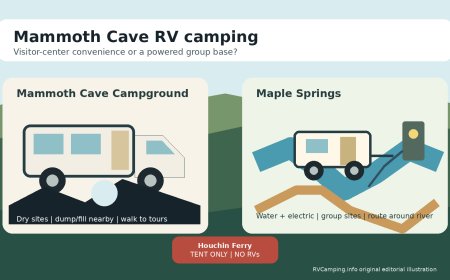
Fort Pickens wins for Florida beach and fort access; Davis Bayou is the simpler utility choice and a better first screen for longer RV setups.

Fort Pickens vs. Davis Bayou: Which Gulf Islands Campground Fits Your RV?
By Romana | Updated October 9, 2026
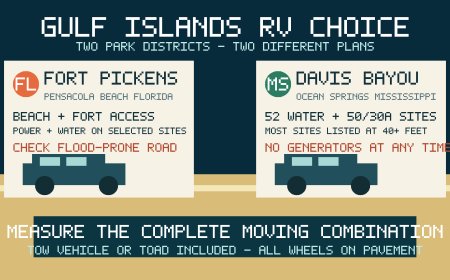
Gulf Islands National Seashore has two developed campgrounds, but they are not interchangeable loops in one destination. Fort Pickens sits on Santa Rosa Island near Pensacola Beach, Florida. Davis Bayou is in Ocean Springs, Mississippi. Both can put an RV on a paved site with water and electricity, yet the better booking depends on which coast you mean to explore, the exact length of your complete setup, and how much road and storm uncertainty you are willing to accept.[1][2][3]
The short answer: choose Fort Pickens for the Florida barrier-island setting and easy campground-to-beach access; choose Davis Bayou for a smaller mainland base, more consistently equipped sites, and a better first screen for a long rig. Neither choice lets you skip the site record. At both campgrounds, every wheel has to fit on pavement, and the reservation length must include the tow vehicle or towed car.[2][3]
Checked October 9, 2026: The park's current closure page lists a Fort Pickens loop road and Battery Cooper closure, a closed Fort Pickens visitor center during renovations, and restroom work at the campground's B/D structure. The campground is not listed as closed, and other campground restrooms remain open for reserved campers. Recheck alerts before driving to either district.[5]
Quick RV comparison
| Decision factor | Fort Pickens, Florida | Davis Bayou, Mississippi |
|---|---|---|
| Setting | Barrier island near Pensacola Beach | Mainland bayou and coastal forest in Ocean Springs |
| Reservations | Year-round; sites released up to six months ahead | Year-round reservations |
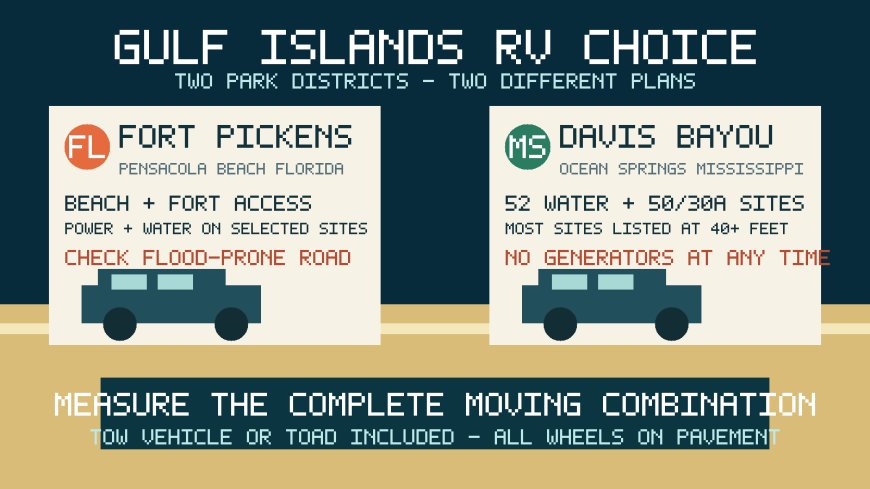
| RV utilities | Many electric-and-water sites; dry RV-capable sites also exist, so loop and site type matter | All 52 individual sites have 50/30-amp electrical service and water |
| Dump station and showers | Yes | Yes |
| Generator rule | Recreation.gov says generators are allowed only in D Loop, 8–10 a.m. and 4–7 p.m., with a 60-decibel limit | Generators are prohibited at all times |
| Published size clue | No useful campground-wide maximum; reserve by the exact site's total-length field | Most sites are described as 40 feet or longer, but the complete setup still has to fit the selected pavement |
| Main access caveat | Fort Pickens Road is flood-prone; overflow parking is limited and not guaranteed | Mainland access avoids the Fort Pickens barrier-island road issue |
| Best for | Florida beach and fort itinerary with a site matched to the full rig | Larger-rig first screen, quieter no-generator camping, Ocean Springs and Mississippi-side activities |
Fort Pickens is the beach-first choice
Fort Pickens is the larger campground. Recreation.gov lists 137 family sites with 20-, 30-, and 50-amp electricity plus water, along with 40 nonelectric tent sites. The same listing says the campground has showers, drinking water, and a dump station, and that individual sites can be reserved up to six months in advance.[2]
The attraction is geographic. Campsites are within a quarter mile of beaches, and historic Fort Pickens is about a mile from the campground.[2] If the trip is built around the Florida district, this location saves the daily shuffle between an inland RV park and the island.
The tradeoff is that "Fort Pickens has hookups" is too broad to book by. NPS says C Loop accepts RVs, trailers, and pop-ups and has power and water. E Loop also accepts RVs and has power and water. D Loop permits several vehicle-based camping types but has no site power or water. NPS restricts B Loop to ground tents.[1] Recreation.gov also shows electric sites in A Loop, which the NPS loop summary does not describe. That mismatch is a good reason to trust the attributes and alerts on the exact reservable site rather than a loop-level assumption.
Power does not erase the generator rule. The current Recreation.gov notice says generators may run only in D Loop, from 8–10 a.m. and 4–7 p.m., subject to a 60-decibel limit.[2] C Loop's NPS rule expressly prohibits generators.[1] An electric-site camper should not pack a generator as a universal backup and assume it can be started during an outage.
Davis Bayou is the cleaner utility choice
Davis Bayou is much smaller, with 52 individual sites. Recreation.gov says every one has a 50/30-amp breaker and water connection; the campground also has showers, drinking water, and a dump station.[3] That makes the utility question simpler than it is at Fort Pickens.
It is also the stronger first screen for a longer RV. The official listing says most Davis Bayou sites are 40 feet or longer.[3] That is not a promise that a 40-foot motorhome plus a towed car fits any open site. It does mean the campground deserves a closer site-by-site look before Fort Pickens if the setup is long.
Davis Bayou's no-generator rule is absolute: generators are not permitted at any time.[3] For an RV on a functioning electric pedestal, that can make the campground noticeably quieter. It also removes the backup option if site power fails. Travelers with medical equipment or another critical electrical load should bring an independent contingency that follows park rules, not rely on starting the onboard generator.
The location suits a different trip. The campground is about half a mile from the park boat launch, and the Davis Bayou Trail is nearby. The official listing frames it as a base for boating, fishing, biking, and hiking on the Mississippi side.[3] It does not put the RV beside the Florida beaches and fort. Pick the district before comparing amenities.
Exact RV fit: measure the whole moving combination
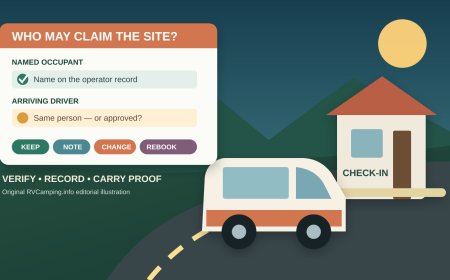
Both booking pages make the same point in slightly different language: site length is not just the trailer box or motorhome body. Fort Pickens defines total length as the vehicle plus trailer, or the RV plus tow vehicle. It warns that a reservation may be canceled on arrival if the selected site cannot hold the setup, and requires all wheels to fit in line on the pavement.[2]
Davis Bayou tells campers to add vehicle length to trailer length and requires the RV, support vehicle, motorcycle, and any boat or cargo trailer to stay on pavement. A car cannot be turned sideways across the pad to manufacture extra length; it must sit in line or move to overflow parking.[3]
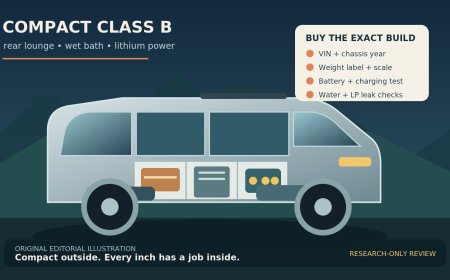
Use this measurement before opening Recreation.gov:
- Measure a motorhome from its frontmost fixed point to its rearmost carried item, including a bike rack or cargo carrier.
- If towing a car, add the tow hardware and car. Do not filter sites by motorhome length alone.
- For a trailer, measure the coupled truck-and-trailer combination, including the hitch and anything mounted behind the trailer.
- Record height and width separately. A length match does not verify tree clearance, turn angle, slide deployment, awning room, or pedestal reach.
- Open the exact campsite record and compare its stated limits with the complete numbers. Save a screenshot or PDF of the site details used to book.
A campground summary can help choose where to search. It cannot clear a specific RV for a specific pad.
Fort Pickens adds a road-and-parking test
Fort Pickens Road is subject to flooding, according to the NPS campground page.[1] The park's parking guidance goes further: roads in the Fort Pickens area can become severely flooded and may be impassable even to low-clearance cars. NPS tells drivers to monitor announcements and weather and not enter floodwater at high tide or after dark.[4]
That warning matters more in an RV than in a sedan. Turning around may be difficult, salt water is corrosive, and the campground is reached by an exposed barrier-island road. Treat a forecast or alert as an access decision, not an invitation to see how deep the water is. If the park closes or restricts the road, a valid reservation does not make the route passable.
Do not use overflow parking to rescue a site that was too short from the start. NPS says Fort Pickens overflow space is limited, is not guaranteed for overnight campers, and does not change the two-vehicle maximum at a campsite.[4] Two Fort Pickens beach-access lots also prohibit RVs and campers because of limited space.[4] Book a pad that holds the intended arrangement, then identify day-use parking that accepts the vehicle you plan to drive.
Davis Bayou avoids this particular barrier-island approach, which is a meaningful advantage in uncertain coastal weather. It is still coastal camping. Check the same-day park alerts and local weather before arrival rather than treating "mainland" as storm-proof.
Rules that can change the stay
The park caps a normal continuous stay at 14 nights and requires a 48-hour break before returning after that run. It also limits campers to 42 nights per calendar year.[1] Davis Bayou's Recreation.gov notice describes a seasonal variation in how its two 14-day increments can be used, so long-stay travelers should read the current reservation notice rather than extrapolate from one date range.[3]
At either campground, no more than two vehicles may occupy a site, and trailers and RVs count toward that number.[1] Greywater discharge is prohibited, including wash water with soap, and campers may not hang hammocks, lights, clotheslines, food bags, or similar equipment from trees, vegetation, or park electrical equipment.[1]
After-hours arrival also needs planning. Fort Pickens gates close at sunset, with the gate code provided in the confirmation email.[2] Davis Bayou uses automatic gates and tells registered campers to obtain or locate the code before the office closes.[3] Download the confirmation before losing service and arrive with the campsite number already noted.
Which one should you book?
Book Fort Pickens when the Florida beaches and historic fort are the point of the trip, the exact site fits every vehicle on pavement, and the weather leaves Fort Pickens Road comfortably usable. Choose an electric-and-water site if you need shore power; do not assume every RV-capable loop has hookups.
Book Davis Bayou when the Mississippi district is the destination, a majority-40-plus-foot site pool improves the odds for a longer setup, and a campground-wide no-generator rule works for your power plan. Its uniform water and 50/30-amp service removes one source of booking error, though exact pad fit still controls.
Choose neither until you can answer four questions from the live site record: Does the complete combination fit? Does the site type supply the power you need? Can every wheel remain on pavement? Is the approach open and comfortable for the forecast? Gulf Islands gives RV travelers two good bases, but they solve different trips.
Source credit: RVCamping.info compared current National Park Service campground, parking, and closure guidance with the official Recreation.gov listings for Fort Pickens and Davis Bayou, retrieved October 9, 2026. The fit checklist and campground-selection framework are original editorial analysis.
Sources
- Campground details — Gulf Islands National Seashore — Shared rules, loop-specific campsite restrictions, stay limits, and Fort Pickens Road flood notice. Accessed October 9, 2026.
- Fort Pickens Campground — Recreation.gov — Facilities, reservation horizon, total-length rule, generator hours, location, and arrival details. Accessed October 9, 2026.
- Davis Bayou Campground — Recreation.gov — Site count, utilities, length context, pavement rule, generator ban, and arrival details. Accessed October 9, 2026.
- Parking — Gulf Islands National Seashore — Fort Pickens overflow limits, RV-restricted lots, roadside parking, and flood cautions. Accessed October 9, 2026.
- Temporary Road and Facility Closures — Gulf Islands National Seashore — Current Fort Pickens road, visitor-center, and campground-restroom work. Accessed October 9, 2026.
What's Your Reaction?