









Mammoth Cave RV camping: Mammoth Cave Campground or Maple Springs?
Compare Mammoth Cave Campground and Maple Springs for RV camping, including hookups, rig limits, dump access, group-site rules, and the Green River route.

By Romana | October 9, 2026 | Campgrounds
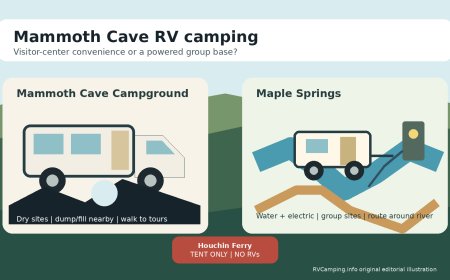
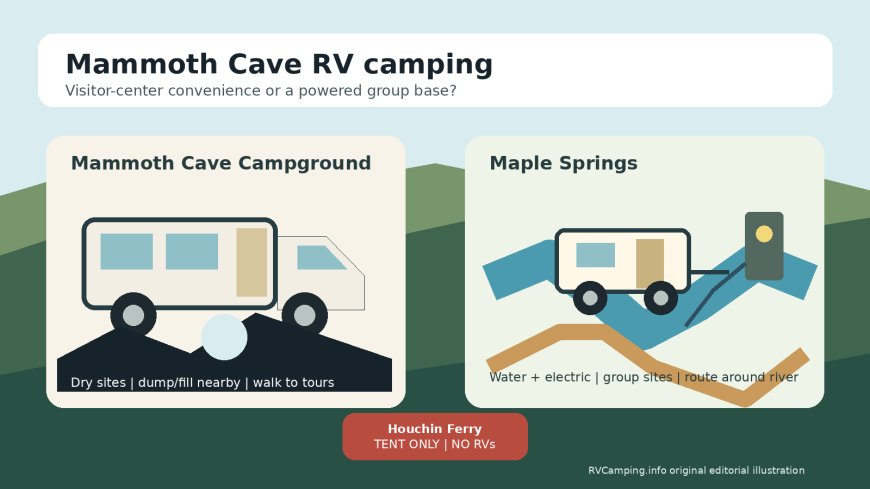
Mammoth Cave National Park lists three developed frontcountry campgrounds, but an RV traveler really has two in-park choices.[1] Mammoth Cave Campground is the practical cave-tour base.[2] Maple Springs is a seven-site group campground with water and electric hookups, yet its north-side location turns the route into part of the decision.[3] Houchin Ferry is tent-only and should not appear on an RV short list.[4]
The quick answer: book Mammoth Cave Campground for a normal couple or family trip built around cave tours. Consider Maple Springs only if you need a group site, can use its utility setup, and have planned the longer RV approach around the Green River rather than across it.
At a glance
| Question | Mammoth Cave Campground | Maple Springs Group Campground | Houchin Ferry Campground |
|---|---|---|---|
| RV camping? | Yes | Yes, on group sites | No; tents only |
| Utility setup | No hookups; fill and dump stations nearby | Water and electric hookups; no sewer or dump station | Primitive tent sites |
| Published overall RV limit | 38 feet | 40 feet in the NPS park table; verify the exact reservable site | No RVs or trailers |
| Best use | Cave tours and visitor-center access | Groups, equestrian campers, north-side trails | Tent camping by the Green River |
| Main planning catch | Every wheel and vehicle must fit on pavement | RVs must use the road route around the river | Bringing an RV is not allowed |
The park's current overview lists Mammoth Cave Campground with 111 sites, Maple Springs with seven, and Houchin Ferry with 12. It gives March 1 through November 30 operating dates for the first two and year-round operation for Houchin Ferry.[1] Availability still has to be checked for the actual travel dates.
Choose Mammoth Cave Campground for cave-tour convenience
Mammoth Cave Campground sits one-quarter mile from the visitor center, and Recreation.gov describes it as about a five-minute walk from where cave tours begin.[2][7] That location matters more than it may look on a map. A timed cave tour is easier when the RV can stay parked at camp and nobody has to build a ferry status check or a long road approach into the morning.
The campground is dry camping. Recreation.gov currently lists no hookups, an RV maximum of 38 feet, and a separate 26-foot trailer maximum. It also says the stated maximum vehicle length applies to all vehicles, RVs, and trailers at the site, and all wheels must remain on paved surfaces.[2] Those numbers are screening limits, not a promise that any open site will fit a particular combination. Open the individual site record and check its maximum vehicle length, driveway length, entry type, grade, and vehicle count before paying.
This is the easier place to manage tanks. The service area by the Camp Store has the fresh-water fill and waste dump; each camping loop has drinking water and restrooms. Paid showers sit behind the store.[2] The trade is generator dependence if the house batteries or solar cannot carry the stay. Properly muffled generators are allowed only from 8 a.m. to 8 p.m.[2]
Choose Mammoth Cave Campground when:
- the visitor center and cave tours anchor the trip;
- a no-hookup site works for your water, battery, and temperature plan;
- the RV is within the published limits for the exact site; and
- easy access to fill, dump, restrooms, and paid showers matters more than a powered pedestal.
Choose Maple Springs for a group, not as a hookup shortcut
Maple Springs solves a different problem. All seven sites are group sites, and the park charges $50 per night for both regular group and horseback group sites.[3][7] Recreation.gov lists electric and water hookups, vault toilets, and no sewer or dump station.[3] Four sites are recommended for equestrian use, so non-equestrian groups are asked to consider sites 5, 6, and 7 first.[3]
The NPS comparison table publishes a 40-foot RV maximum for Maple Springs.[1] Treat that as the outer park-level limit and then inspect the chosen site record. A group pad, a listed equipment maximum, and enough pavement for every vehicle are separate questions.
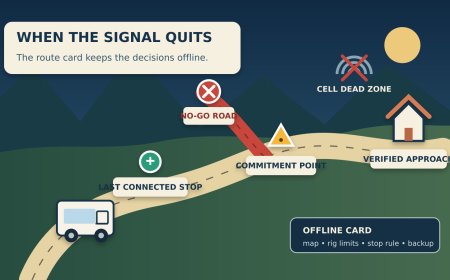
The routing issue is decisive. Maple Springs is north of the Green River, while cave tours and most visitor services are on the south side.[5] The Green River Ferry has a 16-foot length limit and a 12-ton limit; Recreation.gov tells RV drivers not to board it and to take the alternate driving route around the park.[3][5] The park's directions send that route through Brownsville, KY-259, KY-728 by Nolin River Dam, and state roads back to Green River Ferry Road.[5]
That means Maple Springs is not simply "ten minutes from the visitor center" for a typical RV. That short description assumes a usable ferry crossing for a vehicle that qualifies. Recreation.gov warns that the road trip between Maple Springs and the visitor-center side can take about 45 minutes when the ferry is unavailable, and the ferry can close with little notice.[3] For an RV, plan on the road route from the start. If a smaller support vehicle will cross later, call the ferry hotline and confirm current status and eligibility that day.
Choose Maple Springs when:
- one group reservation fits the party better than several individual sites;
- water and electric hookups justify the higher nightly fee;
- no on-site sewer or dump station works with the group's tank plan;
- north-side hiking, biking, or horseback riding is part of the trip; and
- everyone accepts the road approach and the extra time to reach cave tours.
Do not book Houchin Ferry for an RV
Houchin Ferry's riverfront setting can make it look like the quiet alternative, but the official listing is unambiguous: 12 primitive tent-only sites, no RVs or trailers, and no generators.[4] Campers find drinking water and portable toilets near the campground entrance.[4] It can work for a separate tent trip or day use. It is not an overflow solution when the two RV options are full.
The rig-fit check before booking
Start with the campground-level limit, then confirm the exact site. For Mammoth Cave Campground, Recreation.gov says the 38-foot RV and 26-foot trailer limits sit alongside a rule that every vehicle must fit on paved surfaces.[2] A 35-foot motorhome with a towed car therefore needs more than a listing that merely says "38 feet." The site record must account for the parked combination or a documented overflow plan.
At Maple Springs, check the listed equipment maximum, the group's vehicle count, and where any horse trailer or support vehicles will stand. Do not infer a full hookup from the water-and-electric listing: the campground has no sewer connection and no dump station.[3]
Before checkout, save screenshots or a PDF of the selected site's details and answer five questions:
- Which number limits the booking: RV length, trailer length, maximum vehicle length, or driveway length?
- Can the tow vehicle or toad remain on pavement without blocking the loop road?
- Are slides and the entry door usable within the site boundary?
- Where will fresh water be added and wastewater dumped?
- Does the arrival route avoid the Green River Ferry if the rig exceeds its limits?
Rules that affect either RV choice
Frontcountry check-in starts after 1 p.m.; checkout is before 11 a.m.; and the maximum stay is 14 consecutive nights.[6] Quiet hours run from 10 p.m. to 6 a.m.[6] The park also requires food to be stored in a vehicle when it is not being prepared or eaten, prohibits washing at water hydrants, and requires drain water to be caught and emptied into toilets.[6]
Do not haul firewood into the park. Mammoth Cave prohibits transported firewood and directs visitors to collect dead and downed wood in the park or buy wood locally at the camp store.[1][6]
Bottom line
Mammoth Cave Campground is the default RV answer because it puts a conventional campsite, dump-and-fill access, showers, and the visitor center in one compact base. Maple Springs is the specialist choice: seven group sites with water and electric service, no sewer or dump station, and an RV route that belongs on the itinerary rather than in the fine print. Houchin Ferry is not an RV campground.
Verify the exact site and current route again before departure. Campground inventory, ferry operations, and local conditions can change after this guide's October 9, 2026 evidence check.
Sources
- Camping - Mammoth Cave National Park — campground comparison, operating dates, site counts, services, generator window, and park-level RV limits; page updated June 26, 2026.
- Mammoth Cave Campground - Recreation.gov — current reservation listing for facilities, limits, paved-pad rule, dump/fill location, showers, and generator hours; retrieved October 9, 2026.
- Maple Springs - Recreation.gov — current reservation listing for hookups, no-sewer/no-dump limitation, group-site use, ferry warning, and alternate RV routing; retrieved October 9, 2026.
- Houchin Ferry Campground - Recreation.gov — current reservation listing confirming tent-only use, 12 sites, no generators, potable water, and portable restrooms; retrieved October 9, 2026.
- Directions & Transportation - Mammoth Cave National Park — park layout, Maple Springs road route, and Green River Ferry size and weight limits; page updated March 3, 2026.
- Camping Regulations - Mammoth Cave National Park — check-in/out, stay limit, quiet hours, food, water, pavement, and firewood rules; page updated September 19, 2025.
- Fees & Passes - Mammoth Cave National Park — current campground fees and campground locations; page updated August 17, 2026.
What's Your Reaction?