



Before you plug in the induction cooktop, budget the RV's 30 amps
A label-led, two-circuit check for deciding whether a 1,800-watt induction cooktop fits a 30-amp RV's live electrical load.
Before you plug in the induction cooktop, budget the RV's 30 amps
By Romana | Information checked 2026-10-27 UTC | Cooking
A portable induction cooktop can be a tidy way to make dinner in an RV, but the familiar "30-amp" label does not mean every combination of appliances will run together. A full-power 1,800-watt cooktop accounts for about 15 amps at 120 volts. On a 30-amp coach, that leaves a nominal 15 amps for the air conditioner, converter, refrigerator, water heater and everything else using 120-volt power.

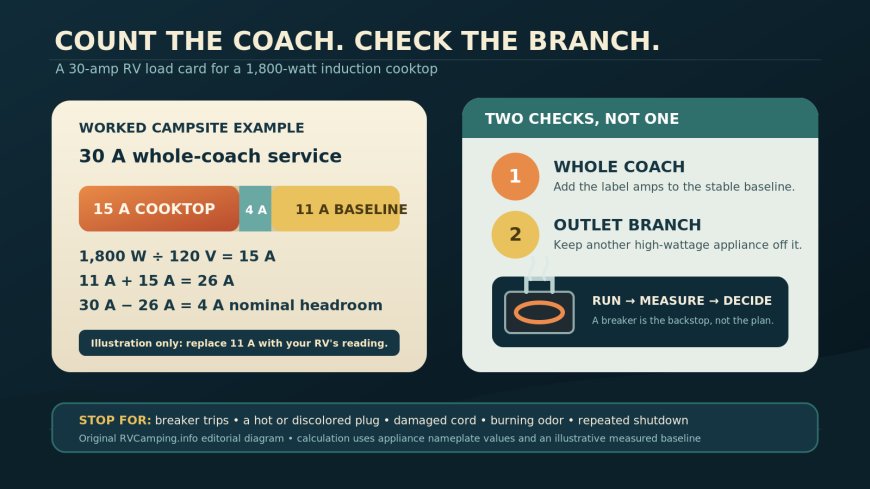
That first calculation is useful, but it is not the verdict. The outlet serving the cooker has its own branch-circuit limit, and a whole-coach current reading cannot prove that branch has room. The decision takes two checks: can the coach carry the combined load, and can that outlet circuit carry the cooktop without another high-wattage appliance sharing it?
Start with the labels, not a generic appliance chart
Winnebago's 2026 towable manual describes a 110-125-volt, 30-amp supply and warns owners not to exceed the circuit rating. It also notes that the 120-volt system may be feeding the refrigerator, air conditioner, microwave, water heater, converter and plug-in appliances at the same time.[1]
The exact lineup changes by RV and by switch position. A refrigerator or water heater that can use propane may be drawing AC in one setup and not another. A converter may pull more while charging a depleted battery. This is why a canned chart of "typical amps" is a poor substitute for the labels and displays in the actual rig.
For a worked example, the Hamilton Beach 34104 induction cooker is labeled 1,800 watts at 120 volts.[2] The planning conversion is:
1,800 watts ÷ 120 volts = 15 amps
The nameplate value is the right number for a pre-cooking budget. A lower heat setting may reduce average demand, but dinner should not depend on assuming that a cycling appliance will stay below its maximum.
The 11-amp campsite example
Suppose the RV's installed current display settles at 11 amps after the air conditioner starts, with the refrigerator and converter in the modes you intend to keep. This is an illustrative reading, not a value to borrow for another RV.
Add the cooktop's label-equivalent draw:
11-amp observed baseline + 15-amp cooktop = 26 amps
That leaves 4 amps below a 30-amp service rating. The arithmetic says the combination fits on paper. It does not give much room for another load to start or for the baseline to change. Winnebago tells owners to shed other demand when needed while the air conditioner runs, rather than risk an overload and a tripped main breaker.[1]
A sensible dinner plan would switch off one discretionary AC load before the cooktop goes to full power. The microwave, electric water-heating element and second countertop appliance are obvious items to inspect, but the correct choice comes from the controls and manuals in that RV. Do not turn off equipment whose operation you do not understand merely to make the arithmetic work.
The outlet gets a separate vote
Hamilton Beach says this cooktop must not share its circuit with a second appliance that draws substantial power.[2] That warning concerns the outlet branch, not the 30-amp service total.
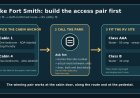
Two galley receptacles can look separate while sharing one breaker. Open the RV's breaker directory and identify the breaker for the intended outlet. Then test which receptacles lose power when that breaker is switched off, following the RV manual. If the directory is unclear, mislabeled or inaccessible, stop and have a qualified RV technician or electrician identify the circuit. This is not a reason to remove a panel.
A GFCI does not add load capacity. Winnebago's manual says the GFI protects against certain leakage and ground-fault hazards but does not protect against electrical circuit overloads.[1] A reset button beside the counter therefore does not answer whether a cooker and a second appliance can share the branch.
The cooktop manual adds two practical boundaries. Model 34104 is for household use, and its English instructions say not to use it outdoors. It also calls for flat-bottomed induction-ready cookware 4 to 10 inches in diameter.[2] For this model, cooking under the awning or on a picnic table would contradict the manual even if the electrical numbers looked comfortable.
Use a run-measure-decide sequence
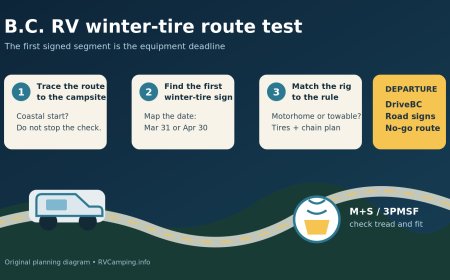
Before making a high-power electric meal in a 30-amp RV:
- Read the RV service label, the breaker directory and the cooker's nameplate.
- Identify every outlet that shares the cooktop's branch. Keep another high-wattage appliance off that branch.
- Put the refrigerator, water heater and other dual-fuel equipment in the modes you intend to use during dinner.
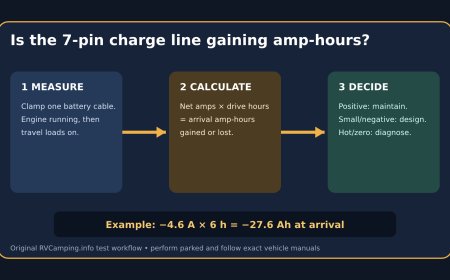
- Start and stabilize any load that must remain on, especially the air conditioner. Read total current only from installed equipment designed to show it; do not improvise a live-panel measurement.
- Convert cooktop watts to amps with
watts ÷ volts, then add the result to the observed baseline. - If the sum crowds the service rating, shut off a discretionary AC load before cooking. If the outlet branch cannot support the cooktop by itself, use another cooking method.
- After switching the cooker on, watch the current display and the connection. A tripped breaker, hot or discolored plug, damaged cord, persistent low-voltage indication, burning odor or repeated shutdown ends the experiment. Do not solve repeated trips with a larger breaker.
This workflow deliberately separates planning from live operation. The 15-amp calculation is a conservative label-based estimate. Actual draw can vary with line voltage and control cycling, and compressor starting behavior does not appear in a steady baseline. The display is there to catch what the paper estimate missed.
Write one line on the meal plan
For the worked example, the useful note is short:
Cooktop 15 A + observed 11 A = 26 A; keep other galley heat off; recheck after A/C starts.
Change every number and appliance state for the actual RV. If there is no reliable current display, use the labels and take the cautious route: run one large electric cooking load at a time. A breaker is the backstop, not the meal planner.
Source credit: RVCamping.info reviewed the Winnebago and Hamilton Beach primary manuals retrieved on 2026-10-27. The amperage conversion, 11-amp campsite example and run-measure-decide worksheet are original editorial calculations and synthesis.
Sources
- Winnebago Towables Owner's Manual, Model Year 2026 — 30-amp supply, coach loads, air-conditioner load management and GFI boundary; retrieved October 27, 2026.
- Hamilton Beach Induction Cooktop 34104 Use and Care Guide — 1,800-watt nameplate, same-circuit warning, location and cookware limits; retrieved October 27, 2026.
What's Your Reaction?