






The second-night dinner test: reheating leftovers safely in an RV
A practical RV leftovers check for cooling, cold storage, thermometer use, 165°F reheating, boiling gravy and firm discard boundaries.

The second-night dinner test: reheating leftovers safely in an RV
By Romana | September 24, 2026 | Cooking
Quick answer: Keep leftovers only when you know they were cooled on time and stayed at 40°F or colder. Reheat the portion you will eat to 165°F, using a food thermometer in the coldest part. Liquid foods need another visible checkpoint: sauces, soups, and gravies must reach a rolling boil. If the clock, refrigerator temperature, or contamination history is uncertain, discard the food rather than trying to make it safe with extra heat.[1][2][3]

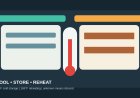
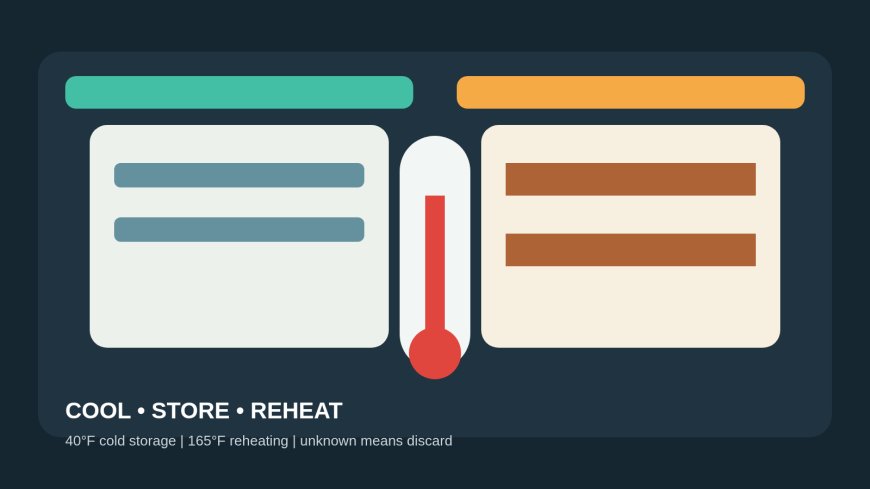
Cooling, storage, and reheating are separate checkpoints. Original illustration by RVCamping.info.
Reheating starts with yesterday's record
The burner is the last checkpoint, not the first. Before a container leaves the RV refrigerator, ask when the food was put away, how cold the refrigerator stayed, and whether raw juices or dirty utensils could have reached it. A pan can reach 165°F and still be a poor bet if it spent an unknown afternoon on the picnic table.
Use a simple three-part gate:
- Known clock: Perishable food went into refrigeration within two hours. The limit was one hour if it was exposed to air above 90°F.[1][2]
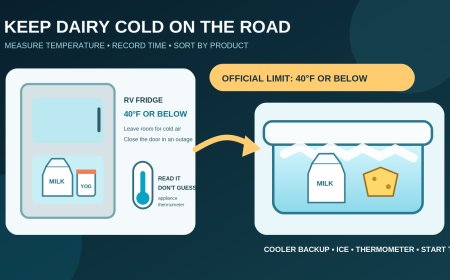
- Known cold: The appliance or food cooler held 40°F or below. A cold control dial, a bag of melting ice, and a cool-feeling container are not measurements.[2][3]
- Known handling: The food was protected from raw meat drips, used serving utensils, cooler water, and unwashed hands.
If one answer is no or unknown, stop. Heating is not a way to reconstruct a missing storage history.
Cool the meal you actually intend to save
Set aside shallow containers before serving. That small move matters in an RV because a deep casserole dish or stockpot may fit through the refrigerator door yet cool poorly and warm the food around it. USDA advises dividing large amounts among shallow containers and refrigerating promptly; FDA likewise recommends shallow portions for faster cooling.[1][2]
Small portions can move from the hot meal straight to refrigeration.[1] You do not need to leave them on the counter until they feel cool. Leave room around the containers instead of stacking them warm, and make sure the refrigerator continues to read 40°F or below.[2][3]
For a pot of chili, gravy, stew, or rice, make several meal-size portions. Wide containers expose more food to the cold surface and make tomorrow's serving easier. If the refrigerator has no open shelf, use an ice-water bath around closed or protected containers to pull down heat, then move them into verified cold storage. Do not let the cooling project run past the original one-hour or two-hour limit.[1]
A cooler can substitute for an RV refrigerator only while it maintains 40°F or below. Put sealed containers above meltwater and keep the lid shut. If the temperature cannot be verified, plan a no-leftovers meal instead.
Label for the next meal, not for archaeology
Write the food name and cooking date on each lid. USDA says refrigerated leftovers can be kept three to four days, and FoodSafety.gov lists the same window for cooked meat or poultry.[1][3] Freeze a portion earlier if it will not be used in time.
The calendar limit assumes the food had a safe start and stayed cold. It does not grant four days to a container that sat out too long before refrigeration. It also does not restart when food moves from the RV refrigerator to a cooler.
Use an appliance thermometer where you can read it without unloading the whole shelf. Check it after adding warm containers and again later. A small refrigerator can lose ground when the door is opened repeatedly, the shelf is packed solid, or power changes during travel. If the temperature history becomes uncertain, make a discard decision while the facts are still fresh.
Build a reheating station in a tiny galley
Take out one eating portion. Keep the rest cold. Reheating the entire batch creates more handling and another cooling job for food that may not be eaten.
Set up the food thermometer before turning on the burner. A clean spoon, lid, trivet, and serving plate should already be within reach; an RV counter gets unsafe quickly when the hot pan has nowhere to land. Keep the thermometer probe away from the sink and raw-food area.
Match the method to the food:
| Food | RV-friendly move | Where to check |
|---|---|---|
| Dense casserole or pasta | Cover, use moderate heat, and turn or stir portions | Center and any thick pockets |
| Meat with sides | Separate thick pieces if needed so everything heats evenly | Thickest piece plus the coolest side |
| Rice, beans, or chopped leftovers | Break up clumps and stir from the bottom | Several places after stirring |
| Soup, sauce, or gravy | Stir to prevent scorching and bring the whole portion to a rolling boil | Confirm the boil throughout; check dense solids too |
| Microwave portion | Cover with a vent, rotate, stir, and allow brief standing time | Multiple spots, especially the center |
USDA sets 165°F for reheated leftovers and calls for checking with a food thermometer.[1] FDA also lists 165°F for leftovers and casseroles.[2] Steam on the lid, a bubbling edge, or a hot plate does not establish the temperature at the center.
Insert the probe into the area most likely to stay cold. On a mixed dish, that may mean checking a thick piece of meat and the middle of the starch separately. Clean the probe before and after use. If one spot is below 165°F, continue heating, stir or rearrange, and check again.
Give gravy and sauce their own rule
Sauces and gravies heat unevenly on a small propane burner. The bottom can scorch while the top stays lukewarm, especially in a narrow pan. Stir across the bottom and into the corners, use a lid when it is safe for the recipe, and keep handles out of the aisle.
USDA and FDA say sauces, soups, and gravies should be brought to a boil during reheating; USDA specifies a rolling boil.[1][2] This does not replace the earlier storage gate. Boiling a gravy with an unknown picnic-table history is still a discard problem.
Do not pour fresh gravy into a questionable leftover dish to warm it, and do not use an old serving spoon that has been sitting on the table. Reheat a known-safe portion with clean equipment, then serve it promptly.
The microwave needs a cold-spot check
An RV microwave can be useful, but wattage, battery or generator load, container shape, and a missing turntable all affect heating. Cover the food with a vent so steam can circulate. Pause to stir and rotate the dish. Let it stand briefly, then measure several locations. USDA warns that microwave reheating can leave cold spots and advises covering, rotating, and checking in multiple places.[1]
Do not trust a preset "reheat" button as a safety measurement. The machine tracks time and power, not the coldest bite in the container.
Keep, eat, or throw it away
A useful discard list is blunt:
- The food exceeded two hours without cold or hot control, or one hour when exposed above 90°F.[1][2]
- Nobody knows when it left the table or entered the refrigerator.
- The RV refrigerator or cooler was not verified at 40°F or below.[2][3]
- Raw meat liquid, cooler meltwater, dirty utensils, or other contamination reached the food.
- The container is beyond the three-to-four-day refrigerated window.[1][3]
- The food cannot be heated evenly to 165°F with the available equipment.[1][2]
- The sauce, soup, or gravy cannot be brought to a proper boil.[1][2]
Do not taste uncertain food to decide. Smell can reveal spoilage, but a normal smell does not prove a safe clock or temperature history.
If reheated food will not be eaten at once, keep it at 140°F or hotter and verify the temperature.[1] In a cramped campsite kitchen, the easier plan is usually to reheat a smaller portion and finish it.
A card for the refrigerator door
Write this on painter's tape before the first meal:
- Cooked: date and time
- Refrigerated by: time
- Fridge or cooler: actual temperature
- Use or freeze by: date
- Reheat: 165°F in the coldest spot
- Sauce, soup, gravy: rolling boil
- Unknown history: discard
The card does not make food safe. It keeps the facts available when the next meal is being assembled in a small kitchen with poor light and limited counter space.
Evidence note: USDA FSIS, FDA, and FoodSafety.gov provide the temperatures, time limits, cooling methods, storage window, and reheating instructions. The three-part gate, galley setup, method table, and refrigerator-door card are original RVCamping.info planning tools.
Sources
- Leftovers and Food Safety | USDA FSIS — Consumer guidance for prompt cooling, shallow containers, refrigerator storage, 165°F reheating, microwave handling, hot holding, and rolling-boil guidance.
- Safe Food Handling | FDA — FDA consumer guidance for the two-hour/one-hour rule, 40°F refrigeration, shallow containers, 165°F leftovers, and boiling sauces, soups, and gravy.
- Cold Food Storage Chart | FoodSafety.gov — Federal chart for refrigerator and freezer storage limits, including cooked leftovers.
What's Your Reaction?