













National park timed entry for RV trips: a 2026 booking plan
Plan an RV national park visit around 2026 timed-entry, road-reservation, parking and shuttle rules with a practical booking workflow.

National park timed entry for RV trips: a 2026 booking plan
By Romana | September 14, 2026
An RV campsite booking does not automatically settle park access. In 2026, Rocky Mountain National Park requires timed entry during set hours, while Acadia requires a separate reservation for one summit road.[2][3] Glacier and Yosemite do not require vehicle reservations in 2026.[4][5] Those differences can turn a tidy itinerary into a missed entry window unless you plan the vehicle, the destination and the clock together.
Originating source credit: This guide was prompted by the National Park Service's February 18, 2026 announcement on summer access at Arches, Glacier, Rocky Mountain and Yosemite national parks.[1] RVCamping.info built the RV-specific workflow below from current park pages rather than treating that announcement as a trip plan.
The short answer
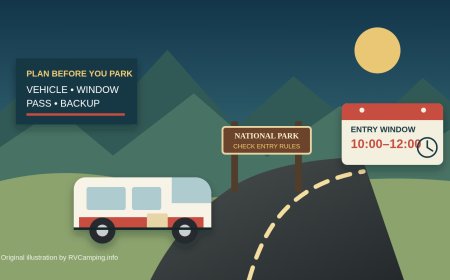
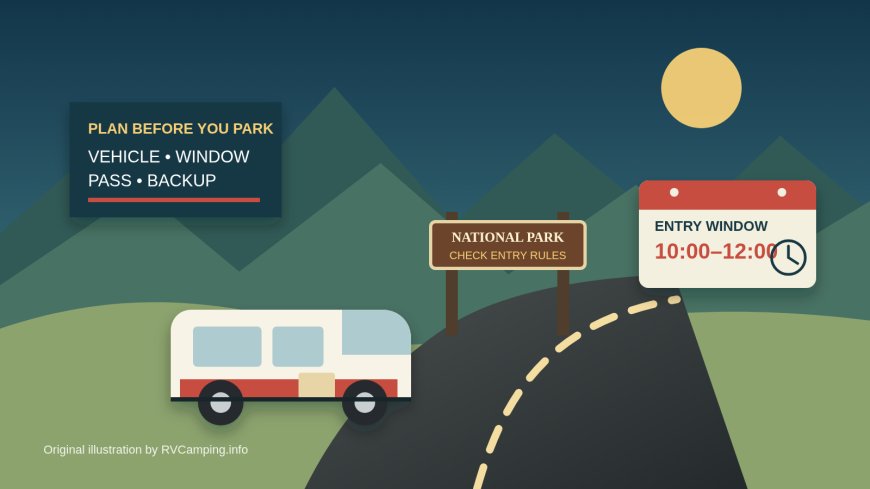
Before paying for an RV site near a busy national park, make one access sheet for every park day. Record the exact destination, the vehicle you will drive, its total length, the park's local time zone, the booking release time, the entry window and any separate entrance pass. Then book the item with the least flexibility first.
That last item may be a timed entry permit. It may also be the only campground that fits your rig, a legal parking plan for a motorhome, or a shuttle ticket that replaces a long stay in time-limited parking. The label "vehicle reservation" is too broad to make the decision for you.
Start with the vehicle that will reach the attraction
Write down the actual vehicle for each day, not just the RV on your campsite confirmation.
- A travel trailer may stay at camp while the tow vehicle enters the park.
- A motorhome with a towed car may use the smaller car for a restricted road, provided the car and any rack meet the posted limit.
- A motorhome without a second vehicle needs a different plan if the destination prohibits RVs. That could mean a park-approved shuttle, a taxi, a bicycle route that suits the rider, or choosing another destination.
Acadia makes this distinction expensive to overlook. Its 2026 reservation applies only to Cadillac Summit Road, but recreational vehicles and trailers are prohibited there. Any vehicle over 21 feet, including a bike rack or hitch attachment, can be denied even with a valid reservation.[3] A reservation for the wrong vehicle is not access.
Measure the travel configuration before booking. Save four numbers: motorhome or tow-vehicle length, trailer length, combined length, and the added length of racks or hitch cargo. The park page may use any one of them.
Build a one-line dependency map for each park day
Use one row per planned outing:
| Date | Destination | Vehicle | Access item | Release moment | Entry rule | Backup |
|---|---|---|---|---|---|---|
| Sept. 28 | RMNP, Bear Lake Road | towed car | Timed Entry + Bear Lake Road | already released; watch prior-night inventory | enter reserved two-hour window | visit outside corridor after its controlled hours |
| Oct. 3 | Acadia, Cadillac Summit | tow vehicle under 21 feet | daytime vehicle reservation | 10 a.m. ET, 90 days or two days ahead | enter within 30 minutes; no re-entry | another Acadia area with no vehicle reservation |
The sample rows show the method, not live availability. Check Recreation.gov before treating a slot as open.
Add the campground confirmation as its own column if a park says it changes the entry requirement. Do not infer an exemption from the word "camping." A campground booking, an entrance pass, a road reservation and a shuttle ticket are different products unless the park explicitly says otherwise.
Put every release time on one clock
Booking errors often begin with a correct time in the wrong zone. Convert the official release time to the time zone where you will be when sales open. Put both versions in the calendar reminder.
For Rocky Mountain, the 2026 monthly inventory opened at 8 a.m. MDT on a published schedule. At 7 p.m. MDT each evening, Recreation.gov adds permits for the following day.[2] For Acadia, 30 percent of sunrise and daytime reservations open 90 days ahead, while the remaining 70 percent open at 10 a.m. ET two days ahead.[3]
Prepare before the release minute:
- Create and test the Recreation.gov account.
- Save the exact park product page, not a general search result.
- Decide which vehicle and entry time you can actually use.
- Put the preferred slot and one acceptable alternative in writing.
- Sign in early, but refresh the official listing at the stated release time.
This does not guarantee a reservation. It does remove the preventable scramble over passwords, time zones and which permit name covers which road.
Book in dependency order, not driving order
A practical order is:
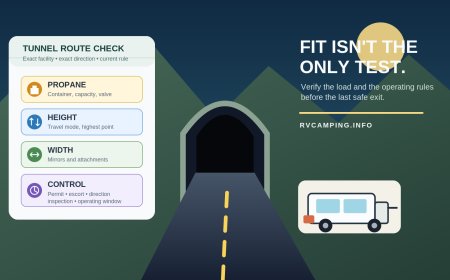
- Prove that the rig can reach and fit the campsite. Check road, bridge, tunnel and campsite limits.
- Identify the scarce park-access item. Include road permits and shuttle seats, not only whole-park entry.
- Compare cancellation terms. If the campsite opens months before timed entry, decide how much cancellation risk you will accept.
- Reserve the hard constraint when its window opens. Avoid stacking nonrefundable purchases around an access slot you do not have.
- Fill in flexible days. Keep at least one outing that does not depend on a scarce reservation.
For a one-base, three-day stay, do not assign every attraction to a fixed day before you know the release rules. Mark one day "permit-dependent," one "weather-dependent" and one "no timed entry needed." That gives you room to swap days without moving the RV.
What the 2026 park rules actually look like
Rocky Mountain: two permits, two controlled periods
Rocky Mountain National Park has two products in 2026. The standard Timed Entry reservation excludes Bear Lake Road and is required from 9 a.m. to 2 p.m. from May 22 through October 12. Timed Entry + Bear Lake Road covers that corridor and the rest of the park; it is required for the corridor from 5 a.m. to 6 p.m. from May 22 through October 18. Both use a reserved two-hour entry window.[2]
The extra reservation inventory released at 7 p.m. MDT the prior evening is a real backup, but it is not a sound foundation for a nonrefundable RV itinerary. The park says these permits can sell quickly and that timed entry is available only through Recreation.gov, not at an entrance station or visitor center.[2]
An entrance pass is still separate, and the timed-entry processing fee is $2.[2] Put both documents in the offline trip packet.
Acadia: a narrow road reservation with a hard RV limit
Acadia's Cadillac Summit Road reservation is required from May 20 through October 25, 2026. It costs $6 and is sold online in advance; the park does not sell it on arrival. Sunrise reservations allow a 90-minute entry window, while daytime reservations allow 30 minutes. The reservation does not permit re-entry.[3]
The rule covers one road, not the rest of Acadia. That narrower scope makes a strong backup easy to design: spend the day elsewhere in the park if a Cadillac slot does not fit. But RV travelers must solve the vehicle problem before buying. RVs, trailers and vehicles over 21 feet are prohibited on the summit road.[3]
Acadia also tells visitors to print or save the QR confirmation because connectivity is unreliable.[3] Do that before leaving the campground Wi-Fi, not at the check station.
Glacier: no vehicle reservation, but access still has a clock
Glacier required no vehicle reservation anywhere in the park in 2026. During the July 1 through September 7 pilot period, however, private vehicles at Logan Pass were limited to three hours, enforced around the clock. Longer visits depended on a ticketed shuttle rather than a vehicle reservation.[4]
The shuttle had its own release pattern: some tickets opened 60 days ahead at 8 a.m. MDT, and the remainder opened at 7 p.m. MDT for the next day. Tickets were not sold inside the park.[4] This is the useful planning lesson for future seasons: a page that says "no vehicle reservations" may still contain timed parking, shuttle inventory or temporary diversions.
Yosemite and Arches: no 2026 vehicle reservation does not mean guaranteed parking
Yosemite ended its timed vehicle reservation system for 2026 after reviewing 2025 traffic and parking. The park said it would instead use real-time traffic monitoring, active parking management and more staff at congested locations.[5] The national NPS announcement also said Arches would not use timed entry in 2026 and warned that parks may use short-term traffic controls when roads or parking reach capacity.[1]
For an RV itinerary, treat those parks as "no advance vehicle reservation required," not "arrive whenever you want." Choose an early arrival target, identify an overflow or alternate-day plan, and check current conditions before moving a large rig into a queue.
Make an offline gate packet
Cell service is a weak link, and two parks explicitly direct visitors to save their confirmations.[2][3] Put these items in one offline folder and print a paper copy when practical:
- timed-entry, road or shuttle confirmation with QR code;
- campground confirmation;
- entrance pass or purchase record;
- photo ID matching the reservation account when required;
- screenshot of the current vehicle-length rule;
- a simple map to the correct entrance and check station;
- the no-reservation backup day.
Name files with the date first, such as 2026-10-03-acadia-cadillac-daytime.pdf. A screenshot buried under two weeks of fuel receipts is not much of a backup.
Recheck at three points
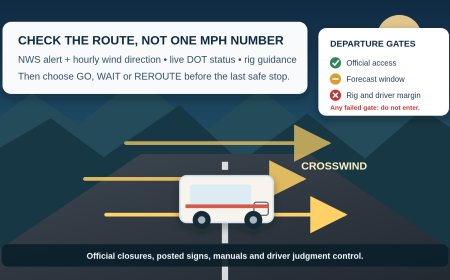
Park access plans can change between campsite booking and arrival. Use three checks:
- Before paying: verify the official park page, release calendar, vehicle restriction and cancellation terms.
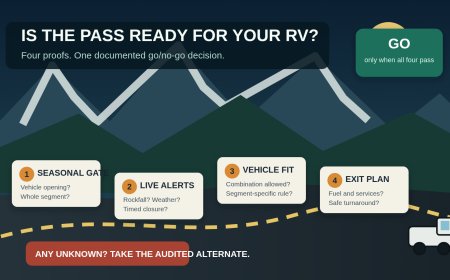
- Seven days before arrival: check alerts, road status, construction, wildfire or weather impacts, and the exact entrance you intend to use.
- The evening before: check current conditions, confirm local time, download documents, and look for any prior-night inventory that fits without breaking the rest of the trip.
Do not reuse a 2026 chart for 2027. Glacier, Yosemite and Arches are especially clear examples of why last year's reservation habit can be wrong this year.[1][4][5]
A five-minute final audit
Before pulling out of the campground, answer each question with a document or official page:
- Which vehicle is entering, and does its full travel length comply?
- Is the booking for the whole park, one corridor, one road, parking or a shuttle?
- Does the reservation supplement an entrance pass?
- What is the earliest and latest valid gate time in the park's local zone?
- Does the booking allow re-entry?
- Is the confirmation stored offline?
- What will you do if parking fills, traffic is diverted or weather closes the route?
If one answer is blank, the itinerary is not ready yet. Fixing it at the campsite is far easier than turning an RV around at a crowded entrance.
Sources
- National Park Service expands access for summer 2026 while maintaining safety at high-visitation parks — originating NPS announcement, February 18, 2026; retrieved September 14, 2026.
- Rocky Mountain National Park: Timed Entry Permit System (2026) — detailed 2026 products, dates, fees and release schedule; retrieved September 14, 2026.
- Acadia National Park: Cadillac Summit Road Vehicle Reservations (2026) — booking windows, road restrictions and confirmation instructions; retrieved September 14, 2026.
- Glacier National Park: Visiting Logan Pass in 2026 — 2026 vehicle, parking and shuttle rules; retrieved September 14, 2026.
- Yosemite National Park will not require vehicle reservations in 2026 — official February 18, 2026 news release; retrieved September 14, 2026.
What's Your Reaction?