



















Your RV fits the campsite. Is the combination legal in the next state?
A three-state worksheet for checking RV overall length, towed-unit count, route access, and driver-license scope before crossing Oregon, California, or Nevada.

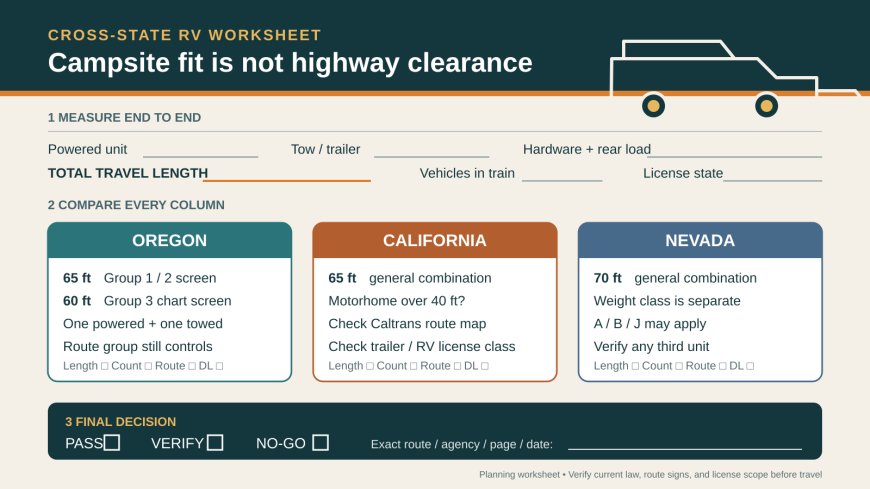
Your RV fits the campsite. Is the combination legal in the next state?
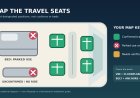
A campsite's 65-foot pad does not answer a 65-foot highway question. The campground may measure the parked RV only, while a state measures the motorhome, tow bar, car, bike rack, and anything else attached behind it. A pickup and fifth-wheel can create the same mismatch: the site listing might use trailer length, but the road rule applies to the full combination.
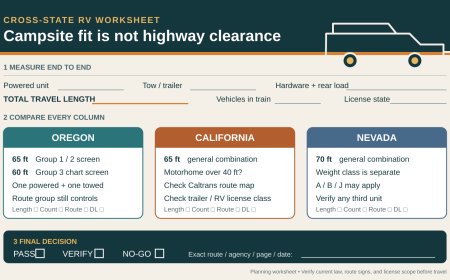
Oregon, California, and Nevada make a useful border-trip test. The headline limits look close: 65 feet in Oregon and California, 70 feet in Nevada. The details are not close enough to treat them as one rule. Oregon's 65-foot RV allowance depends on the highway group. California sends motorhomes longer than 40 feet to a designated-route map. Nevada's 70-foot ceiling does not waive its driver-license weight thresholds.[2][7][12]
This worksheet is a planning aid, not legal advice. Statutes, posted signs, permit terms, local restrictions, and temporary orders control. Check the exact route and confirm an unusual combination with the relevant DMV, DOT, or enforcement agency before departure.

Build one travel measurement, not three brochure numbers
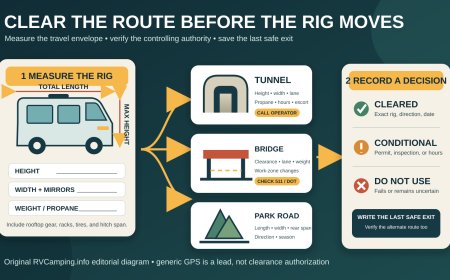
Measure the rig in road configuration from its foremost point to its rearmost attachment. Do not stop at the factory length of the motorhome or trailer. Include the tow bar or dolly, the towed car, rear cargo, spare tires, and a bike rack if it remains mounted while moving. Record both actual loaded weights from a scale and the ratings on the certification labels; licensing rules can turn on GVWR or GCWR rather than today's scale reading.
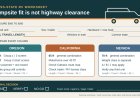
Fill these lines before comparing states:
- Powered vehicle or motorhome length: _____ ft _____ in
- Trailer or towed vehicle length: _____ ft _____ in
- Coupler, tow bar, dolly, and rear attachment allowance: _____ ft _____ in
- Measured overall travel length: _____ ft _____ in
- Number of vehicles in the train, including the powered vehicle: _____
- Tow vehicle GVWR: _____ lb
- Towed unit GVWR: _____ lb
- Manufacturer GCWR, if stated: _____ lb
- Actual loaded combination weight: _____ lb
- Driver's license state, class, endorsements, and restrictions: _____
Use the measured overall length for the first screen. Then check vehicle count, route access, licensing, registration, braking, hitch, lighting, and insurance separately. Passing one row never clears the others.
The three-state worksheet
| Check | Oregon | California | Nevada |
|---|---|---|---|
| General RV combination screen | Up to 65 ft only on Group 1 or Group 2 highways; Group 3 chart limit for a passenger vehicle plus RV is 60 ft, and shorter posted limits can apply.[2][3] | General combination ceiling is 65 ft, including attachments, subject to statutory exceptions that ordinary RV travelers should not assume apply.[7] | General combination ceiling is 70 ft, including attachments, unless a statutory exception or permit applies.[12] |
| Single RV or motorhome | RV may be up to 45 ft under the statutory exemption.[2] | A housecar may reach 45 ft, but a unit over 40 ft is restricted to approved routes and qualifying access roads.[10] | Do not infer a universal motorhome length from the 40-ft motortruck rule. Confirm the vehicle classification and route with Nevada authorities.[12] |
| How many units? | ORS 818.110 generally prohibits a highway combination with more than two vehicles; check the statutory exceptions rather than assuming they cover recreational travel.[16] | The restriction applies to passenger vehicles and other motor vehicles whose unladen weight is below 4,000 lb: they may tow only one vehicle. A dolly carrying that vehicle does not count as a separate towed unit for this rule.[8] | The 70-ft statute is a length rule, not a blanket approval for every three-unit setup. Record every unit and ask Nevada DMV or Highway Patrol to confirm the exact configuration before towing a second trailer.[12][14] |
| Resident-license screen | ORS 807.030 gives a Class C holder authority to operate vehicles that do not require a commercial license. Whether a heavy or unusual RV combination stays within that boundary depends on the vehicle's legal classification, not its nickname; confirm it with Oregon DMV.[4] | California residents need noncommercial Class A for a trailer coach over 10,000 lb GVWR or a fifth-wheel over 15,000 lb GVWR. A fifth-wheel over 10,000 but under 15,000 lb can fit Class C only with the recreational trailer endorsement. A housecar over 40 through 45 ft calls for noncommercial Class B.[9] | Nevada calls for noncommercial Class A when GCWR reaches 26,001 lb and the towed unit exceeds 10,000 lb GVWR. Class B covers a single vehicle at 26,001 lb or more and may include a towed unit at 10,000 lb or less. A J endorsement is the Nevada path for certain Class C towing over 10,000 lb when the combination stays within the Class A threshold.[13][14] |
| Route check | Look up the highway segment on ODOT Group Map 1, revised April 2026, and obey any shorter posted limit.[3] | If the motorhome itself exceeds 40 ft, use Caltrans' current 45-foot motorhome map. A motorhome at 40 ft or less does not trigger that specific route map merely because it tows, but the 65-ft combination limit still applies.[10] | Check Nevada 511, NDOT restrictions, and posted limits. A legal statewide length is not proof that a narrow park, county, or local road accepts the rig. |
| Your result | Length: ___ / unit count: ___ / route: ___ / license: ___ | Length: ___ / unit count: ___ / route: ___ / license: ___ | Length: ___ / unit count: ___ / route: ___ / license: ___ |
Mark a state PASS only when every applicable row passes. Use VERIFY when an agency must classify the vehicle, confirm a route, or interpret an out-of-state license. Mark NO-GO when a measured value or vehicle count exceeds the rule and no applicable permit or exception has been confirmed.
Oregon: 65 feet is a route-dependent allowance
ODOT's older towing booklet is still useful for the practical warning: an RV combination can be no longer than 65 feet, some roads are shorter, and an ordinary tow setup is limited to a single unit behind the powered vehicle. The PDF itself is dated June 2012, so it should not be the final legal check.[1] Current ORS 818.110 supplies the two-vehicle rule, with exceptions listed separately in ORS 818.120.[16]
The current statutory basis is ORS 818.100. It allows an RV up to 45 feet and allows a combination containing an RV to reach 65 feet while operating on highways ODOT designates Group 1 or Group 2.[2] ODOT's current route-map page identifies Group Map 1 as the no-permit chart for legal-size vehicles. The April 2026 legend shows 65 feet for the passenger-vehicle-and-RV combination on Groups 1 and 2, but 60 feet on Group 3. Portions can be posted for less.[3]
That changes the worksheet question. Do not write "Oregon: 65." Write the route number, milepoints if a designation changes mid-route, highway group, chart row, overall measurement, and retrieval date. A 63-foot motorhome-and-car combination may pass on one Oregon highway and fail on another without changing equipment.
For an Oregon resident, ORS 807.030 says a Class C license covers vehicles that do not require a commercial license.[4] That broad line is not a substitute for classifying a particular rig. If the combination is heavy, carries something other than a recreational unit, or is used for business, give DMV the exact GVWR and GCWR figures instead of asking whether a "big RV" is covered.
California: separate the 65-foot total from the 40-foot route trigger
California Vehicle Code section 35401 sets the ordinary combined-length ceiling at 65 feet and counts attachments.[7] A 42-foot motorhome plus a 20-foot car is not a 62-foot combination once the tow bar and rear carrier add four more feet. It is 66 feet and fails the first screen.
Motorhome route access is a second test. Caltrans defines the controlled class as a motorhome over 40 feet and no longer than 45 feet. Those motorhomes may use interstates and approved routes shown by Caltrans, with limited access off route under the conditions on the agency page. Caltrans also makes an important distinction: a motorhome at 40 feet or less does not become a "45-foot motorhome" for route-map purposes merely because it tows a car. The full train still must remain within 65 feet.[10]
California's RV handbook remains online, but it is revision 11/2011. Use it to understand terminology and maneuvering, not as proof that a rule remained unchanged.[6] Current DMV licensing pages still list the important resident thresholds: noncommercial Class A for a trailer coach over 10,000 lb GVWR or fifth-wheel over 15,000 lb GVWR; an endorsement for a fifth-wheel above 10,000 and below 15,000 lb under Class C; and noncommercial Class B for a housecar over 40 through 45 feet.[9]
Vehicle count needs its own line. CVC 21715 bars passenger vehicles, along with other motor vehicles weighing less than 4,000 pounds unladen, from pulling more than one vehicle. The statute treats a tow dolly carrying the one towed vehicle as part of that tow rather than a second vehicle.[8] Do not extend that narrow dolly language into permission for a boat behind a fifth-wheel.
Nevada: the extra five feet does not settle the license question
Nevada Revised Statutes section 484D.615 generally caps a coupled combination, attachments included, at 70 feet.[12] That makes Nevada look easy after two 65-foot states. It is only the length column.
Nevada DMV's current licensing page says RV, boat, and trailer owners need the appropriate noncommercial class when their vehicles cross the weight lines. It identifies noncommercial Class A for a 26,001-pound-or-more combination when the towed unit exceeds 10,000 lb GVWR, Class B for a 26,001-pound-or-more single vehicle, and a J endorsement for towing over 10,000 lb in the applicable lower-weight combination.[13] The agency's noncommercial study guide adds the same 70-foot ceiling to its class descriptions.[14]
A Nevada-issued Class C license therefore cannot be evaluated from actual campground weight or the trailer's empty sticker alone. Copy the tow vehicle GVWR, towed-unit GVWR, GCWR, and loaded weights. Ask DMV which figure controls if the manufacturer's labels or the combination's configuration leave doubt.
Do the same with a three-unit train. Nevada's length statute speaks broadly about combinations, while DMV materials mention multiple trailers, but those facts do not confirm that every motorhome-car-boat or pickup-fifth-wheel-boat arrangement is lawful. Get a written or citable answer for the exact hitch sequence, weights, brakes, endorsements, and route.
Your home-state license still sets the ceiling
Crossing a border does not normally require a tourist to obtain a new resident license. It also does not turn a basic license into a higher class.
Oregon allows a nonresident with a current out-of-state license to drive only within the privileges that license grants.[5] Nevada similarly lets a nonresident drive the type or class authorized by the home license.[15] California also has a statutory exemption for qualifying nonresidents who carry a valid license from their jurisdiction.[11] Because state class names and RV endorsements do not line up neatly, do not treat any of these exemptions as an automatic upgrade.
Put the issuing state on the worksheet and get that agency's answer first. Then ask the destination state whether it recognizes that class for the proposed RV combination. Keep the response, staff name or case number, date, and the page or statute used. This is especially important when the destination state has a named noncommercial Class A, Class B, or trailer endorsement that the home state does not issue under the same label.
Run the worked example before reserving the next stop
Assume a 42-foot motorhome, 20-foot car, 3-foot tow assembly, and 1-foot rear bike-rack extension. Measured end to end, the train is 66 feet. It has two vehicles.
- Oregon: NO-GO on length. It exceeds the 65-foot Group 1/2 allowance, so changing from a Group 3 road cannot cure it.[2][3]
- California: NO-GO on length. The motorhome also triggers the over-40-foot Caltrans route check, but passing that route check would not cure the 66-foot total.[7][10]
- Nevada: Length screen PASS at 66 feet, subject to the exact route and attachments. Licensing remains VERIFY until the driver's home class and all weight ratings are checked.[12][13]
The practical fix is not to round down. Remove the rear carrier, choose a shorter towed vehicle, or travel without the car. Re-measure after the change. If the revised total is 65 feet, Oregon still needs a Group 1 or 2 route for the 65-foot allowance, California still needs the over-40-foot motorhome route check, and Nevada still needs the correct license for the weight class.
Keep the finished sheet in the cab
Record the source date beside each decision. Save the route map and the page that describes the applicable license class. Recheck before departure and after any equipment change. A new tow bar, cargo tray, or replacement car can change total length even though the campsite reservation stays the same.
The campsite-fit number belongs in the reservation folder. The legal-travel number belongs on a state-by-state worksheet.
Sources
- ODOT, Towing a Trailer in Oregon — Form 737-3503, dated June 2012; retained as practical agency guidance and checked against current law.
- Oregon Revised Statutes, Chapter 818 — Current ORS 818.100 RV length and highway-group basis, accessed October 17, 2026.
- ODOT Oregon Route Maps and Group Map 1 — Page identifies the April 2026 Group Map 1; accompanying Form 8100 supplies group-specific legal lengths.
- Oregon Revised Statutes section 807.030 — Current Class C privilege boundary, accessed October 17, 2026.
- Oregon Revised Statutes, Chapter 807 — ORS 807.020 nonresident driving privilege, accessed October 17, 2026.
- California DMV Recreational Vehicles and Trailers Handbook — DL 648, revision 11/2011; treated as an old summary and corroborated with current sources.
- California Vehicle Code section 35401 — Current general combination-length statute, accessed October 17, 2026.
- California Vehicle Code section 21715 — Current towing-unit restriction and tow-dolly language, accessed October 17, 2026.
- California DMV driver's license classes — Current noncommercial RV and trailer class thresholds, accessed October 17, 2026.
- Caltrans 45-foot motorhome routes — Current route rules and motorhome-plus-tow explanation, accessed October 17, 2026.
- California Vehicle Code section 12502 — Current nonresident license exemption, accessed October 17, 2026.
- Nevada Revised Statutes, Chapter 484D — Current NRS 484D.615 combination-length statute, accessed October 17, 2026.
- Nevada DMV driver license classes — Current noncommercial Class A, Class B, and J endorsement summary, accessed October 17, 2026.
- Nevada DMV Non-Commercial Class A and B, J Endorsement Study Guide — Current agency study guide for weight, length, and testing thresholds, accessed October 17, 2026.
- Nevada Revised Statutes, Chapter 483 — Current NRS 483.240 nonresident license rule, accessed October 17, 2026.
- Oregon Revised Statutes section 818.110 — Current two-vehicle limit for combinations, subject to the exceptions in ORS 818.120, accessed October 17, 2026.
What's Your Reaction?