











Glacier National Park RV Campgrounds: 2026 Rig Limits and Generator Rules
A rig-first comparison of all 13 Glacier front-country campgrounds, with reservation status, published length limits, generator restrictions, and realistic dry-camping expectations for 2026.

Glacier National Park RV campgrounds: 2026 rig limits, reservations and generator rules
By Romana | September 14, 2026
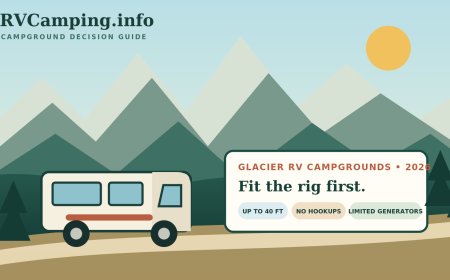
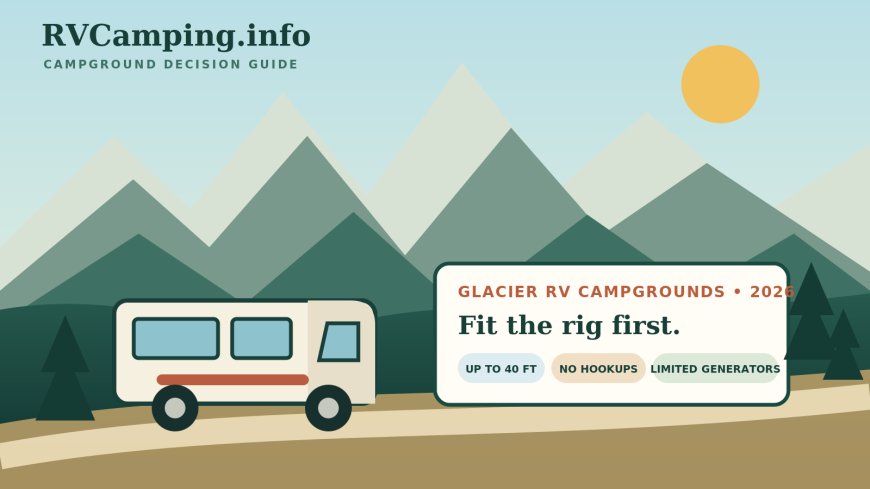
Glacier has 13 front-country campgrounds, but RV owners should not treat them as interchangeable pins on a map. Apgar and St. Mary have the best odds for a 35- to 40-foot setup, Fish Creek has a useful middle tier, and five remote campgrounds cap vehicle combinations at 21 feet. None of the park campgrounds has electric, water, or sewer hookups at individual sites.[1]
For the rest of 2026, remove Two Medicine from the shortlist: Recreation.gov says it is closed all year for construction.[5] On September 14, St. Mary and Many Glacier were still reservation campgrounds but had shifted to primitive service. St. Mary also had a temporary hard-sided-camping-only restriction because of bear activity.[3][4]
The practical rule is simple: choose a campground for your measured combination, reserve the exact compatible site where required, and arrive prepared to dry camp even if the normal-season description mentions potable water and flush toilets.
Quick picks by RV type
- Long motorhome or large fifth-wheel: Start with St. Mary or Apgar. St. Mary has three spaces listed up to 40 feet and 22 more up to 35 feet; Apgar has 25 spaces up to 40 feet. Those numbers describe the largest parking spaces, not every site.[1]
- Rig around 27 to 35 feet: Check Fish Creek first, then the limited large sites at St. Mary or Many Glacier. Fish Creek has 18 spaces up to 35 feet and 62 additional spaces up to 27 feet.[1]
- Camper van or short truck camper: Nearly the full campground list is possible at 21 feet or less, but remote North Fork roads and a first-come arrival add more risk than the length number suggests.
- Solar-dependent or generator-free camper: Sprague Creek and Cut Bank prohibit generators campground-wide. Several loops or site blocks elsewhere are also generator-free.[1]
- Late-season traveler: Verify both operating status and service status on the day you travel. "Open" can mean vault toilets, no potable water, and no dump station.
All 13 campgrounds compared for RV travelers
The length figures below come from Glacier's current campground information page. A figure such as "largest 25 up to 40 feet" is an inventory clue, not permission to book any site with a 40-foot rig. Check the equipment-length field and site notes before paying.[1]
| Campground | 2026 access | Published RV or vehicle limit | Generator rule | Service reality |
|---|---|---|---|---|
| Apgar | Reservation | Largest 25 spaces: 40 ft | Timed windows | Best large-rig inventory in the park; no hookups |
| Avalanche | Reservation | Largest 50 spaces: 26 ft | Timed windows | Central location, but not a big-rig campground |
| Bowman Lake | First come | Combination max: 21 ft | Timed windows | Remote, smaller, fewer amenities |
| Cut Bank | First come; Scan & Pay through the Recreation.gov app | Combination max: 21 ft | Prohibited everywhere | Remote and basic; download the app before arrival |
| Fish Creek | Reservation | 18 spaces: 35 ft; 62 more: 27 ft | Loop C prohibited; timed elsewhere | Strong west-side compromise for mid-size rigs |
| Kintla Lake | First come | Combination max: 21 ft | Timed windows | Remote and basic; poor choice for a trailer near the limit |
| Logging Creek | First come | Combination max: 21 ft | Timed windows | Small and low-service |
| Many Glacier | Reservation | Largest 13 spaces: 35 ft | Generator-free site blocks; timed elsewhere | Tight drives and slide-out conflicts are common |
| Quartz Creek | First come | Combination max: 21 ft | Timed windows | Remote and basic |
| Rising Sun | First come | Largest 10 spaces fit combinations up to 21 ft; over 21 ft prohibited | Sites 49-84 prohibited; timed elsewhere | Useful only for short rigs; normally seasonal |
| Sprague Creek | Reservation | Combination max: 21 ft | Prohibited everywhere | Quiet but small; no generator fallback |
| St. Mary | Reservation | 3 spaces: 40 ft; 22 more: 35 ft | Loop A prohibited; timed in B and C | Best east-side large-rig target; exposed sites and seasonal services |
| Two Medicine | Closed throughout 2026 | Normally, largest 10 spaces: 35 ft | Loop A generator-free | Do not build a 2026 itinerary around it |
For 2026, Glacier assigns seven campgrounds to advance booking: St. Mary, Apgar, Sprague Creek, Fish Creek, Avalanche, Many Glacier, and Two Medicine. The first-come group is Rising Sun, Quartz Creek, Logging Creek, Kintla Lake, Cut Bank, and Bowman Lake.[1] Two Medicine's construction closure supersedes its normal reservation status for 2026.[5]
The two best bets for bigger rigs
Apgar: the most forgiving west-side choice
Apgar is Glacier's largest campground, with 194 sites, potable water, and flush toilets during its normal operating season. Recreation.gov says all regular sites require reservations; most use a six-month booking window, while a smaller set opens four days ahead.[2] That split gives planners two chances, but it does not make a compatible long site likely.
Apgar's advantages are practical. It is close to the west entrance and Apgar Village, so resupply is easier than at a remote campground. The 25 largest parking spaces reach 40 feet.[1] Measure the motorhome itself or the full tow vehicle and trailer combination as the booking page instructs. Leave room in your plan for mirrors, racks, and anything that changes the parked footprint.
St. Mary: the strongest east-side option, with fewer long spaces
St. Mary has the park's other 40-foot inventory, but only three spaces reach that length. Another 22 reach 35 feet.[1] That is enough to make St. Mary the sensible first search for a large RV on the east side, not enough to arrive without an exact reservation.
The September 14 snapshot is unusually restrictive. Recreation.gov says the campground is in primitive status, with no potable water, dump station, water spigots, showers, or flush toilets; a vault toilet remains available. Reservations are still required. The same page reports a hard-sided-only restriction until further notice because of increased bear activity, excluding tents, tent trailers, and other soft-sided RVs.[3] Check that alert again immediately before departure.
Why Many Glacier needs extra caution
The park-wide table says Many Glacier's largest 13 sites have 35-foot parking spaces.[1] The campground's booking page adds the detail that matters: most campsites and drives are very small, most will not accept towed units over 21 feet, only a limited number handle 26- to 30-foot towed units, and many sites cannot take slide-outs.[4]
That makes Many Glacier a site-by-site decision rather than a campground-wide recommendation. A short Class B or truck camper is a much easier fit. If your trailer needs slides deployed to be usable, St. Mary is the safer search.
Many Glacier entered primitive status on September 13. Recreation.gov reports no potable water, dump station, water spigots, or flush toilets, with a vault toilet available; reservations remain mandatory.[4] Fill the fresh tank and empty holding tanks before driving in.
There is also a small official-source discrepancy in the generator-free block. Glacier's park-wide page lists sites 48-59, 71, and 88-102, while Recreation.gov lists 48-59, 71, and 86-102.[1][4] The cautious choice is to treat sites 86-102 as generator-free unless the reservation record or a ranger confirms otherwise.
Generator hours are short and split across the day
Where generators are allowed, Glacier limits use to three windows: 8-10 a.m., noon-2 p.m., and 5-7 p.m. Quiet hours run from 10 p.m. to 6 a.m., and unreasonable vehicle idling is prohibited.[1]
Generator-free areas are:
- all of Sprague Creek and Cut Bank;
- Fish Creek Loop C;
- St. Mary Loop A;
- Rising Sun sites 49-84;
- Many Glacier's designated site blocks; and
- Two Medicine Loop A, although the campground is closed in 2026.[1][5]
The park-wide page lists Two Medicine sites 1-36 as generator-free, while Recreation.gov labels Loop A, sites 1-37.[1][5] The distinction has no practical effect during the 2026 closure, but Loop A should be treated as generator-free when the campground reopens unless the park publishes a revised map.
If batteries run a residential refrigerator, CPAP, furnace blower, or mobility equipment, six permitted generator hours do not guarantee enough charging. Start with charged batteries, reduce inverter loads, and know the actual output of the converter or inverter-charger. Sprague Creek and Cut Bank require a plan that works with no generator at all.
"No hookups" means real dry camping
Glacier prohibits connections to water, sewer, and electrical outlets. In normal operations, many larger campgrounds have shared potable-water spigots and restrooms, but those are not campsite hookups.[1] Do not plan to top up from a spigot with a permanently connected hose.
The park says showers are available to registered campers at Fish Creek, Apgar, and St. Mary. Fee showers may be available at Rising Sun and Swiftcurrent Motor Inns.[1] Seasonal closures and primitive status can remove those options, as St. Mary's current notice demonstrates.[3]
Cell service is unreliable enough that the park recommends reserving before entering. Two Medicine's listing says there is no cell service or Wi-Fi, and Many Glacier reports no campground cell coverage.[1][4][5] Save confirmations and campsite details offline. Download the Recreation.gov app before heading to Cut Bank, where Scan & Pay is required.[1]
A workable arrival setup includes:
- enough fresh water for the first night plus a delay;
- empty gray and black tanks;
- offline reservation screenshots and maps;
- a battery plan matched to the generator rules for the exact loop; and
- food and scented items that can fit inside a hard-sided vehicle or food locker.
Do not route a long RV across Logan Pass
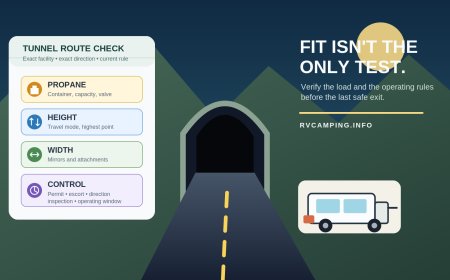
A campground may fit your rig even when the road between park districts does not. Recreation.gov warns that vehicles or combinations over 21 feet long or 8 feet wide, including mirrors, are prohibited on the restricted central portion of Going-to-the-Sun Road.[2][3] Plan west-side arrivals through West Glacier and east-side arrivals through St. Mary or the appropriate outside-park highway. Do not use Logan Pass as the transfer route for a conventional motorhome or towable.
Booking checklist before you commit
- Measure the full combination in travel mode, including bikes, cargo trays, bumpers, and the tow vehicle where the rule applies.
- Open the exact Recreation.gov site record. Match its driveway length, vehicle type, and site alerts to your setup.
- Confirm that slide-outs can open without crossing the parking pad or hitting vegetation.
- Check the generator designation for the loop and site, not just the campground name.
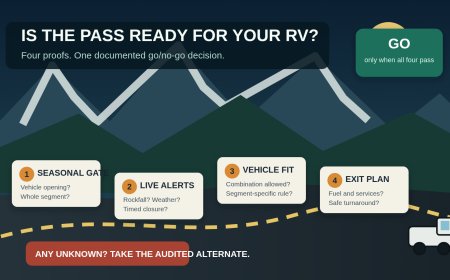
- Read the current campground alert for primitive status, water, toilets, dump stations, bear restrictions, and closure dates.
- Save the reservation and map offline before entering the park.
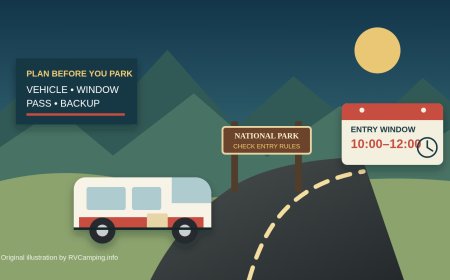
- Recheck the NPS campground-status page on travel day. Seasonal weather, construction, wildlife, and water-system issues can change the usable product after you book.
Glacier rewards smaller rigs with more choices. Larger rigs can still camp inside the park, but they need an exact site match and a service plan that does not depend on hookups, strong cellular data, or an unrestricted generator schedule.
Source credit: RVCamping.info compared current National Park Service and Recreation.gov campground pages retrieved September 14, 2026. The rig-first decision framework, service-risk analysis, and booking checklist are original editorial work.
Sources
- Camping Information — Glacier National Park. Accessed September 14, 2026.
- Apgar Campground — Recreation.gov. Accessed September 14, 2026.
- St. Mary Campground — Recreation.gov. Accessed September 14, 2026.
- Many Glacier Campground — Recreation.gov. Accessed September 14, 2026.
- Two Medicine Campground — Recreation.gov. Accessed September 14, 2026.
What's Your Reaction?