





Getting Packages on an RV Trip: A Pickup Plan That Survives Delays
Plan package pickup during an RV trip by matching USPS General Delivery, parcel lockers or campground acceptance to a verified receiver, deadline and route window.

Getting Packages on an RV Trip: A Pickup Plan That Survives Delays
By Romana | October 3, 2026 | RV Camping
Quick answer: Pick a receiving method only after confirming the exact location, recipient-name rule, identification requirement, hold deadline and hours. Use USPS General Delivery only at an authorized facility you have contacted, use a locker only when the order is eligible, and send a parcel to a campground only with that property's advance approval.

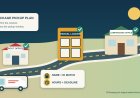
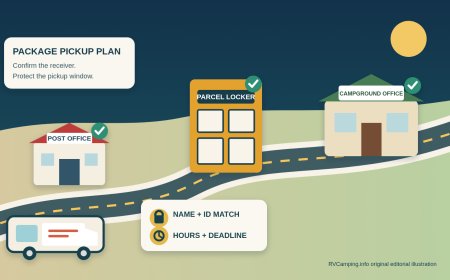
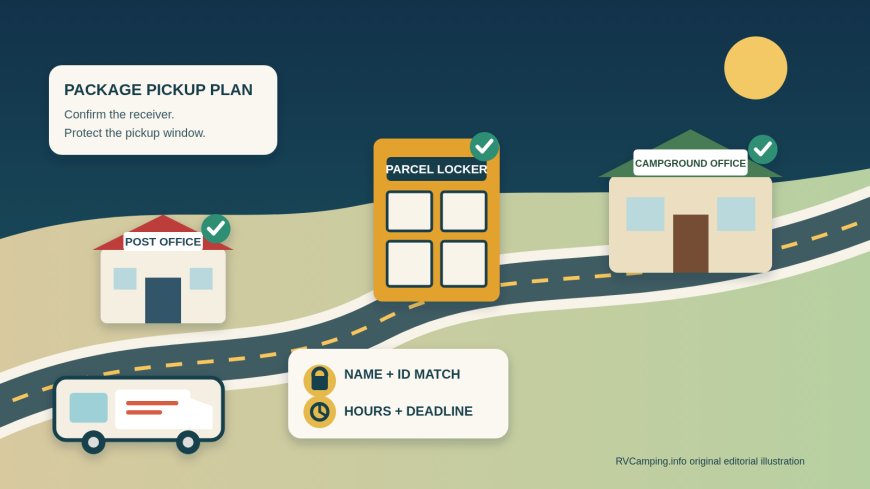
Match the shipment to a verified receiver, then leave enough calendar margin to collect it. Original illustration by RVCamping.info.
Receiving a replacement water-pump part or a refill of ordinary supplies while traveling sounds simple until the package and the RV arrive on different days. The safe approach is not to pick one delivery address and hope. Build a pickup window around three facts: who is authorized to receive the item, how long it will be held, and whether you can still reach the pickup point if your route changes.
USPS General Delivery, a carrier or retailer pickup location, and campground acceptance solve different problems. None should be treated as a universal RV mailing address.
Start with the route window, not the checkout screen
Before ordering, write down the earliest and latest day you can realistically collect the item. Add one day for a weather, repair, or campground delay. Then compare that window with the seller's delivery estimate and the receiving location's hold policy.
A workable handoff has four confirmed parts:
- Eligible shipment: The seller and carrier will send that exact item to that kind of pickup point.
- Exact recipient name: The label matches the traveler's identification or campground reservation.
- Verified location: The address, ZIP Code, counter or locker, hours, and access instructions are current.
- Pickup margin: Delivery can slip without forcing a route change or return to sender.
Tracking is evidence that a carrier scanned an item, not proof that a campground office or locker is ready to release it. Wait for the receiver's pickup notice when its policy requires one.
Option 1: USPS General Delivery
General Delivery is designed primarily as temporary delivery for travelers and customers who are not permanently located.[1] That makes it useful for an RVer who can visit a specific Post Office during counter hours. It is not permission to address an item to any postal building in town; USPS says the service is normally offered at only one facility under a Post Office's administration.[2]
USPS tells customers to use its location finder, filter for General Delivery, and then contact the selected facility to confirm availability and the correct ZIP Code.[2] Do that before giving the address to a sender. The Domestic Mail Manual also says customers should contact the destination Post Office before mailing to identify the authorized facility and applicable ZIP Code.[1]
Use the format USPS publishes:
YOUR FULL NAME
GENERAL DELIVERY
CITY STATE ZIP CODE
Keep the recipient name consistent with the identification you will carry. USPS may require suitable identification before releasing the mail, and a postmaster may restrict service when a customer cannot present it or when the office cannot reasonably accommodate the mail volume.[1]
General Delivery is free where authorized and does not require an application, but local limits can still matter.[2] USPS normally caps retention at 30 days, and a sender can specify less time.[1] That is a ceiling, not a planning target. Ask the chosen office how you will know the item is ready, what counter hours apply, and whether its size or service class creates a problem. Plan pickup early enough to recover from a misspelled name, an early closure, or a delayed scan.
Option 2: a retailer or carrier pickup point
A locker can be cleaner than sending a parcel to a campground because the order is tied to a defined pickup location. The tradeoff is eligibility. A checkout page may reject an item because of the seller, size, contents, value, or delivery method. Treat a locker as confirmed only when the order itself accepts that location.
Amazon says collection begins after its delivery confirmation email arrives.[3] Its screen-equipped lockers use a pickup code or barcode, while some screenless lockers require the Amazon app, Bluetooth, and location access on a smartphone.[3] Read the instructions for the exact locker instead of assuming every unit works the same way. If your phone is your key, download the app, sign in, and preserve the confirmation before leaving reliable service.
Do not estimate a locker deadline from a previous order. Use the deadline in the current notice. If the package is not collected, Amazon says it is returned.[3] Also verify public access hours for a locker inside a store, apartment building, or other host. A 24-hour-looking map pin does not guarantee that the host's doors are open.
For any carrier counter or pickup partner, confirm three details on the carrier's own tracking page: the package is actually awaiting pickup, the ID or release code required, and the last pickup day. Do not send a package directly to an unfamiliar store address unless the checkout flow or carrier explicitly offers that location for the shipment.
Option 3: campground or RV resort acceptance
Campground package handling is a courtesy with local rules, not an assumed campsite amenity.[4] Call or email before ordering. Ask whether the office accepts the specific carrier, whether you must already be checked in, and exactly how the label should show your name, reservation, and site number.
Published campground rules show why the confirmation matters. Ocean Lakes Family Campground requires a name and site number on packages, requires photo ID at pickup, charges some recipients handling fees, may decline packages above stated size or weight limits, and says uncollected packages are returned after seven days.[4] Those are that campground's rules, not an industry standard. Your park may refuse all packages, accept only private carriers, exclude refrigerated or signature-required items, or use different fees and retention periods.
Get answers to these questions in writing when the item is costly or trip-critical:
- Which carriers are accepted at the office?
- Must the recipient have an active reservation on delivery day?
- What exact address and label format should be used?
- Are there fees, size or weight limits, or prohibited contents?
- Will staff sign for a package?
- How will the park notify you, and how long will it hold the parcel?
- Is pickup limited to office hours, and what ID is required?
- What happens if the reservation or site number changes?
Never use the campground's address for billing, residency, or legal records unless the property explicitly permits that separate use.
Build a two-stop plan for important shipments
For an inexpensive, replaceable item, one verified receiver may be enough. For a part that could stop the trip, choose a primary pickup point and identify a second authorized option farther along the route before buying. Save the order number, tracking number, receiver phone number, address, hours, and pickup deadline in one note available offline.
Do not send the same urgent item to two places unless you are prepared to manage and pay for both. The backup is a decision point: if tracking has not reached a defined milestone by your cutoff, cancel or reroute when the seller and carrier allow it, then place the replacement order to the second verified location.
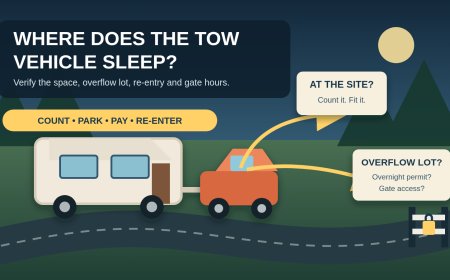
Finally, schedule collection like a fuel stop. Check parking and turning room, avoid towing into a tight urban lot if you can collect with the tow vehicle alone, and arrive well before closing. A package plan is complete only when the shipment, receiver, calendar, identification, and RV access all fit the same stop.
Evidence note: USPS supports the General Delivery purpose, location confirmation, addressing, identification and retention rules. Amazon supports its locker-release methods and return outcome. Ocean Lakes illustrates one campground's name, site-number, identification, fee, size and hold rules. The four-part handoff and two-stop planning methods are RVCamping.info editorial analysis.
Sources
- DMM 508 Recipient Services — General Delivery — Official purpose, facility, identification and retention standards.
- What Is General Delivery? — USPS — Facility lookup, address format and service guidance.
- Collect a Package at an Amazon Locker — Amazon Customer Service — Current release methods and uncollected-package guidance.
- Package Guidelines — Ocean Lakes Family Campground — Example campground requirements, fees, size limits and retention period.
What's Your Reaction?