







Big Bend RV Camping: Rio Grande vs. Chisos vs. Cottonwood
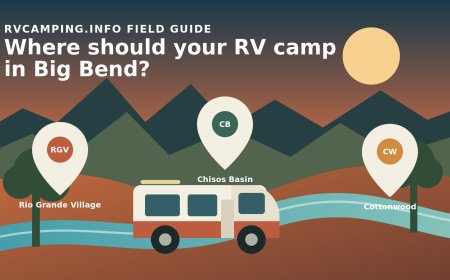
Rio Grande Village is the practical choice for most RVs, Chisos Basin favors short rigs and hikers, and Cottonwood rewards self-contained campers when it is open.

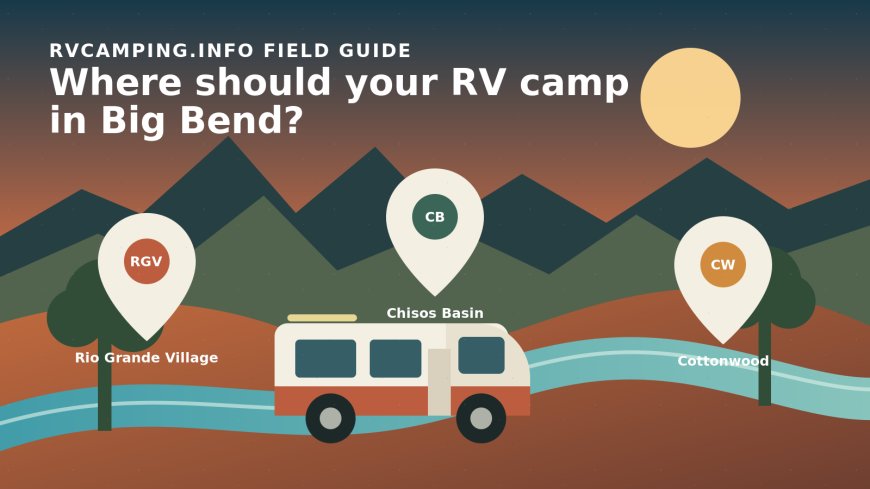
Big Bend RV camping: Rio Grande Village vs. Chisos Basin vs. Cottonwood

Updated September 18, 2026
For most RV travelers, Rio Grande Village is the practical first choice. The National Park Service campground has the park's most forgiving dry-camping sites, including some that fit a 40-foot motorhome, while the adjacent concession RV park is the only in-park option with full hookups.[1][3][9]
Chisos Basin is the pick for a short rig and trail access.[5] Cottonwood is the quiet, generator-free base for the west side, but it is seasonal and closed on this article's publication date.[2][7]
There is no single "Rio Grande Village" RV product. Two neighboring campgrounds share the name: the 100-site NPS campground is dry camping, while the 25-site concession RV park has electricity, water, and sewer. That distinction changes the answer for anyone who needs air-conditioning without running a generator.[1][3][9]
The decision in 30 seconds
| If you need... | Best fit | The catch |
|---|---|---|
| A site for the largest rigs accommodated by these three areas | Rio Grande Village NPS campground | Only selected sites fit a 40-foot motorhome; there are no hookups and branches/clearance vary by site.[3] |
| Full hookups | Rio Grande Village RV Park | The concession page lists 36- and 38-foot RV sites, not 40-foot sites.[9] |
| The shortest drive to Chisos Basin trailheads | Chisos Basin | Hard cap: 24 feet for motorhomes and 20 feet for travel trailers; sites are often rocky and unlevel.[5] |
| Quiet camping without generator noise | Cottonwood | Generators and vehicle idling for power are prohibited; no hookups or dump/fill station.[7] |
| Santa Elena Canyon and the Ross Maxwell Scenic Drive | Cottonwood | Closed for summer and scheduled to reopen November 1; reservations open only 14 days ahead.[2][7][8] |
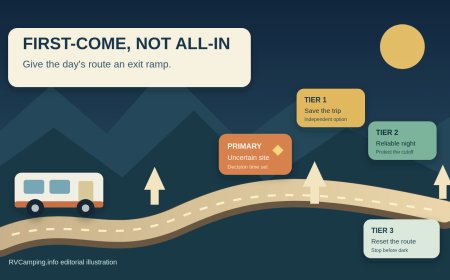
Our ranking for a typical self-contained RV: Rio Grande Village NPS first, Cottonwood second when open, Chisos Basin third. That is not a scenery ranking. It is a maneuvering-and-services ranking. A camper van or short Class B built around hiking could reasonably reverse it and choose Chisos first.
Exact limits and services
| Campground | Rig limit | Hookups and power | Water, toilets, dump | Season and booking |
|---|---|---|---|---|
| Rio Grande Village, NPS | Suitable sites can fit a motorhome up to 40 feet. Choose by the individual listing; low branches and site dimensions rule out some rigs.[3] | No hookups. Generators only in designated sites: 8 a.m.–11 a.m. and 5 p.m.–8 p.m. from Nov. 1–Apr. 30; 8 a.m.–8 p.m. from May 1–Oct. 31.[3] | Water spigots, flush toilets, utility sinks, and a fill/dump station. Coin showers and laundry are at the nearby store.[3] | Open year-round; reservation required; no first-come, first-served camping. Some sites release six months ahead and the named short-window sites release two weeks ahead.[3][4] |
| Rio Grande Village RV Park, concession | The operator lists 36- and 38-foot RV sites.[9] | Full hookups: electricity, water, and sewer; 30- and 50-amp service.[9] | Public showers and the Rio Grande Village Store are on site; propane fill-ups are available by appointment.[9] | Year-round. Reserve with the concessioner, not Recreation.gov; the published phone is 855-765-1324.[9] |
| Chisos Basin | 24 feet for motorhomes; 20 feet for travel trailers. Recreation.gov also warns that the approach has sharp hairpins and that many sites cannot be leveled.[5] | No hookups. Generators only in designated areas, 8 a.m.–11 a.m. and 5 p.m.–8 p.m.[5][10] | Drinking water, toilets, and a fill/dump station. The dump is on the opposite side from most RV sewer outlets, so Recreation.gov advises an extra-long hose. No showers.[5] | Open and reservable year-round; no first-come, first-served camping. Some sites release six months ahead and specified sites release two weeks ahead.[5][6] |
| Cottonwood | No campground-wide RV-length ceiling is published on the campground overview. Limits are site-specific, and the listing warns of dirt/gravel pads and low branches on some sites. Book only a site whose equipment field fits the exact RV/trailer combination.[7] | No hookups. No generators, and idling a vehicle to make power is also prohibited.[7] | Potable water and vault toilets; no fill/dump station.[7] | Closed for summer; NPS says it reopens Nov. 1. Every individual site uses a 14-day reservation window; no first-come, first-served camping.[2][7][8] |
The campground capacity numbers also need context. Rio Grande Village has 100 sites, Chisos Basin has 60 individual sites, and Cottonwood has 30 individual sites plus one tent-only group site.[3][5][7] A site count is not an RV-site count: Chisos has many listings that accept only shorter equipment, and Cottonwood's equipment limits differ by site.
Rio Grande Village: the least complicated RV choice
Rio Grande Village gives an RV trip the widest safety margin. The NPS campground includes pull-through and back-in choices, a fill/dump station, and selected spaces for a motorhome up to 40 feet. It also puts showers, laundry, and the camp store within a walk of roughly 5 to 15 minutes.[3] For a large dry-camping rig, that is a better fit than trying to force the same vehicle through the Chisos Basin road.
The tradeoff is heat. Recreation.gov says the 1,850-foot campground commonly sees daily highs above 100–107°F from April through September.[3] On the September 18 publication date, this is not a place to treat shore power as a minor preference. If air-conditioning is essential, reserve the concession RV park or arrive with a power plan that follows the generator designation and hours. A no-generator NPS site is not interchangeable with a generator site.[3][9]
The concession campground solves the electrical question but gives back some flexibility on length. Its current page lists full hookups, both 30- and 50-amp service, and 36- and 38-foot site categories.[9] The NPS overview describes 25 concession sites and a 38-foot maximum.[1] Owners of rigs near that limit should give the operator the RV's actual bumper-to-bumper length rather than relying on its model number.
Choose Rio Grande Village when the rig is long, hookups matter, or the trip centers on Boquillas Canyon, Hot Springs, and the park's east side. It is less efficient for a trip built around Santa Elena Canyon: the Recreation.gov page itself places that canyon about a 1.5-hour drive away.[3]
Chisos Basin: best location, strictest approach
Chisos Basin is the compelling choice for a small RV whose occupants want to walk or make a short drive to major mountain trailheads. At 5,400 feet, it is far higher than either river campground, and Recreation.gov places the Window, Lost Mine, South Rim, Pinnacles, and Emory Peak access in the Basin area.[5]
The 24-foot motorhome and 20-foot travel-trailer limits are restrictions, not suggestions to round up. The road is steep, winding, and cut by sharp hairpins; Recreation.gov says longer equipment will not be accommodated.[5] The same listing warns that sites are small, rocky, and often impossible to level. Bring leveling blocks, read the exact site's driveway and equipment fields, and do not assume another site will be available if the reserved one proves unsuitable.[5]
Chisos also asks more of a dry-camping setup. There are no utility hookups and no showers. Some sites prohibit generators, while allowed sites follow two short daily windows rather than Rio Grande Village's all-day summer schedule.[5][10] The fill/dump station exists, but its placement can require an extra-long sewer hose.[5]
A once-planned 2026 closure is the biggest source of stale advice online. The current Recreation.gov notice says the planned lodge and facility work will not proceed as scheduled and that the previously planned Basin closures will not take place.[5]
The NPS campground page still carries an older construction warning near the top, so use the park's live conditions page and the Recreation.gov alert rather than an old itinerary or search snippet.[2][5][6]
Cottonwood: quiet, shaded, seasonal
Cottonwood wins on quiet. It bans generators outright, and Recreation.gov explicitly treats idling a vehicle for electricity as prohibited generator use.[7] It has potable water, vault toilets, picnic tables, food lockers, grills, and shade from cottonwood trees, but no hookups and no place to fill or dump RV tanks.[7] Arrive with a full fresh-water tank and enough waste capacity to leave without servicing.
This is the natural base for the Ross Maxwell Scenic Drive, Castolon, and Santa Elena Canyon.[7] It also requires more date and route checking than the other choices. NPS reported the campground closed for summer and scheduled to reopen November 1.[2][8] On September 18, 2026, it is therefore not a bookable camping alternative for an immediate trip.
There is a second current complication: the NPS conditions page, last updated September 13, reported the paved road between Cottonwood and Santa Elena Canyon closed until further notice after flash flooding.[2] Cottonwood itself is already seasonally closed, but fall travelers should not assume the normal canyon connection will reopen on the same date as the campground.
Recreation.gov warns that GPS may route drivers over Old Maverick Road, which it describes as rough and appropriate only for high-clearance four-wheel-drive vehicles.[7] The live NPS conditions page is blunter: primitive dirt roads are not passable for motorhomes.[2] An RV route to Cottonwood should stay on the paved park-road approach unless rangers provide different current guidance.
Reservation strategy
Start with the non-negotiable dimension. If the motorhome is longer than 24 feet or the trailer is longer than 20 feet, remove Chisos Basin from the list.[5]
If continuous shore power is required, go directly to the concession RV park's booking system.[9]
The three NPS campgrounds have no campsite hookups.[3][5][7]
For Rio Grande Village or Chisos Basin, use Recreation.gov's individual site filters and read the site page before checkout. Most inventory can be booked up to six months ahead, while listed subsets release only two weeks before arrival.[3][5]
Cottonwood's individual sites all release on the 14-day window.[7][8]
None of the three NPS campgrounds offers first-come, first-served camping.[4][6][8]
Park stay rules cap a visit at 14 consecutive nights and 28 nights total in a calendar year; a specific site can be occupied for no more than 14 nights in that year. From January 1 through April 15, the park-wide total is limited to 14 nights.[1]
Checks to make before driving into the park
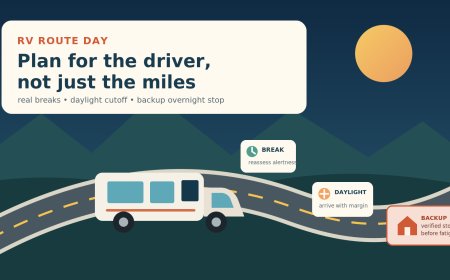
- Open the NPS Alerts & Conditions page. Check campground status, paved-road closures, flash-flood impacts, and facility hours. On September 18, Cottonwood was closed, and the Cottonwood–Santa Elena road was also closed.[2]
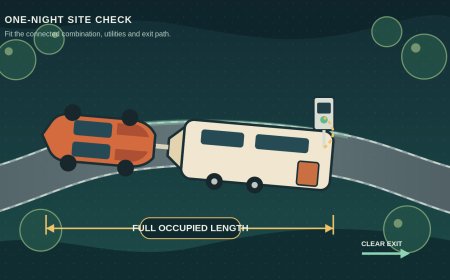
- Re-read the exact Recreation.gov site listing. Confirm permitted equipment, total vehicle length, driveway type, grade, overhead clearance, and generator status. A campground-level maximum does not guarantee that a specific pad fits.[3][5][7]
- Call the concessioner for a near-limit rig. The full-hookup operator lists 36- and 38-foot categories and publishes 855-765-1324.[9]
- Plan tanks and electricity. Cottonwood has neither a fill/dump station nor generators. Chisos and Rio Grande Village NPS have fill/dump stations but no hookups.[3][5][7]
- Keep the arrival route on pavement. NPS says motorhomes cannot use the park's primitive roads, and flood closures can change the normal west-side route.[2]
Bottom line
Pick Rio Grande Village for a conventional RV trip, especially with a long rig or a need for hookups.[3][9] Pick Chisos Basin only when the RV is within the 24-foot motorhome or 20-foot trailer cap and trail access matters more than level pads or services.[5]
Pick Cottonwood for a quiet, self-contained, generator-free stay near the west-side sights, but only after its November 1 reopening and a same-day road check.[2][7]
Big Bend is too remote for a campground choice based on atmosphere alone. Match the reservation to the measured rig, the power plan, the tank plan, and the road report. That turns three appealing names into one workable campsite.
Sources
- Camping - Big Bend National Park
- Alerts & Conditions - Big Bend National Park
- Rio Grande Village (Big Bend, TX)
- Rio Grande Village Campground - NPS
- Chisos Basin Campground (Big Bend, TX)
- Chisos Basin Campground - NPS
- Cottonwood (Big Bend, TX)
- Cottonwood Campground - NPS
- Rio Grande Village RV Park - Chisos Mountains Lodge
- Campground Regulations - Big Bend National Park
What's Your Reaction?