















Is Your RV Site Number Guaranteed? Check Before You Build the Trip Around It
A practical audit for telling an exact-site guarantee from a site request, site-type booking or check-in assignment before an RV campground stay.


Is Your RV Site Number Guaranteed? Check Before You Build the Trip Around It
By Romana | October 9, 2026 | RV Camping
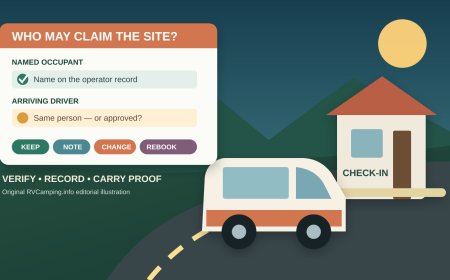
You picked site 42 because the awning side faces the trees, the bathhouse is close, and the 40-foot pad keeps your truck out of the road. The confirmation shows “42.” That still may not mean the campground promised you site 42.
Campground booking systems use several different ideas that can look identical on a checkout screen: a site request, a site-type reservation, a provisional assignment and an exact-site guarantee. If the location matters to your rig or your group, verify which one you bought. Do it while there is still time to change the plan.
Read the reservation as four separate promises
Open the confirmation and sort its language into four fields:
| Field | What it answers | Language to look for |
|---|---|---|
| Stay | Is space reserved for these dates? | confirmed, deposit received, balance due |
| Site type | What features should the assigned site have? | pull-through, back-in, 30/50 amp, full hookup, length class |
| Site number | Is this exact numbered space promised? | guaranteed, locked, selected site |
| Placement | Is a location relationship promised? | adjacent, near bathhouse, shaded area, accessibility feature |
A confirmation can be firm in the first two fields and flexible in the last two. Vacation Station RV Resort, for example, says guests who skip its optional lock-in may receive another space in an equal or upgraded category, with the site number supplied at check-in.[1] Holiday Shores RV Resort publishes a different model: it considers requests but does not lock individual campsites, and it makes the final assignment at check-in according to availability and operating needs.[2]
Those policies do not mean the reservation is fake or weak. They mean the thing being sold is not necessarily an address-sized patch of ground. It may be inventory in a category.
A map click is not enough evidence
Interactive maps encourage precise choices. You zoom in, compare loops, click a numbered shape and see that number carry into the cart. Keep the screenshot if it helps, but do not treat the interface alone as the contract.
Search the checkout page, rate details, confirmation and campground rules for these terms:
- request or preference: staff will try, but the placement may move;
- assigned: a number exists now, though the rules may allow reassignment;
- site type: the operator promises a category rather than one number;
- lock, lock-in, site guarantee or select my site: an added option may protect a number;
- subject to change or operational needs: the operator has stated a reason it may move the booking;
- same or better: the substitute may be measured by the operator's category, not by the feature you personally value.
That last distinction matters. A “better” site could have a higher rate class or more hookups yet be worse for your door side, mobility route, satellite view, pet setup or tow vehicle. Translate “same or better” into the features your trip actually needs.
Decide whether the number is a preference or a dependency
Most campers do not need to pay extra merely to keep a number. A different full-hookup pull-through may be perfectly fine for a one-night stop. The calculation changes when the location controls whether the stay works.
Treat the exact site or placement as a dependency when any of these apply:
- your measured combination fits only a small subset of sites;
- you need a documented accessible feature or route;
- slides, doors, ramps or lifts require a particular usable side;
- two reservations must remain adjacent for caregiving or shared equipment;
- a child, older adult or traveler with limited stamina needs a short route to a facility;
- the site must keep a second vehicle legally off the road;
- you selected that space to avoid a known obstruction, steep grade or tight turn.
Write down the functional reason. “We like 42” invites a vague assurance. “Our curb-side lift needs the level clear area shown on 42, and the other sites in this class do not show it” gives staff something concrete to verify.
Do not disclose a diagnosis when a description of the needed campsite feature will do. If you booked an accessible site, follow the operator's eligibility rules and ask it to confirm the actual feature, not just the label.
Audit any site-lock fee before paying it
A lock fee should answer a narrow question: what exactly becomes guaranteed?
Vacation Station states that its paid lock-in keeps the selected site from being moved, and it lists reasons a guest might value the option, including proximity, site length and multi-site placement. The same policy says the lock fee is nonrefundable if the guest cancels.[1] That is useful, specific language. Other campgrounds may define a similarly named fee differently.
Before adding one, capture answers to these questions:
- Does the fee guarantee the exact number, only the site type, or merely the operator's best effort?
- Does every reservation in a multi-site group need its own lock?
- Is the fee refundable if you cancel, shorten or move the stay?
- What happens if the campground itself cannot provide the locked site?
- May the operator move you for safety, maintenance, weather, utility failure or an unusable pad?
- If a move is unavoidable, which features must the replacement preserve?
Do not infer the answer from the fee's name. Save the definition that was displayed when you paid, along with the charge on the receipt.
Even a selected public campsite can move
Private resorts are not the only places where a number may change. Sonoma County Regional Parks says specific sites are not guaranteed because conditions such as flooding or a fallen tree can make a site unavailable.[3] That is a practical reminder: no booking term can make a damaged pad usable.
Separate two risks:
- inventory optimization: the operator moves reservations to arrange stays or manage categories;
- site failure: the selected space becomes unsafe, inaccessible or out of service.
A paid lock may address the first risk. It cannot reasonably eliminate the second. What you can verify is the remedy: notification, a substitute with required features, a date change, credit or refund. The policy may not promise your preferred remedy, so ask before a location-dependent trip.
Use a two-minute confirmation test
Run this immediately after booking and again a few days before arrival.
Step 1: Find the controlling words. Search the confirmation and linked rules for “site,” “assigned,” “request,” “guarantee,” “lock,” “change” and “check-in.” Follow the policy link from the confirmation rather than relying on an old browser tab.
Step 2: Label the reservation. Put one of these notes in the trip file:
- exact number guaranteed;
- number assigned but change allowed;
- site type guaranteed, number pending;
- location requested only;
- assignment unknown, campground confirmation needed.
Step 3: Record the nonnegotiable features. Use measurable facts: total rig length, electrical service, sewer need, slide side, accessible route, legal parking and required adjacency. Avoid “nice site” or “good location.”
Step 4: Contact the campground if the label is unclear. Use the official phone number or email from the operator's site. Ask:
“My confirmation shows site 42 for October 18–21. Is 42 guaranteed, assigned but movable, or only requested? If it can change, which booked features are guaranteed, and how can I protect the features my rig needs?”
Step 5: Preserve the answer. Save the confirmation, applicable rule, itemized fee and any email response as an offline PDF or screenshot. Note the date and the staff member or department. Do not store a payment-card image or account password in the trip folder.
Verify again after any reservation edit
Date changes can alter the available inventory. Extending one night may cause a booking engine to move the entire stay, split it, or retain only the site type. A rig-length update can shift the reservation into another category. Removing a fee might remove the lock. A campground merger or software change can also replace the original confirmation format.
After every edit, compare the old and new records line by line:
- arrival and departure dates;
- site type and hookup level;
- equipment type and measured length;
- displayed site number;
- site-lock or selection charge;
- adjacent-reservation notes;
- accessibility or placement features;
- balance, cancellation deadline and change terms.
Then reopen the live reservation. An agent's email saying “done” is helpful, but the guest-facing record should also show the intended result whenever the system supports it.
Make arrival day boring
If the number is flexible, arrive with the feature list rather than a demand for the map choice. Before entering the loop, compare the assigned site's posted number and setup space with the confirmation. Stop at the office if the site cannot safely hold the rig, the electrical service differs, or a required access feature is missing. Do not occupy an empty site that looks better; it may be reserved, closed or incompatible with your booking.
If the number was guaranteed and the desk assigns another one, show the saved policy and receipt calmly. Ask whether the move is a correction, a temporary hold or a response to a site problem. Then evaluate the replacement by function. A different number with the correct length, access and utilities may solve the stay, even while the fee or remedy still needs review.
The useful question is not “Why did they change my site?” It is “What did this reservation promise, what does the trip require, and does today's assignment still meet both?” Once those three items are written down, a site-number surprise becomes a problem you can check instead of an argument at the campground gate.
Source note: The reservation examples and operator terms come from the three cited official campground and county park pages. The four-field audit, dependency test, call script and post-edit comparison are original RVCamping.info planning tools. Policies and fees can change; verify the terms attached to your own booking. No firsthand stay or booking test is claimed.
Sources
- Resort Policies | Vacation Station RV Resort — Official lock-in, site-type assignment and fee-refund terms; accessed October 9, 2026.
- Policies & Guidelines | Holiday Shores RV Resort — Official site-request and check-in assignment policy; accessed October 9, 2026.
- Reservations and Cancellations | Sonoma County Regional Parks — Official notice that unexpected conditions can prevent a specific-site guarantee; accessed October 9, 2026.
What's Your Reaction?