





Can We Cook Here? Food Rules for Mixed RV and Glamping Groups
A unit-by-unit verification plan for shared meals when one group sleeps in an RV and another uses a glamping tent, cabin or yurt.

Can we cook here? A food-rules plan for mixed RV and glamping groups
By Romana | October 5, 2026 | Glamping
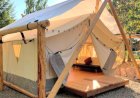
One reservation can put half the group in an RV with a refrigerator and stove, and the other half in a canvas tent with neither. That mismatch is where bad assumptions start. The RV travelers may expect everyone to cook at their site. The glamping guests may read "grill available" as permission to use any burner beside the tent. Neither conclusion is safe until the property confirms it.
This guide is a verification plan, not a universal rule sheet. Cooking locations, fire restrictions, wildlife storage and quiet hours can change by property, unit type, weather and season. Confirm the exact arrangement for your dates, then give every person the same short plan.
Verify each sleeping unit separately
Do not ask only, "Is cooking allowed?" Ask where each appliance may be used and which rule applies to each booked unit. A property may allow an RV's installed stove, provide a grill at a glamping unit and forbid a guest's portable stove on the deck. Another may direct all tent guests to a pavilion cooktop.
Walden Retreats, for example, describes a compact place to prep indoors plus a gas grill outside. It also says the refrigerators do not have freezers.[1] That is useful property-specific information, not evidence that other glamping units have the same setup.
Winthrop/North Cascades KOA describes another arrangement: some sites do not have fire pits, a pavilion has a cooktop, and burn bans may prohibit wood and charcoal while allowing propane.[2] The lesson is to identify the approved cooking place and fuel for this stay. Do not copy one property's answer to another property.
Send the operator a unit-by-unit question:
- May guests cook inside the RV, inside the glamping unit, on its deck, at its fire ring, or only in a shared kitchen?
- Which guest-owned appliances are allowed: propane stove, electric hot plate, induction burner, charcoal grill or none?
- Does a current fire restriction change those permissions?
- Is the provided grill shared or assigned, and must it be reserved?
- Where may cooking equipment cool before storage?
Save the written response or note the employee's name, date and phone answer. Recheck at arrival because a new burn restriction can supersede an older email.
Treat the shared kitchen as a scheduled facility
A listing that says "shared kitchen" leaves important details unanswered. Ask for opening hours, appliance inventory, cookware, sink rules, cleaning supplies and the number of groups expected to use it. Find out whether the kitchen locks during quiet hours and whether food may remain there overnight.
Then divide dinner into short blocks. One person brings ingredients from storage. One handles raw food. Another washes the group's dishes where the property permits. This is less about assigning fancy titles than keeping eight people from covering the only counter with coolers and grocery bags.
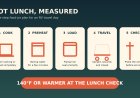
The FDA's basic food-safety sequence is clean, separate, cook and chill. Its consumer guidance says refrigerators should stay at 40°F or below and perishables should generally be refrigerated within two hours, or within one hour when the outside temperature is above 90°F.[3] A shared campground refrigerator deserves the same temperature check as the RV refrigerator. Put an appliance thermometer inside; do not assume a humming unit is cold enough.
Bring one washable bin for clean utensils and one for dirty items. Keep raw meat in a leakproof container below ready-to-eat food. Use a labeled tray or bag so another guest does not move exposed ingredients to make room. If the kitchen lacks safe dishwashing facilities, ask where wash water belongs rather than emptying it beside the building or at the campsite.
Decide what the RV refrigerator is, and is not
The RV refrigerator may be the group's best controlled cold space, but it should not become an unplanned public pantry. Before shopping, the RV occupants decide how much shelf room is available, when glamping guests may retrieve food and whether anyone else may enter the RV.
Use a simple allocation:
- one labeled bin for glamping guests' refrigerated ingredients;
- one sealed container for raw meat or seafood;
- one shelf area for cooked leftovers; and
- a separate cooler only if the property approves where and how it will be stored.
If the glamping refrigerator has no freezer, frozen ice packs need another plan.[1] Ask whether the property sells ice, permits a powered cooler, or has guest freezer space. "There is a fridge" is not enough for a menu that depends on frozen food.
Set a cutoff for putting dinner away. The person responsible for cold storage should not have to hunt through two sites after everyone leaves the table. Record allergies on the shared meal plan and use separate utensils and sealed containers where cross-contact matters.
Wildlife rules cover more than groceries
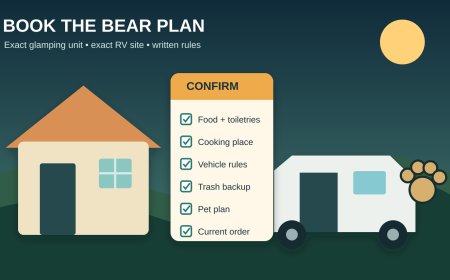
National Park Service guidance warns that parks differ: some require lockers or bear-resistant containers, while others permit certain vehicle storage. It treats scented items broadly, including toiletries, trash, coolers and cooking equipment, and tells visitors to check the rules for the specific park.[4] That variability is exactly why a mixed group needs one property answer.
Rocky Mountain National Park provides a concrete example. Its campground guidance says food lockers are shared and cannot be locked. It also includes coolers, dirty stoves, grills, cookware and toiletries in the items that must be secured when not in use.[5] Again, those are that park's instructions, not a universal permission to use an RV or car elsewhere.
Ask the operator to name the approved overnight location for all of these:
- dry food, drinks and pet food;
- coolers and grocery totes;
- clean and dirty grills, stoves and cookware;
- trash, recycling and food scraps; and
- toothpaste, sunscreen and other scented toiletries.
Do not solve limited locker space by quietly moving overflow into a glamping tent. Measure or request the locker dimensions before arrival. If lockers are shared, label bins with a name and phone number, but never add a personal lock unless the operator allows it.
Assign a last-person check after every meal: table clear, stove cool, dishes handled, grease and scraps removed, trash secured, refrigerator closed and scented items back in the approved place. This check belongs to the whole group, not automatically to the people sleeping in the RV.
Separate flame rules from meal plans
A fire ring does not promise that a fire will be legal on the night you arrive. Ask which authority posts restrictions, whether the property's rules are stricter, and whether propane appliances remain allowed when wood or charcoal is prohibited. Winthrop KOA explicitly says its policy can change with a burn ban.[2]
Plan one meal that needs no flame and no shared appliance. It is a practical fallback when wind, smoke, a power outage or a full kitchen changes dinner. Keep it genuinely ready to eat; a meal that still needs boiling water is not the fallback.
If fires are allowed, name the adult who lights and extinguishes the fire. Confirm where ashes or cooled charcoal go. Never use the fire ring as a food-waste disposal method. NPS guidance says partially burned food can still attract wildlife.[4]
Put quiet hours on the cooking schedule
Quiet hours can close the social evening before anyone expects. At Winthrop KOA they start at 10 at night and end at 7 the next morning, and the property asks guests to turn off outdoor televisions, music and generators.[2] Your campground may post different times.
Work backward from the actual rule. If quiet time begins at 10 p.m., the group should not start washing pans at 9:58 beside a sleeping unit. Schedule the last hot course, cleanup and cooler transfer early enough to finish without slamming locker lids, running an exterior RV generator or holding a loud conversation across sites.
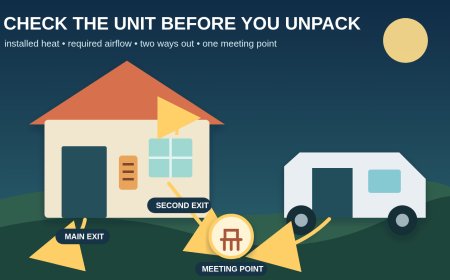
Choose a daytime meeting place and a quiet-hours contact method. A group text is better than knocking on the RV door at midnight to retrieve milk. Parents should know where children may walk between units, and nobody should cross another occupied campsite as a shortcut.
Give the group one arrival card
The trip organizer can reduce all of this to one page:
- approved cooking location for the RV site;
- approved cooking location for the glamping unit;
- shared-kitchen hours and reservation method;
- refrigerator assignments and retrieval times;
- current fire-status source and no-cook backup meal;
- exact wildlife-storage locations for food, cookware, trash and toiletries;
- dishwashing and gray-water location;
- quiet hours and generator limits; and
- who performs the post-meal storage check.
At check-in, one RV traveler and one glamping traveler review the card with staff. Photograph posted changes. If the front desk answer conflicts with a sign or booking terms, ask staff to resolve the conflict before lighting anything.
The useful question is not whether glamping "usually" includes cooking. It is whether this property allows this group to use this appliance, in this place, on these dates. Once that answer is written down, shared meals become easier and the RV stops functioning as an accidental kitchen, refrigerator and after-hours clubhouse for everyone.
Sources
- Walden Retreats FAQ — Property information on room prep areas, outdoor gas grills, refrigerators and ice; accessed October 5, 2026.
- Winthrop / North Cascades National Park KOA Holiday general information — Property rules for cooking locations, burn bans and quiet hours; accessed October 5, 2026.
- Safe food handling — FDA guidance on cleaning, separation, cooking and cold storage; content current March 5, 2024; accessed October 5, 2026.
- Storing food — National Park Service overview of varying park rules and scented-item storage; accessed October 5, 2026.
- Food storage at campgrounds and trailheads — Rocky Mountain National Park's campground storage details; accessed October 5, 2026.
What's Your Reaction?