











Twin Peaks vs. Alamo Canyon: the Organ Pipe RV choice is simpler than it looks
Twin Peaks is Organ Pipe’s only standard RV campground; Alamo Canyon is tent-only. Compare exact site lengths, dirt-road access, services, generators, reservations, and current restrictions.

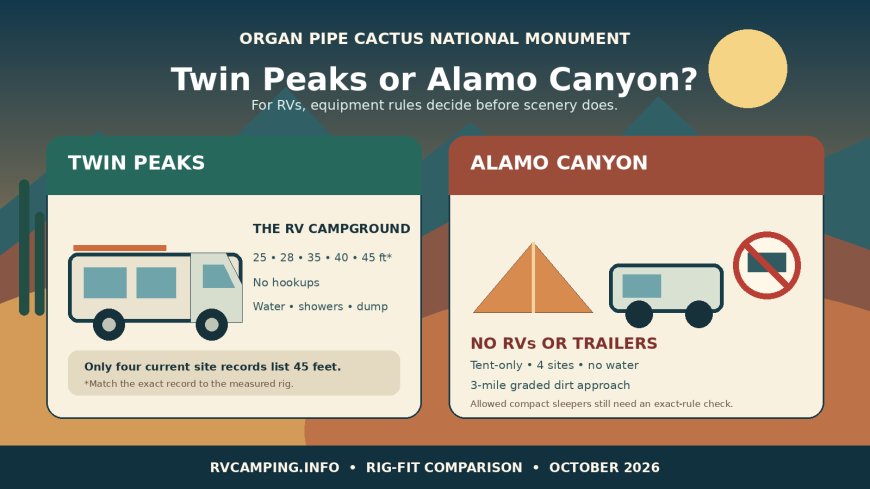

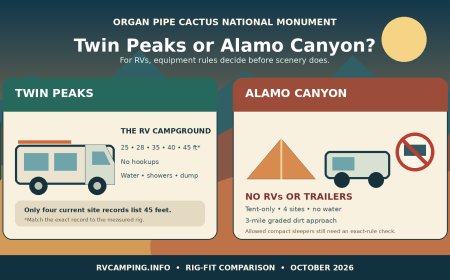
Bottom line: Book Twin Peaks if your camping unit is an RV, travel trailer, fifth wheel, or conventional motorhome. It is Organ Pipe Cactus National Monument’s developed campground, with reservable RV inventory, drinking water, flush toilets, solar-heated showers, and an RV dump-and-fill station—but no campsite hookups. Alamo Canyon is not a smaller-RV fallback. The National Park Service limits it to tents and a narrow set of vehicle-based sleeping setups, expressly excluding RVs, motorhomes, and trailers.[1][2]
Quick comparison
| Decision | Twin Peaks | Alamo Canyon |
|---|---|---|
| RV eligibility | Yes; 174 RV sites in the NPS overview | No RVs, motorhomes, or trailers |
| Exact rig fit | Site records use 25-, 28-, 35-, 40-, and 45-foot RV bands; only four records list 45 feet | Four tent-only records; permitted sleeping vehicles are limited to qualifying vans, cars, or pickup campers |
| Approach | Developed campground about 1.5 miles from the visitor center | Three-mile graded dirt road from unsigned Highway 85 turn at milepost 65.5 |
| Hookups | None | None |
| Water and toilets | Potable water, flush toilets, three solar-heated showers | No water; pit toilet |
| Waste | RV dump-and-fill station | No RV service; trash cans only |
| Generators | Limited windows after Labor Day; prohibited in sites 113–208 at all times | Prohibited |
| Reservations | Same day through six months ahead | Reservation only; same day through six months ahead |
| Stay limit | 21 consecutive days; 28 total per calendar year | Seven consecutive calendar days |
Twin Peaks: the only in-park answer for a normal RV
Twin Peaks has 208 campsites: 34 for tents and 174 identified by NPS as RV sites. The park says four can take RVs as long as 45 feet.[1] That last number is useful, but it is not a campground-wide permission slip.
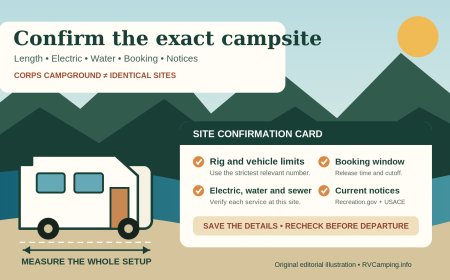
The Recreation.gov campsite snapshot retrieved for this comparison contains 209 records because it also includes group and management entries. Among records with a positive RV-length field, the displayed bands are 25, 28, 35, 40, and 45 feet. Sites 058, 071, 096, and 161 are the four records carrying a 45-foot RV maximum.[3] A 38-foot motorhome therefore should not be booked into a 35-foot record just because the overview says the campground can serve larger rigs.
Towable owners need one additional check. A site’s “RV maximum” does not automatically explain where the tow vehicle will sit, how much straight backing room exists, or whether the deployed slide and steps remain inside the campsite. Measure the trailer body and the full coupled combination, then open the individual Recreation.gov record. If the listing does not make the parking arrangement clear, call before paying. The site limit controls; an empty shoulder is not overflow parking.
Twin Peaks is dry camping at the pedestal, not primitive camping. There are no water, sewer, or electric connections at individual sites. Shared infrastructure includes potable-water points, running water in the restrooms, flush toilets, three solar-heated showers, and a dump station where RV tanks can be filled.[1] The 2026 superintendent’s compendium adds an important detail: campers may not attach a hose to campground faucets; potable-tank hoses are available at the dump station. Gray water belongs in a designated utility sink or the dump station, and sewage may go only to the dump station.[7]
That distinction changes the arrival plan. Fill the fresh tank at the proper station rather than blocking a restroom faucet, and arrive with enough battery capacity for long generator-off periods. A water faucet near a site is not a hookup.
Generator choice is also a site choice
The campground page gives two daily generator periods: 8–10 a.m. and 4–6 p.m. It also says sites 113 through 208 are generator-free at all times.[1] The current compendium provides seasonal context. From Labor Day through Memorial Day—the rule in force on October 8—it uses those same morning and afternoon windows. From Memorial Day to Labor Day it lists no generator-time restriction, while allowing staff discretion during temperatures above 90°F.[7]
For a fall or winter visit, plan around four permitted generator hours, not an all-day charging session. If generator use is essential, do not reserve in the 113–208 block. If silence matters more, that block gives a clear booking filter. In either case, a reservation in a generator-permitted loop does not erase quiet hours or justify exhaust near a neighboring opening.
Alamo Canyon: a tent campground with limited vehicle sleepers
Alamo Canyon has four sites and a much narrower equipment rule. NPS permits tents, passenger cars, pickups with camper shells, small slide-in pickup campers, and vans with pop-up sleeping units. It prohibits RVs, motorhomes, and trailers.[2] Recreation.gov’s four current campsite records likewise classify every site as tent-only and list tents, cars, pickup campers, and camper vans rather than conventional RV categories.[5]
That means “small enough for the road” is not the same as “allowed to camp.” A 20-foot Class B may physically resemble a camper van, but an owner should not assume that appearance overrides the campground’s express RV ban. A factory camper van, converted van, or pickup camper that fits the allowed language should still be matched to the exact booking record. A travel trailer, teardrop, fifth wheel, Class A, Class C, or vehicle registered and represented as a motorhome belongs at Twin Peaks or outside the monument.
Alamo is reservation-only, with bookings available on the day of arrival and as far as six months ahead. Each site allows no more than five people and two vehicles, and every vehicle must stay in the provided parking space. The consecutive-stay ceiling is seven days.[2] There is no first-come overflow option if all four sites are taken.
Services are intentionally spare. Each site has a table and charcoal grill; the campground has trash cans and a pit toilet. Drinking water is unavailable. All fires and all generators are forbidden.[2] “Charcoal grill” should not be read as authorization to burn charcoal: the no-fire rule controls. Bring water, lighting, and a battery plan that works without a generator.
The road does not turn Alamo into an RV option
The turn for Alamo Canyon Road is easy to miss because NPS says there is no highway sign. It is on the east side of Highway 85 at milepost 65.5, immediately north of the bridge over the wash. From there, the campground sits at the end of a three-mile graded dirt road.[2]
NPS’s driving guide says the road is suitable for vehicles no longer than 25 feet and leads to a tent-only campground.[5] That 25-foot road threshold is an access ceiling, not a camping entitlement. A 24-foot motorhome can satisfy the road dimension and still fail the campground’s equipment rule. This is the key mistake the comparison prevents.
A dirt road described as suitable for passenger cars can also change after rain. NPS says the monument is open throughout the year, but summer monsoon conditions can trigger temporary daytime road closures for flash-flood safety.[6] Do not enter a flooded wash, and do not treat a reservation as proof that the final road is passable now.
Keep the RV off the scenic loops unless it fits their separate rule
Reaching Twin Peaks does not make every monument road appropriate for the same rig. Ajo Mountain Drive is a 21-mile one-way mix of gravel and pavement. NPS allows RVs under 25 feet and prohibits longer vehicles because of the road’s bends and dips.[5]
Puerto Blanco has a different decision point. The road is open to all vehicles only as far as Pinkley Peak. Beyond that point, it becomes a one-way, high-clearance four-wheel-drive route, and there is no turn-around after entering that section.[5] The October conditions notice also closes several southern crossover roads while leaving South Puerto Blanco Drive itself open.[4]
The practical move for a large motorhome or towable is to establish camp at Twin Peaks, then tour in a shorter vehicle that meets the live road rules. Do not use a campground’s 45-foot site capacity as evidence that a 45-foot rig can travel the scenic drives.
A booking sequence that catches the mismatch
- Classify the camping unit honestly. If it is an RV, motorhome, or trailer, remove Alamo Canyon from the list.[2]
- Measure more than the coach. Record the RV or trailer length, full coupled length, height, width, rear overhang, and slide deployment.
- Choose the exact Twin Peaks record. The current RV fields step through 25, 28, 35, 40, and 45 feet; only four records show 45 feet.[3]
- Select a power plan. In the fall rule period, generator operation is limited to 8–10 a.m. and 4–6 p.m.; sites 113–208 remain generator-free.[1][7]
- Separate campground access from sightseeing access. The Alamo road and the two major scenic-drive systems carry their own vehicle limits.[2][5]
- Check the live notice on departure day. Temporary construction restrictions, flash flooding, or a new closure can change the usable road network.[4][6]
- Save the evidence offline. Keep the exact site page, equipment rule, confirmation, and conditions notice available without relying on service in the desert.
Twin Peaks wins by default for RV travelers, but it still demands a site-level length check and a dry-camping power plan. Alamo Canyon serves a different traveler: a tent camper or specifically permitted compact vehicle sleeper prepared for an unsigned dirt-road approach, no water, no fire, and no generator. The two campgrounds are close on a map; their equipment rules are not close at all.
Sources
- Twin Peaks Campground — Organ Pipe Cactus National Monument, National Park Service (accessed October 8, 2026)
- Alamo Canyon Campground — Organ Pipe Cactus National Monument, National Park Service (accessed October 8, 2026)
- Twin Peaks campsite inventory — Recreation.gov API (site-level JSON retrieved October 8, 2026)
- Alerts & Conditions — Organ Pipe Cactus National Monument, National Park Service (updated August 31, 2026; accessed October 8, 2026)
- Driving and Biking — Organ Pipe Cactus National Monument, National Park Service (accessed October 8, 2026)
- Operating Hours & Seasons — Organ Pipe Cactus National Monument, National Park Service (accessed October 8, 2026)
- Superintendent’s Compendium, revised January 2026 — Organ Pipe Cactus National Monument, National Park Service (accessed October 8, 2026)
What's Your Reaction?