










Denali RV Campgrounds: Riley Creek, Savage River, or Teklanika?
Riley Creek wins on services, Savage River balances access and distance, and Teklanika trades road freedom for a bus-based stay farther inside Denali.

Denali RV campgrounds: Riley Creek, Savage River, or Teklanika?
By Romana
The practical choice among Denali's three RV campgrounds is not about scenery alone. Riley Creek keeps an RV beside the park entrance and the only in-park dump/fill station.[1][2] Savage River moves camp to Mile 14 while preserving paved-road access and a free shuttle back to the entrance area.[1][3][5] Teklanika reaches Mile 29, but the last stretch is gravel and a camper who drives there accepts a three-night minimum plus a parked-vehicle rule.[1][4]
For most first visits, Riley Creek is the forgiving choice. Savage River is the better middle ground for campers who can live without nearby showers and laundry.[3] Teklanika is for a self-contained crew that wants the bus system, not the RV, to handle daily sightseeing.[2][3][4]
The October 2026 status comes first
This comparison is being prepared on October 8, after the regular summer season. Teklanika's final 2026 night was September 17, and Savage River closed September 20.[7][9] NPS said Bear Loop at Riley Creek shifted to free, first-come camping on September 21, without water or trash service; at least five sites were to remain available through winter.[7]
The current-conditions page says fall private-vehicle access may extend to Teklanika Rest Area at Mile 30 through October 15, weather permitting, but snow or ice can move the closure back to Mountain Vista or Park Headquarters sooner.[8] That road opening does not reopen Teklanika Campground. For an October trip, Riley Creek is the camping option to check; the drive west is a separate day-use road-status question.[7][8]
For 2027 planning, NPS says the full-length park bus service is expected to return and that bus and campground reservations open December 1, 2026.[8] Exact 2027 campground dates, prices and service levels still need confirmation. The 2026 dates below are a record of the most recent completed season, not a promise for next summer.[8][9]
Comparison at a glance
| Decision factor | Riley Creek | Savage River | Teklanika River |
|---|---|---|---|
| Park-road location | Mile 0.25, by the entrance | Mile 14, near the normal private-vehicle turnaround | Mile 29, inside the restricted road section |
| Best fit | First visit, short stay, service margin, late or early season | Quieter summer base without giving up paved access | Three-plus-night, bus-centered stay farther inside the park |
| RV site classes | A: up to 40 feet; B: up to 30 feet | A: up to 40 feet; B: up to 30 feet | Individual RV or camper-trailer up to 40 feet; special combination rule |
| Driving rule | Normal campground access | Drive in and out while open | Gravel after Savage; after arrival, keep the vehicle at the site until final departure |
| Hookups | None | None | None |
| Water and toilets in summer | Potable water; flush and vault toilets | Potable water; flush and vault toilets | Potable water is weather-dependent; restrooms |
| RV services | Only in-park dump/fill; nearby mercantile, showers and laundry in summer | No shower or laundry; use Riley dump/fill | No shower or laundry; fill and dump at Riley before or after |
| Free bus | Riley Creek Loop | Savage River Shuttle | No entrance-area courtesy shuttle; use paid transit/Tek Pass structure |
| 2026 regular season record | RV site classes: May 8-Sept. 20 | May 20-Sept. 20 | May 20-Sept. 17 |
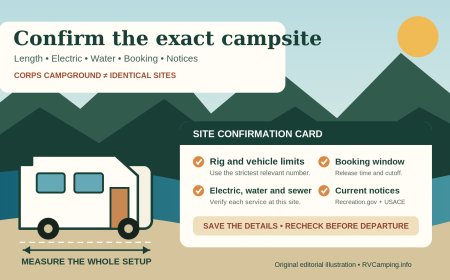
The length numbers are booking classes, not blanket fit guarantees.[1][9] NPS says campers choose an unoccupied site within the reserved class after arrival, rather than reserving a numbered campsite.[1] A 40-foot class therefore tells you the upper class boundary, not the grade, turning room, branch clearance or slide clearance of the site you will find open.
Riley Creek: the service-margin choice
Riley Creek is Denali's largest campground and the only one of the three open year-round.[1][2] Its official page allows RVs up to 40 feet and puts the mercantile, shower house, laundry and dump/fill station nearby during the serviced season.[2] The 2026 concessioner table split reservable inventory into A sites for RVs up to 40 feet and B sites for RVs up to 30 feet; C sites were walk-in tent sites with no vehicle at the site.[9]
That setup is useful when arrival logistics are uncertain. You can check in, fill fresh water, dump tanks, buy forgotten supplies and reach the bus depot without first committing to the restricted road.[2][9] The free Riley Creek Loop linked the campground, mercantile, bus depot, Horseshoe Lake trailhead and visitor center every 30 minutes during its 2026 operating period.[5]
The tradeoff is location. Riley is convenient because it sits at the front of the park, not because it reaches deep into it. A paid transit day still begins with a long bus ride west.[6] It is also not a full-service RV park: no Denali campground has campsite water or electrical hookups.[1]
Riley's year-round label needs a service footnote. NPS aims to activate water spigots and the dump/fill station around May 15, but weather can delay that work.[2] Outside the summer season, services are limited.[2] In the current fall operation, NPS specifically says to bring water and pack out trash.[7]
Savage River: the paved-road middle ground
Savage River sits near the end of the paved, publicly drivable section of Denali Park Road. Campers may drive an RV to and from the campground while it is open.[3] The 2026 booking table used the same basic RV classes as Riley: A for up to 40 feet and B for up to 30 feet.[9]
Its location removes some entrance-area motion without imposing Teklanika's vehicle lock-in. The free Savage River Shuttle ran between the entrance area and the campground, with service every 30 minutes and stops at Mountain Vista and Savage River.[5] Campers could also board paid transit at the campground for travel farther west.[3][6]
Savage is a better fit than Riley when the campsite should feel removed but the trip still needs an easy exit. That matters for a short reservation, a changing itinerary or a crew that is uneasy about driving a long RV on gravel. It is also a clean compromise for pets: pets may stay at the campground, but they are not allowed on park buses, so one person may need to remain behind during a transit outing.[3][4]
Services are thinner. Savage has potable water and toilets, but no hookups, showers or laundry.[3] The in-park dump/fill remains back at Riley Creek.[4][9] Fill the fresh tank and empty holding tanks before driving out to Mile 14 rather than treating the return trip as an afterthought.
Teklanika: farther in, with rules that reshape the stay
Teklanika offers 53 sites at Mile 29.[4] An RV camper may drive there even though ordinary private vehicles usually turn around around Mile 15.[4] The price of that access is structural: the road from Savage to Tek is gravel, a vehicle camper must book at least three nights, and the vehicle must remain parked after reaching the campsite until final departure.[4]
The RV rule is also different from a simple pad-length label. NPS permits an individual RV or camper-trailer up to 40 feet.[4] A truck-and-camper-trailer combination may exceed 40 feet in total if each component is no longer than 40 feet, but only one vehicle is allowed with the qualifying camping trailer.[4] A car towed behind a motorhome is not treated as integral camping equipment and must stay at the entrance.[4] Confirm the exact combination with the concessioner before booking rather than stretching that exception.
Tek's service plan starts at Riley. There are no hookups, showers or laundry, and its potable water may be unavailable in spring or early summer.[4] The park's only RV dump/fill station is at Riley Creek, for use before or after the Tek stay.[4]
Daily travel then shifts to transit. Vehicle campers can buy a Tek Pass for each person.[4] The selected first ride has guaranteed seats; later rides from Tek are space-available.[4] The pass is designed for westbound sightseeing and return to Tek.[4] Riding back to the park entrance ends the useful loop and requires a new ticket to return, so NPS tells campers not to go back east until the stay is finished.[4]
In 2026, every transit bus stopped at East Fork, Mile 43, because of the Pretty Rocks closure.[6] That cap limited Tek's geography but did not erase its advantage: Tek started the bus day 29 miles inside the park. NPS now expects full-length bus service to resume in 2027, so next season's route will be materially different if that plan holds.[8]
The shuttle tradeoff in plain language
Riley and Savage make the RV the flexible part of the plan. Both allow normal campground driving, and both had free courtesy service during the 2026 summer schedule.[3][5] Riley's loop is for entrance-area errands and connections. Savage's shuttle is the no-parking route between the front country and Mile 15.[5]
Tek makes the bus the flexible part. The RV becomes a parked base, and every errand omitted from the packing list becomes harder. That is attractive if the plan is three or more nights of transit-based hiking and wildlife viewing. It is a poor fit for a one-night stay, frequent grocery runs, a pet that cannot be left in the RV, or a traveler who wants to drive out on impulse.[4]
Paid transit is separate from the free courtesy buses. In 2026, Riley and Savage campers were ineligible for camper-bus tickets because they could drive or use free shuttles to reach those campgrounds; they could still buy ordinary sightseeing transit tickets.[6] Tek vehicle campers used the campground-specific Tek Pass.[4][6]
A booking check that catches the expensive mistakes
- Measure the exact equipment. Record motorhome length, trailer length, tow vehicle length, full combination length, height and slide width separately.
- Choose the campground before the site class. Riley prioritizes services, Savage balances access and distance, and Tek prioritizes an inside-the-park bus base.
- Book the correct class. Do not put a 31-foot RV into a B class listed for less than or up to 30 feet; use the A class and confirm how the operator measures the rig.[9]
- For Tek, describe every component. Ask specifically about a towed car, utility trailer or unusually long truck-and-trailer combination.[4]
- Reserve buses with the campground plan. A campsite does not automatically solve the paid-transit ticket, and Tek Pass rules are directional.[4][6]
- Stage water and tanks at Riley. None of the sites has hookups, and the only in-park RV fill/dump is there.[1][4]
- Recheck current conditions just before travel. Road limits, water, campground dates and bus operations can change with weather.[7][8][9]
Riley Creek is the low-friction answer. Savage River is the best compromise. Teklanika is the most distinctive stay, but only when its gravel approach, three-night floor, bus dependence and service limits sound like the trip you want rather than rules you hope to work around.
Sources
- Campgrounds in Denali — NPS campground locations, seasons, RV ceiling, amenities and site-selection model. Accessed October 8, 2026.
- Riley Creek Campground — NPS RV fit, services, generator hours and shoulder-season limits. Accessed October 8, 2026.
- Savage River Campground — NPS access, services and bus connections. Accessed October 8, 2026.
- Teklanika River Campground — NPS vehicle, RV, three-night, service and Tek Pass rules. Accessed October 8, 2026.
- Free buses — NPS 2026 Riley Creek Loop and Savage River Shuttle routes and dates. Accessed October 8, 2026.
- Non-narrated transit buses — NPS 2026 Mile 43 limit, ticket distinctions and camper-bus eligibility. Accessed October 8, 2026.
- Denali Park Road opens to private vehicles to Teklanika Sept. 18 — NPS fall 2026 campground closures and Riley Creek winter transition. Accessed October 8, 2026.
- Current conditions — NPS October 6 road status and 2027 reservation/bus notice. Accessed October 8, 2026.
- Denali campground information — Official concessioner 2026 site classes, dates, fees and service policies. Accessed October 8, 2026.
What's Your Reaction?