















Camco Olympian Wave-3 57331 review: silent heat, serious ventilation
The Camco Wave-3 provides quiet, battery-free RV heat, but ventilation, propane setup, clearances, moisture and awake-only use define the decision.

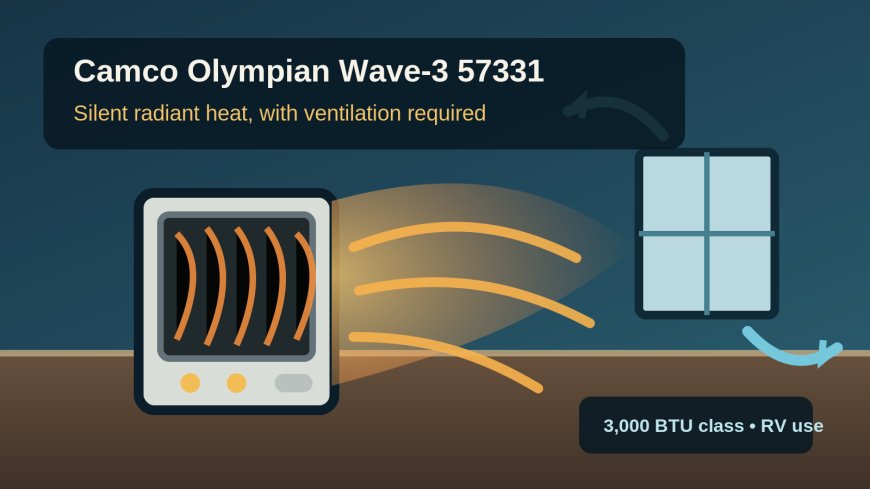
The Camco Olympian Wave-3 57331 is best for a small RV owner who wants quiet, battery-free radiant heat and is willing to manage ventilation, clearances, propane plumbing, and annual service carefully. Skip it if you want thermostatic whole-RV heat, fast air warming, a sealed-combustion appliance, or something you can run while sleeping. Its central tradeoff is simple: the heater draws no 12-volt power, but it uses room air and releases its combustion products and moisture into the living space.[2][3][6]
This is a research-based review. RVCamping.info did not purchase, install, or physically test this heater.
The exact model and Amazon listing
This review covers the Camco Olympian Wave-3, model 57331, a 3,000-BTU-class low-pressure propane catalytic heater.[1][2] Camco's current product page identifies SKU 57331 and UPC 014717573313.[1] The matched Amazon listing is ASIN B0F9TMTMXD and names the same Camco 57331 Wave-3.[5]
As an Amazon Associate, RVCamping.info earns from qualifying purchases. If you buy through an Amazon link in this article, we may earn a commission at no additional cost to you.
Check the Camco Olympian Wave-3 57331 on Amazon
The listing identity looks current, but some specifications are not consistent across current and older material.[1][2][5] Camco's current page gives exterior dimensions of 4.8 by 11.6 by 14.4 inches and a 12-month warranty.[1] The older installation manual describes a 36-month guarantee, while Amazon's indexed title advertises a limited three-year warranty.[2][5] Confirm the warranty and the dimensions printed on the exact unit before planning a tight installation.
Verdict
The Wave-3 can be a good supplemental heater for a compact, well-insulated RV during awake hours. It is quiet, needs no electrical connection, and directs radiant heat toward people and surfaces rather than waiting for a blower to warm all the air.[2][3] It is a weak choice as a blind replacement for a factory furnace. There is no thermostat, no ducting, and no sealed exterior exhaust.[2]
A long-term Olympian owner reported that the older 3,000-BTU model was too small for one popup camper and moved to a larger Wave 6. The same owner valued the lack of electrical draw and used a cover to protect the catalyst pad.[3] That experience does not predict performance in every rig, but it captures the sizing problem: floor area alone says little about heat loss through canvas, glass, slide seals, roof vents, and cold-soaked walls.
What makes it useful off grid
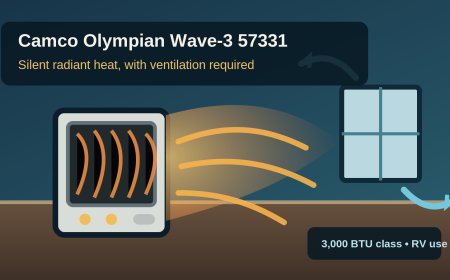
Most RV furnaces consume propane and 12-volt power because a blower moves heated air through ducts. The Wave-3 has no blower.[2][3] Once lit, catalytic combustion heats its pad, and the pad sends infrared energy forward.[2] The manual says the face can reach 720°F, so "flameless" must not be confused with cool or burn-proof.[2]
The result feels different from furnace heat. A person or cabinet in the heater's line of sight warms first; a distant bathroom or cab-over may remain cold. That can be useful when two people are sitting in one part of a small trailer. It is less useful when the goal is even heat around plumbing, tanks, hidden water lines, or separated sleeping spaces.
No fan also means no furnace cycling noise and no blower load on the battery. It does not mean free heat. The heater still consumes propane, and the required ventilation deliberately lets some warm air escape.
The compatibility boundary: this is a low-pressure propane appliance
The manual specifies HD-5 propane and a heater manifold pressure of 10.5 inches water column.[2] It calls for a listed low-pressure regulator at the cylinder, an excess-flow valve on the high-pressure section, a drip leg in the supply line, a manual shutoff, and a 3/8-inch SAE flare connection at the heater.[2]
Do not attach an improvised cylinder hose simply because the threads appear to fit. Portable use needs the correct leg stand and a compatible low-pressure hose/regulator arrangement; fixed installation involves RV gas-system codes and should be handled by qualified LP-gas personnel.[2] The manual reserves installation and repairs for certified LP-gas service technicians and calls for professional inspection at least annually.[2]
The Wave-3 can mount on a wall, but only vertically with the controls at the bottom.[2] It cannot be recessed.[2] A cabinet cutout that hides the case may look tidy, but the manual warns that recessed operation can overheat the unit and create a fire hazard.[2]
Ventilation is an operating requirement
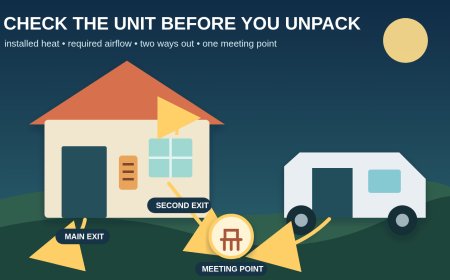
The Wave-3 is unvented and consumes oxygen from the room.[2] Camco requires at least 24 square inches of total free-air opening and recommends openings high and low.[2] Tightly sealed spaces need additional ventilation, and other fuel-burning appliances operating at the same time require more free area.[2]
A cracked window chosen by habit is not automatically equivalent to 24 square inches of free opening. Screen, rain guard, opening shape, and actual gap affect the usable area. Work out a repeatable high-and-low ventilation plan for the specific RV, then keep those openings clear of snow, bedding, and storage.
A working CO alarm is backup protection, not permission to reduce the manual's ventilation.[2][7] NFPA's RV safety guidance calls for a working CO alarm, propane-system inspections, and keeping camping heaters off while sleeping.[7] The U.S. Consumer Product Safety Commission also says not to use portable heaters while sleeping in enclosed campers or vehicles, with extra concern at altitude.[6]
That is the safest decision boundary for this review: use the Wave-3 while awake and attentive. Turn it off before sleeping. If a CO alarm sounds, or anyone develops headache, dizziness, weakness, nausea, sleepiness, or confusion, get everyone into fresh air and follow emergency guidance rather than troubleshooting inside the RV.[6]
Clearance and placement are harder than the heater's footprint suggests
Camco's manual calls for at least 4 inches from each side, 4 inches from the floor, 18 inches above, and 30 inches in front of the heater.[2] The rear clearance can be zero when correctly wall mounted.[2]
The 30-inch front zone is the easy one to lose in a compact RV. A swiveling seat, dog bed, hanging jacket, towel, curtain, or bag can move into the radiant path after setup. The unit also belongs out of normal foot traffic and away from furniture and drapery. Children and pets need a layout that keeps them from touching the hot guard or face.
Before buying, make a cardboard rectangle using the current dimensions, add the required clearance envelope, and test the location with slides in and out. Check the escape path and every ordinary movement around the dinette or galley. If the only workable location points at a vinyl seat, walkway, or fabric bunk, the small heater is not compatible with that floorplan.
Moisture and uneven heat are the main comfort costs
An unvented propane heater leaves water vapor inside the RV. Cold windows and wall cavities can collect that moisture even when the cabin feels comfortable. Ventilation helps combustion and moisture control, but it also increases heat loss. This is one reason a 3,000-BTU heater can feel adequate in a compact insulated trailer and disappointing in a drafty popup.
Watch the windows, mattress underside, corners, and cabinet backs during the first few uses. More condensation calls for more ventilation, shorter run time, or a different heat source. Do not solve fogged windows by closing the combustion-air openings.
An independent owner discussion reports the same comfort split: radiant heat can feel strong in front of the heater while the cab-over remains cold.[4] Keep the factory furnace available when ducted heat protects tanks or water lines. A Wave-3 can reduce blower run time in some layouts, but it does not reproduce the furnace's distribution path.
Catalyst-pad care changes the ownership cost
The catalyst pad is the working surface, and Camco warns against touching, brushing, vacuuming, washing, or spraying it.[2] Cooking oils, aerosol products, cleaning vapors, dust, dirty fuel, and physical damage can degrade the pad.[2] Symptoms include reduced output, difficult lighting, uneven operation, or propane odor.[2]
Keep the cool heater covered when it is not in use, especially near a door, galley, pet area, or dusty campsite.[2][3] Never cover a hot heater.[2] The manual recommends qualified inspection after long storage and at least annually, and says catalyst replacement should be done by the factory or a certified LP-gas technician.[2]
This matters in an RV because the heater may spend months exposed to road dust, cooking grease, cleaners, and storage clutter. A protective cover and disciplined placement are part of the product, not optional housekeeping.
A safe first-use and pre-use routine
Have the propane connection and installation checked by a qualified technician. Then use a repeatable routine:
- Verify the heater is vertical, unrecessed, secure, and inside every required clearance.
- Remove the dust cover and inspect the guard, pad, controls, hose, regulator, shutoff, and fittings. Do not use a torn, punctured, wet, or contaminated pad.
- Open the planned high-and-low ventilation before opening the propane supply.
- Confirm the RV's CO, propane, and smoke alarms are in date and pass their test procedures.
- Check fittings with an approved leak-detection solution, never a flame.
- Follow the manual's lighting sequence. It calls for a startup period on high before selecting medium or low.[2]
- Stay present. Keep combustibles, people, and pets out of the hot zone, and monitor both the heater and cabin conditions.
- Turn the control off, close the propane supply when appropriate, allow the heater to cool, and replace the cover only when cool.
If the heater goes out unexpectedly, do not relight it until the cause has been identified, the unit has cooled, and unburned propane has been ruled out. Camco lists an empty cylinder, blockage, leak, inadequate air, regulator trouble, mechanical failure, and catalyst deterioration among the possible causes.[2]
Who should buy it
The Wave-3 57331 suits an owner who:
- camps in a compact, insulated RV and wants supplemental radiant heat;
- spends time off grid and values zero blower draw;
- has a code-compliant low-pressure propane supply or will hire a qualified installer;
- can preserve the ventilation and clearance envelope in normal use;
- is comfortable turning the heater off before sleep;
- will protect the catalyst pad and maintain the RV's alarms and propane system.
Who should skip it
Choose a vented furnace or another heating plan if:
- the RV needs ducted heat to protect plumbing or warm separated rooms;
- occupants want unattended or overnight heating;
- condensation is already difficult to control;
- the floorplan cannot keep 30 inches clear in front;
- children, pets, or mobility needs make the hot radiant surface impractical;
- the owner wants thermostat control or a simple plug-and-play appliance;
- qualified propane installation and inspection are not available.
Bottom line
The Camco Olympian Wave-3 57331 solves a narrow RV problem well: quiet, battery-free spot heat in a small space while people are awake. Its limits are not fine print. The heater needs low-pressure propane, permanent ventilation, a large clear zone, careful catalyst protection, and professional attention to the gas system. It also produces moisture and does not distribute heat like a furnace.
Buy it for that narrow job, not as a promise that 3,000 BTUs will replace the RV's heating system. Confirm the exact unit's dimensions and warranty, plan the clearances on the actual floorplan, and treat the manual's ventilation rules as part of every use.
Sources
- Olympian Wave-3 3000 BTU Heater
- Camco Olympian Wave catalytic safety heater installation and operating instructions
- Wave 8 Heater: Long Term Review
- Wave 3 Heater owner discussion
- Camco 57331 Olympian Wave-3 Catalytic Safety Heater on Amazon
- Portable Heaters & Camping Equipment
- Motor home, camper, and recreational vehicle safety tips
What's Your Reaction?